

Ferran Adrià
Author of The Family Meal: Home Cooking with Ferran Adrià
About the Author
Image credit: Photo by user Sono pazzi / Wikimedia Commons.
Series
Works by Ferran Adrià
A Day at elBulli: An Insight into the Ideas, Methods and Creativity of Ferran Adrià (2012) 312 copies, 5 reviews
NIMM 3: Rezepte mit nur drei frischen Zutaten (aus der gleichnamigen Kolumne im SZ-Magazin): Rezepte mit nur 3 frischen Zutaten (2009) 6 copies
El Bulli: Cooking in Progress 3 copies
Las 50 nuevas tapas de Ferran Adrià 3 copies
Die neue Küche Kataloniens. El Bulli. Mediterrane Eßkultur zwischen Tradition und Phantasie (1999) 3 copies
Risc, llibertat i creativitat 2 copies
Panel Discussion 1 copy
El Bulli, historia de un sueño. Catálogo audiovisual 1963-2009 — Author — 1 copy
Associated Works
Don't Try This At Home: Culinary Catastrophes from the World's Greatest Cooks and Chefs (2005) — Contributor — 434 copies, 10 reviews
My Last Supper: 50 Great Chefs and Their Final Meals / Portraits, Interviews, and Recipes (2007) — Contributor — 207 copies, 4 reviews
How I Learned To Cook: Culinary Educations from the World's Greatest Chefs (2006) — Contributor — 191 copies, 3 reviews
Come In, We're Closed: An Invitation to Staff Meals at the World's Best Restaurants (2012) — Foreword, some editions — 52 copies
Tagged
Common Knowledge
- Canonical name
- Adrià, Ferran
- Legal name
- Adrià i Acosta, Ferran
- Birthdate
- 1962-05-14
- Gender
- male
- Occupations
- chef
- Short biography
- Ferran Adrià began his culinary career in 1980 during his stint as a dishwasher at the Hotel Playafels, in the town of Castelldefels. The chef de cuisine at this hotel taught him traditional Spanish cuisine. At 19 he was drafted into military service where he worked as a cook. In 1984, at the age of 22, Adrià joined the kitchen staff of El Bulli as a line cook. Eighteen months later he became the head chef.
Along with British chef Heston Blumenthal, Adrià is often associated with "molecular gastronomy," although the Catalan chef does not consider his cuisine to be of this category. Instead, he has referred to his cooking as deconstructivist. Adrià's stated goal is to "provide unexpected contrasts of flavour, temperature and texture. Nothing is what it seems. The idea is to provoke, surprise and delight the diner." This is also combined with a large dose of irony and a sense of humour, making his dishes highly épatants (impressive). As he likes to say, "the ideal customer doesn't come to El Bulli to eat but to have an experience."
El Bulli is only open for about six months of the year (in 2010,the season is due to run from June 15 to December 20). Adrià spends the remaining six months of the year perfecting recipes in his workshop "El Taller" in Barcelona. He is famous for his thirty course gourmet menu.
He is also well known for creating "culinary foam". In his quest to enhance flavour Adrià discards the use of cream and egg; foam is made exclusively of the main ingredient and "air" (combined in a siphon bottle equipped with N2O cartridges). Adrià's foam creations include foamed espresso (Èspesso), foamed mushroom, and foamed beetroot, as well as foamed meats.
El Bulli has 3 Michelin stars and is regarded as one of the best restaurants in the world. In 2005 it ranked second in the Restaurant Top 50. It was awarded the first place in 2006, displacing The Fat Duck in England. El Bulli has retained this title in 2007, 2008 and 2009.
Adrià is the author of several cookbooks including A Day at El Bulli, El Bulli 2003-2004 and Cocinar en Casa (Cooking at Home). With his young assistant Daniel Picard, Adrià has made almonds into cheese and asparagus into bread with the help of natural ingredients.
Adrià has been a featured chef on Great Chefs television. - Nationality
- Spain
- Birthplace
- L'Hospitalet de Llobregat, Spain
- Places of residence
- Roses, Girona, Spain
- Associated Place (for map)
- Spain
Members
Reviews
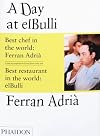
This book is coffee table food porn, seven pounds of food porn, not a good book to curl up in bed with, but certainly a good book to stand in the kitchen with and drool over.
The majority of the book is printed on a think card stock-like paper and inserted into it are smaller, lighter pages where the majority of the text is. It is as thick as my favorite cookbook (the Gold Cook book) which is 1200+ pages, but it is only about 600 pages long. I feel that the choice of paper and style of the show more book does it a disservice. The size and weight of the book distracts from the content which is fantastic.
Getting a table at elBulli is like winning the gourmand lottery. This book documents, mainly with photographs, one day in the ‘life’ of a restaurant that the majority of us will only experience vicariously through the eyes of others who have been lucky enough to pass beyond its doors each year and deign to share the experience with us. There are a smidgen of recipes included in the book, like Spherical-I green olives, Margarita 2005 and Melon with ham 2005, all of which I can’t wait to try! It also talks about how they approach the process of creating a new dish and how they document everything. I must say that there are very few details about anything, it is more like a very large children’s book. It teases and tantalizes you, like going hungry to a buffet but only being allowed one bite.
Would I get it again? Yes, being a confirmed foodie (yes I got a caviar spherification tool kit for x-mass last year and I have had my eye on transglutaminase for several months) I would definitely get this book again, however I know of very few people who would appreciate or enjoy it, since I will not pay $200.00 plus for one of the elBulli cookbooks, I actually saw a used one on Amazon for $599.99,this will have to do for me.
So if you, or the person that you are thinking about getting this book for, actually knows what transglutaminase is without looking it up, then I would get this book. If spherification, foams or Transglutaminase all cause blank looks then I would say get a different book. Or perhaps check out the DVD Decoding Ferran Adria hosted by Anthony Bourdain.
DS show less
The majority of the book is printed on a think card stock-like paper and inserted into it are smaller, lighter pages where the majority of the text is. It is as thick as my favorite cookbook (the Gold Cook book) which is 1200+ pages, but it is only about 600 pages long. I feel that the choice of paper and style of the show more book does it a disservice. The size and weight of the book distracts from the content which is fantastic.
Getting a table at elBulli is like winning the gourmand lottery. This book documents, mainly with photographs, one day in the ‘life’ of a restaurant that the majority of us will only experience vicariously through the eyes of others who have been lucky enough to pass beyond its doors each year and deign to share the experience with us. There are a smidgen of recipes included in the book, like Spherical-I green olives, Margarita 2005 and Melon with ham 2005, all of which I can’t wait to try! It also talks about how they approach the process of creating a new dish and how they document everything. I must say that there are very few details about anything, it is more like a very large children’s book. It teases and tantalizes you, like going hungry to a buffet but only being allowed one bite.
Would I get it again? Yes, being a confirmed foodie (yes I got a caviar spherification tool kit for x-mass last year and I have had my eye on transglutaminase for several months) I would definitely get this book again, however I know of very few people who would appreciate or enjoy it, since I will not pay $200.00 plus for one of the elBulli cookbooks, I actually saw a used one on Amazon for $599.99,this will have to do for me.
So if you, or the person that you are thinking about getting this book for, actually knows what transglutaminase is without looking it up, then I would get this book. If spherification, foams or Transglutaminase all cause blank looks then I would say get a different book. Or perhaps check out the DVD Decoding Ferran Adria hosted by Anthony Bourdain.
DS show less
A beautiful, heavier than your coffeetable book. Huge pictures, some text, crazy recipes. A lot of fun to read, but borrow it from the library given the hefty price tag.
It's the story of a day in the life of El Bulli from the early morning, planning, cooking, serving and final wrap-up. The recipes are not generally accessible to the home cook, most are in the realm of molecular gastronomy.
It's the story of a day in the life of El Bulli from the early morning, planning, cooking, serving and final wrap-up. The recipes are not generally accessible to the home cook, most are in the realm of molecular gastronomy.
I was given this book by my brother-in-law. Otherwise I wouldn't have bought it as it sure takes up a lot of space on a bookshelf whereas it has only enough content to fill a nice article.
This is not to say that it isn't interesting and what little there is I enjoyed reading, but it's not much.
I can't for the life of me imagine why anyone would want to buy this book. It has a lot of pictures, some of them quite nice. It has a few recipes almost all of them impossible to make at home and if show more you want to cook his recipes (well actually their recipes as it's more a team effort than anything else) all of their recipes are available elsewhere.
I imagine that the point of the book is to give all of us who will never eat at el bulli's a kind of second hand experience of eating at the restaurant. Mister Adrià himself remarks (in this very same book!) that it is very difficult to put a taste into words.
About the food I have obviously very little to say, never having eaten there.
Just as obviously I am not particularly eager to go there (though I wouldn't refuse a gift). The recipes are highly technical, strike me as too complicated, and contain too many additives I spend the rest of my life avoiding. To put it bluntly. Mister Adrià strikes me as the pretty face of the food industry.
I was struck by the fact that the average customer spends only € 30 on wine and drinks at the restaurant. The menu (there is only one) is only € 200 (2008) which is very cheap considering how much time and attention is lavished upon each recipe and each customer. show less
This is not to say that it isn't interesting and what little there is I enjoyed reading, but it's not much.
I can't for the life of me imagine why anyone would want to buy this book. It has a lot of pictures, some of them quite nice. It has a few recipes almost all of them impossible to make at home and if show more you want to cook his recipes (well actually their recipes as it's more a team effort than anything else) all of their recipes are available elsewhere.
I imagine that the point of the book is to give all of us who will never eat at el bulli's a kind of second hand experience of eating at the restaurant. Mister Adrià himself remarks (in this very same book!) that it is very difficult to put a taste into words.
About the food I have obviously very little to say, never having eaten there.
Just as obviously I am not particularly eager to go there (though I wouldn't refuse a gift). The recipes are highly technical, strike me as too complicated, and contain too many additives I spend the rest of my life avoiding. To put it bluntly. Mister Adrià strikes me as the pretty face of the food industry.
I was struck by the fact that the average customer spends only € 30 on wine and drinks at the restaurant. The menu (there is only one) is only € 200 (2008) which is very cheap considering how much time and attention is lavished upon each recipe and each customer. show less

El Bulli is the name of Ferran Adria's signiture restaurant in the Catalan Area of Spain. The first version of this book of recipes was released in the Catalan language - this is the English edition that came out a year later.
The recipes are not for the faint of heart - liquid Nitrogen plays an important part in some, as do foaming and freeze-drying. The "advances" made by American chefs for the past ten years in the science of cooking have come from this source. There are even recipes that show more involve varying the temperature of a soup from the top to the bottom of the glass... This is an exciting book for a true foodie, but it is unlikely anyone else will understand why you spent over 200 dollars for it. show less
The recipes are not for the faint of heart - liquid Nitrogen plays an important part in some, as do foaming and freeze-drying. The "advances" made by American chefs for the past ten years in the science of cooking have come from this source. There are even recipes that show more involve varying the temperature of a soup from the top to the bottom of the glass... This is an exciting book for a true foodie, but it is unlikely anyone else will understand why you spent over 200 dollars for it. show less
Lists
Awards


You May Also Like


Associated Authors
Statistics
- Works
- 44
- Also by
- 9
- Members
- 1,194
- Popularity
- #21,529
- Rating
- 3.9
- Reviews
- 13
- ISBNs
- 93
- Languages
- 12