
Dave Arneson (1947–2009)
Author of Dungeons & Dragons Basic Players Manual
About the Author
Image credit: Wikipedia
Series
Works by Dave Arneson
Dungeons & Dragons, Volume 3: The Underworld & Wilderness Adventures (1974) — Author — 17 copies, 1 review
Premium Original Dungeons & Dragons Fantasy Roleplaying Game (D&D Boxed Game) (2013) — Author — 12 copies
Personalities of Sanctuary (Robert L. Asprin's Thieves' World, The Third Book in the Thieves' World Adventure Pack) (1981) 3 copies
The Case of The Pacific Clipper (Mugshots #1 for MSPE/Mercenaries, Spies & Private Eyes) (1991) 3 copies
Associated Works
The Odyssey of Gilthanas (1999) — Based on the original Dungeons & Dragons rules created by — 142 copies
Blackmoor Foundations: The Early Fantasy RPG Works of David Arneson — Cover artist — 3 copies
Tagged
Common Knowledge
- Canonical name
- Arneson, Dave
- Legal name
- Arneson, David Lance
- Birthdate
- 1947-10-01
- Date of death
- 2009-04-11
- Gender
- male
- Education
- University of Minnesota (history) (1970)
Hamline University - Occupations
- game designer
security guard
professor of computer game design
game company owner
playtester - Organizations
- Full Sail University, Florida, USA
- Awards and honors
- HG Wells Award for Original Role-Playing Game Design (1978)
Charles S Roberts Award - Adventure Game Hall of Fame (1983)
Special Origins Award: Father of Role Playing Games (1983)
Academy of Adventure Gaming Arts and Design Hall of Fame (1984) - Nationality
- USA
- Birthplace
- Hennepin County, Minnesota, USA
- Places of residence
- Minnesota, USA
California, USA - Place of death
- Saint Paul, Minnesota, USA
- Associated Place (for map)
- Minnesota, USA
Members
Reviews

This was the first role-playing game I was ever exposed to, aged probably 7 or 8 when my older brother was given a copy in 1979 or 1980. I re-read this in April 2026. I had just started playing 'Dolmenwood', an Old School Revival game heavily derivative of Basic D&D, and I wanted to revisit the source material. This Eric Holmes edition predates the Tom Moldvay Basic Dungeons & Dragons -- it is simply called 'Dungeons & Dragons'. It's clear that the Moldvay D&D is the direct ancestor of show more Dolmenwood (and its parent Old School Essentials), but Holmes' D&D is the ancestor of Moldvay's.
The structure of the book is a bit looser than that of more modern RPGs. Headings are fewer and long paragraphs can conceal rules. For example, this interesting snippet is found under the description of Magic Spells (p.13):
"This rule [that spell casters forget their spells when they cast them] places great limitations on the magic-user's power, but there are ways to partially overcome them. One is to have the spell written out on a magical scroll. Scrolls are written in magic runes that fade from the page as they are read, so a scroll also can only be used once. Magic-users may make a scroll of a spell they already "know" (ie. have in their magic book) at a cost of 100 gold pieces and 1 week's work for each spell of the first leve, 200 gold pieces and 2 weeks for a second level spell (if the magic-user is third level), etc."
The same 'Magic Spells' heading contains notes about the requirements for casting a spell (ie, must not be bound and gagged), the above-mentioned memory effect, how to research new spells and how many spells a magic-user starts with -- a 'chance to know' each spell in the entire list, with a minimum and maximum based on the magic-user's Intelligence.
Third level magic user spells were listed but not described "to give some idea of the range of magical possibilities" (p.16). This is a bit of a tease, but fair because the game only allows characters to reach 3rd level - you'd need to be a fifth level magic-user to cast 3rd level spells.
Other interesting rules that aren't the same as other old school Dungeons & Dragons:
- all weapons do 1d6 damage
- Dexterity determines fighting order, with ties broken by 1d6
- Descending Armour Class - the lower the AC the better the protection
- There are five alignments: Lawful Good, Lawful Evil, Neutral, Chaotic Good, Chaotic Evil
- High ability scores do very little except give you bonuses for experience
Experience points are awarded based on gold recovered and creatures killed or outwitted. There's a proviso for defeating weaker monsters which I don't recall seeing in other D&D versions:
"If the defeated monster is lower in level than the character who overcomes him, less experience is gained. The experience points for the kill are multiplied by a fraction: monster level/character's level. For example if a third level fighting man killed a first level orc he generates ⅓ the experience points." (p.11)
In the section 'Dungeon Mastering as a Fine Art' there is a some useful advice for new DMs about pacing, dramatics, preparation, and giving your players opportunities to turn around and go back to the surface. "Many gamesters start with a trip across country to get to the entrance of the dungeon -- a trip apt to be punctuated by attacks by brigands or wandering monsters, or marked by strange and unusual encounters. The party then enters the underworld, tries to capture the maximum treasure with the minimal risk and escape alive … Do not hesitate to have lawful or helpful characters chance by at times, your adventurers may need a little help!" Oh yes, and I don't know how many dungeons have been inspired by the awesome 'Stone Mountain' diagram in the 'Sample Cross Section of Levels' in this part of the book (p.39)!
"The imaginary universe of Dungeons & Dragons obviously [except to Gary Gygax and TSR, who never admitted it] lies not too far from the Middle Earth of J.R.R. Tolkien's great 'Lord of the Rings' trilogy. The D & D universe also impinges on the fantasy worlds of Fritz Leiber, Robert E. Howard, Gardner F. Fox, classical mythology and any other source of inspiration the Dungeon Master wants to use." (p.41)
Finally the 'Tower of Zenopus' sample adventure is a nice flavourful starting example which seems to have been an influence on the later 'Sinister Secret of Saltmarsh' module, in that it has an abandoned ruin, supposedly haunted near a port town (literally Portown in this book) with an evil wizard and smugglers in sea caves below. show less
The structure of the book is a bit looser than that of more modern RPGs. Headings are fewer and long paragraphs can conceal rules. For example, this interesting snippet is found under the description of Magic Spells (p.13):
"This rule [that spell casters forget their spells when they cast them] places great limitations on the magic-user's power, but there are ways to partially overcome them. One is to have the spell written out on a magical scroll. Scrolls are written in magic runes that fade from the page as they are read, so a scroll also can only be used once. Magic-users may make a scroll of a spell they already "know" (ie. have in their magic book) at a cost of 100 gold pieces and 1 week's work for each spell of the first leve, 200 gold pieces and 2 weeks for a second level spell (if the magic-user is third level), etc."
The same 'Magic Spells' heading contains notes about the requirements for casting a spell (ie, must not be bound and gagged), the above-mentioned memory effect, how to research new spells and how many spells a magic-user starts with -- a 'chance to know' each spell in the entire list, with a minimum and maximum based on the magic-user's Intelligence.
Third level magic user spells were listed but not described "to give some idea of the range of magical possibilities" (p.16). This is a bit of a tease, but fair because the game only allows characters to reach 3rd level - you'd need to be a fifth level magic-user to cast 3rd level spells.
Other interesting rules that aren't the same as other old school Dungeons & Dragons:
- all weapons do 1d6 damage
- Dexterity determines fighting order, with ties broken by 1d6
- Descending Armour Class - the lower the AC the better the protection
- There are five alignments: Lawful Good, Lawful Evil, Neutral, Chaotic Good, Chaotic Evil
- High ability scores do very little except give you bonuses for experience
Experience points are awarded based on gold recovered and creatures killed or outwitted. There's a proviso for defeating weaker monsters which I don't recall seeing in other D&D versions:
"If the defeated monster is lower in level than the character who overcomes him, less experience is gained. The experience points for the kill are multiplied by a fraction: monster level/character's level. For example if a third level fighting man killed a first level orc he generates ⅓ the experience points." (p.11)
In the section 'Dungeon Mastering as a Fine Art' there is a some useful advice for new DMs about pacing, dramatics, preparation, and giving your players opportunities to turn around and go back to the surface. "Many gamesters start with a trip across country to get to the entrance of the dungeon -- a trip apt to be punctuated by attacks by brigands or wandering monsters, or marked by strange and unusual encounters. The party then enters the underworld, tries to capture the maximum treasure with the minimal risk and escape alive … Do not hesitate to have lawful or helpful characters chance by at times, your adventurers may need a little help!" Oh yes, and I don't know how many dungeons have been inspired by the awesome 'Stone Mountain' diagram in the 'Sample Cross Section of Levels' in this part of the book (p.39)!
"The imaginary universe of Dungeons & Dragons obviously [except to Gary Gygax and TSR, who never admitted it] lies not too far from the Middle Earth of J.R.R. Tolkien's great 'Lord of the Rings' trilogy. The D & D universe also impinges on the fantasy worlds of Fritz Leiber, Robert E. Howard, Gardner F. Fox, classical mythology and any other source of inspiration the Dungeon Master wants to use." (p.41)
Finally the 'Tower of Zenopus' sample adventure is a nice flavourful starting example which seems to have been an influence on the later 'Sinister Secret of Saltmarsh' module, in that it has an abandoned ruin, supposedly haunted near a port town (literally Portown in this book) with an evil wizard and smugglers in sea caves below. show less
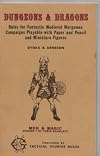
Considering that I've been playing Dungeons & Dragons since I was 8 (back in 1978), it's kind of crazy that I'm just reading this now. I guess part of it is that I didn't own a white boxed set until a couple weeks ago. But then I'm back to, how did I not own a white boxed set until just recently?
It was fun and nostalgic to read this, but also quite painful. It really has the feel of someones random notes about a game that he wants to create. Things like spells that give no description of show more what they actually do, an "alternate" combat system, but no "initial" combat system because they assume you already play Chainmail and will be using that system. Before you even know how to roll up a character there's a section on creating magic items.
Probably the biggest problem I have with this is that there's no "example of play". He never really talks about how the game is played, so someone who had never played an RPG (and I believe this was the first one), would be totally lost. Anyway, I've always said that you should always learn how to play RPGs from people who already know how to play. So maybe Mr. Gygax was writing from that perspective.
Anyway, it's super short and was a "blast from the past". It's really cool to see that many of the ideas still exist in the newest edition of D&D more than 40 years later. show less
It was fun and nostalgic to read this, but also quite painful. It really has the feel of someones random notes about a game that he wants to create. Things like spells that give no description of show more what they actually do, an "alternate" combat system, but no "initial" combat system because they assume you already play Chainmail and will be using that system. Before you even know how to roll up a character there's a section on creating magic items.
Probably the biggest problem I have with this is that there's no "example of play". He never really talks about how the game is played, so someone who had never played an RPG (and I believe this was the first one), would be totally lost. Anyway, I've always said that you should always learn how to play RPGs from people who already know how to play. So maybe Mr. Gygax was writing from that perspective.
Anyway, it's super short and was a "blast from the past". It's really cool to see that many of the ideas still exist in the newest edition of D&D more than 40 years later. show less
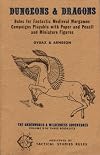
The first two books of the set were strange, but this one was the strangest. I have never heard about this strange thing in D&D where when the party wanders around outside of a city, they might get close to a castle and if they did the inhabitants might come out and attack them. And those inhabitants might be humans, or monsters or anything really.
The dungeon stuff was strange too. He talked about dungeon levels getting boring because the party had cleared them out so the DM needed to show more restock them. He talked about trying to make sure that the players could NOT map the dungeon accurately.
Two strangest/funniest things:
1) This was at the end of a section describing sea monsters -
"Final Note: If sea monsters or monsters of the seas do not get a ship, perhaps it will sail off the edge of the world!"
I guess it was a kind of possible adventure hook.
2) At the very end of the book the last paragraph is entitled "Afterward" instead of "Afterword". Which is a pretty hilarious grammar mistake. But also in the "Afterward" he encourages players NOT to contact them with rules questions, but to figure things out for themselves "for everything herein is fantastic" and "why have us do any more of your imagining for you?" show less
The dungeon stuff was strange too. He talked about dungeon levels getting boring because the party had cleared them out so the DM needed to show more restock them. He talked about trying to make sure that the players could NOT map the dungeon accurately.
Two strangest/funniest things:
1) This was at the end of a section describing sea monsters -
"Final Note: If sea monsters or monsters of the seas do not get a ship, perhaps it will sail off the edge of the world!"
I guess it was a kind of possible adventure hook.
2) At the very end of the book the last paragraph is entitled "Afterward" instead of "Afterword". Which is a pretty hilarious grammar mistake. But also in the "Afterward" he encourages players NOT to contact them with rules questions, but to figure things out for themselves "for everything herein is fantastic" and "why have us do any more of your imagining for you?" show less

This was my introduction to Dungeons & Dragons. While five stars might be high, I remember how I felt way back then. The rules were simple, maybe simplistic, but it opened up a whole new world. My imagination bloomed. It was truly an amazing experience. While later editions have greatly expanded upon and improved the rules, the doors of wonder were already opened for me. That's why I give this five stars.
Lists
You May Also Like


Associated Authors
Statistics
- Works
- 37
- Also by
- 4
- Members
- 742
- Popularity
- #34,227
- Rating
- 4.1
- Reviews
- 7
- ISBNs
- 20
- Languages
- 3
- Favorited
- 1