
Anthony Hill (1) (1942–)
Author of Soldier Boy: The True Story of Jim Martin, The Youngest ANZAC
For other authors named Anthony Hill, see the disambiguation page.
Works by Anthony Hill
The shadow dog: for every dog there has been and for everyone who has loved them (2003) 12 copies, 1 review
For love of country : a true Australian family story of love, war and the ultimate sacrifice (2016) 10 copies, 1 review
Tagged
Common Knowledge
- Birthdate
- 1942
- Gender
- male
- Nationality
- Australia
- Places of residence
- Canberra, Australian Capital Territory, Australia
- Associated Place (for map)
- Australian Capital Territory, Australia
Members
Reviews
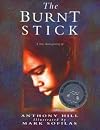
This is an affecting longer picture-book narrative with powerful charcoal illustrations. It concerns a young mixed-race light-skinned Australian aboriginal boy who, at the age of five is seized from his mother and placed in a mission school far from his home. The boy has never known the identity of his white father and has always lived with and been fully accepted by his aboriginal mother’s family and clan. It was long an Australian government policy to remove light-coloured aboriginal show more children from their family groups and place them in missions or foster families. The goal was to integrate them into white society.
Hill’s is a work of fiction, but it is based on accounts he heard over the years of measures aboriginal mothers sometimes took to keep their children with them. In John’s case, the charcoal from a burnt stick was rubbed into his skin to darken it. For a time the “Big Man” from the Welfare Department is fooled, so convincing are the effects of the soot.
Hill respectfully weaves in aboriginal stories and beliefs about the Dreaming in this quietly told story. His depiction of John’s mother Liyan’s grief at being separated from her child is wrenching.
This book is best suited for an older, more mature audience of children. In a few illustrations, the characters are shown naked, and this could certainly be a distraction. (Try taking middle school students to an art gallery where lots of nudes are on display.)
An older book, yes, but still very worthwhile. show less
Hill’s is a work of fiction, but it is based on accounts he heard over the years of measures aboriginal mothers sometimes took to keep their children with them. In John’s case, the charcoal from a burnt stick was rubbed into his skin to darken it. For a time the “Big Man” from the Welfare Department is fooled, so convincing are the effects of the soot.
Hill respectfully weaves in aboriginal stories and beliefs about the Dreaming in this quietly told story. His depiction of John’s mother Liyan’s grief at being separated from her child is wrenching.
This book is best suited for an older, more mature audience of children. In a few illustrations, the characters are shown naked, and this could certainly be a distraction. (Try taking middle school students to an art gallery where lots of nudes are on display.)
An older book, yes, but still very worthwhile. show less
I've had this book sitting on my shelf for several years and finally got around to reading it. I found it quite by accident when it turned up online along with my own book of the same title, although the subtitles are different (mine is AT PLAY IN THE ASA). I finally read it today. It's a pretty quick read.
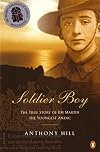
Anthony Hill's SOLDIER BOY: THE TRUE STORY OF JIM MARTIN THE YOUNGEST ANZAC is written for YA readers. It's a pieced-together bio of Jim Martin, who, at 14, is believed to have been the show more youngest soldier of the ANZAC (Australia and New Zealand Army Corps) forces to die at Gallipoli during WWI. There are, it appears, pathetically few official documents or personal papers from young Martin's short life. Having done as much as he could with research, Hill fills in the gaps with 'imagined' dialogue and conversations between Jim and his family, friends and 'mates' in the ANZAC 21st Battalion. So although it's called a "true story," it is, necessarily, partially fictionalized.
Ironically, young Martin was not a casualty of battle, but died of typhoid aboard a hospital ship. Actually this is not surprising, as Hill says this about "the disease debacle" of Gallipoli -
"During September and October alone, some 50,000 Allied casualties were evacuated through Mudros Bay. Of these men, 44,000 - almost nine out of every ten - were sick."
Of course Jim Martin lied about his age to enlist, and his parents reluctantly colluded with him in this, but only because he'd threatened to run away and enlist under another name if they wouldn't. It wasn't until months after his death that his actual age became public. He was three months shy of 15 when he died.
There were plenty of boys like Jim in ANZAC, but he was probably the youngest of them all - boys who would not be denied their part in the fight -
"They were going to have their share of action and glory. If there was any doubt at what fate might decide, men hid it under wisecracks. They were mostly young, and all were invincible. Death, on a battlefield, comes for somebody else."
But die they did, and by tens of thousands. Jim Martin is now a minor part of Australian military history. SOLDIER BOY is probably a story that needed to be told, and one hopes that the boys who read it might learn something from it. The gently used copy I have is inscribed - "Dear Scott, for your 16th Birthday ..." Take heed, Scott, of Jim Martin's sacrifice, and his life so sadly cut short.
SOLDIER BOY is a pretty good story, a bit overly dramatic now and then, perhaps. I probably would have liked it more if I were Australian. Recommended for boys who have an interest in military history.
- Tim Bazzett, author of the Cold War memoir, SOLDIER BOY: AT PLAY IN THE ASA show less
Anthony Hill's SOLDIER BOY: THE TRUE STORY OF JIM MARTIN THE YOUNGEST ANZAC is written for YA readers. It's a pieced-together bio of Jim Martin, who, at 14, is believed to have been the show more youngest soldier of the ANZAC (Australia and New Zealand Army Corps) forces to die at Gallipoli during WWI. There are, it appears, pathetically few official documents or personal papers from young Martin's short life. Having done as much as he could with research, Hill fills in the gaps with 'imagined' dialogue and conversations between Jim and his family, friends and 'mates' in the ANZAC 21st Battalion. So although it's called a "true story," it is, necessarily, partially fictionalized.
Ironically, young Martin was not a casualty of battle, but died of typhoid aboard a hospital ship. Actually this is not surprising, as Hill says this about "the disease debacle" of Gallipoli -
"During September and October alone, some 50,000 Allied casualties were evacuated through Mudros Bay. Of these men, 44,000 - almost nine out of every ten - were sick."
Of course Jim Martin lied about his age to enlist, and his parents reluctantly colluded with him in this, but only because he'd threatened to run away and enlist under another name if they wouldn't. It wasn't until months after his death that his actual age became public. He was three months shy of 15 when he died.
There were plenty of boys like Jim in ANZAC, but he was probably the youngest of them all - boys who would not be denied their part in the fight -
"They were going to have their share of action and glory. If there was any doubt at what fate might decide, men hid it under wisecracks. They were mostly young, and all were invincible. Death, on a battlefield, comes for somebody else."
But die they did, and by tens of thousands. Jim Martin is now a minor part of Australian military history. SOLDIER BOY is probably a story that needed to be told, and one hopes that the boys who read it might learn something from it. The gently used copy I have is inscribed - "Dear Scott, for your 16th Birthday ..." Take heed, Scott, of Jim Martin's sacrifice, and his life so sadly cut short.
SOLDIER BOY is a pretty good story, a bit overly dramatic now and then, perhaps. I probably would have liked it more if I were Australian. Recommended for boys who have an interest in military history.
- Tim Bazzett, author of the Cold War memoir, SOLDIER BOY: AT PLAY IN THE ASA show less
On the 28th of June 1915, James Martin sailed from Melbourne on the troopship Berrima, bound ultimately for Gallipoli. He had almost blackmailed his parents into letting him go to war by saying that if they refused to sign his papers he would go anyway. They would never see him again.
He was almost 6 foot tall but only fourteen but like many others wanted to be part of the action. He was the youngest Australian to land at Gallipoli, and he died from typhoid, 4 months after leaving Australia, show more on a hospital ship in Anzac Cove in October 1915. He had experienced just a few weeks in the trenches. He was 14 years and 9 months.
His story was, in many ways, typical to that of many soldiers in the tragic Gallipoli Campaign. Many had an overwhelming sense of duty and self-sacrifice, which is one of the reasons the legend has grown.
The author, Anthony Hill, used the little primary material available to him, just a few letters and some photographs, to piece together this amazing story.
The portrait of his mother, Amelia Martin, who raised a large family and ran a boarding house, is also interesting.
There is a strong authentic feel to the story although it has to be a rather speculative outline of Jim. The author re-creates possible scenarios of Jim arguing with his parents, his experience in trenches above Wire Gully and the Anzac experience generally. show less
He was almost 6 foot tall but only fourteen but like many others wanted to be part of the action. He was the youngest Australian to land at Gallipoli, and he died from typhoid, 4 months after leaving Australia, show more on a hospital ship in Anzac Cove in October 1915. He had experienced just a few weeks in the trenches. He was 14 years and 9 months.
His story was, in many ways, typical to that of many soldiers in the tragic Gallipoli Campaign. Many had an overwhelming sense of duty and self-sacrifice, which is one of the reasons the legend has grown.
The author, Anthony Hill, used the little primary material available to him, just a few letters and some photographs, to piece together this amazing story.
The portrait of his mother, Amelia Martin, who raised a large family and ran a boarding house, is also interesting.
There is a strong authentic feel to the story although it has to be a rather speculative outline of Jim. The author re-creates possible scenarios of Jim arguing with his parents, his experience in trenches above Wire Gully and the Anzac experience generally. show less

Anthony Hill does it again - a brilliant concise account of Cook's voyage to Australia with just a touch of PC regarding the tribes that the navigator comes across. Hill takes the life of Isaac Manley, a young gentleman apprenticed to the Endeavour's Master Robert Molineux. Using Cook, Banks and various other crew members' journals, Hill has recreated their journey from England around the tip of South America, to the paradise of Tahiti, the circumnavigation of New Zealand, and finally the show more last undiscovered continent Australia. He then shows how a disastrous stopover in Batavia resulted in many of his crew succumbing to dysentry on the final leg of their journey home. Young Issac has had no sea-faring experience prior to setting foot on the Endeavour and must very quickly learn the ropes if he is to survive at sea. Indeed Isaac survives to a ripe old age as a Rear Admiral and the last survivor of Cook's expedition. Hill has also used aboriginal, Maori and Tahitian sources to try and explain the misunderstandings between the English and the native inhabitants of the lands Cook visits which provides a fascinating insight into the difficulties faced when two cultures clash.
p.28-29 The dangers of sea life. Alex stands in a coil of rope and is dragged overboard.
I read this book not long after visiting the National Maritime Museum in Sydney where the replica Endeavour is berthed. I was able to go onboard and so a lot of this book has futher reference because I have actually seen and touched and experienced their quarters and implements first hand. There is only one original timber in the whole ship but I was able to touch it and think about the hard life that these men lived. I have also been to Cooktown, climbed the hill that Cook did and have also sailed over the reef so could really envisage this amazing historical story . An excellent book for students to study . See http://www.penguin.com.au/PUFFIN/NOTES/secondary-pdf/Captain%20Cooks%20Apprentic... for Teacher's notes. show less
p.28-29 The dangers of sea life. Alex stands in a coil of rope and is dragged overboard.
I read this book not long after visiting the National Maritime Museum in Sydney where the replica Endeavour is berthed. I was able to go onboard and so a lot of this book has futher reference because I have actually seen and touched and experienced their quarters and implements first hand. There is only one original timber in the whole ship but I was able to touch it and think about the hard life that these men lived. I have also been to Cooktown, climbed the hill that Cook did and have also sailed over the reef so could really envisage this amazing historical story . An excellent book for students to study . See http://www.penguin.com.au/PUFFIN/NOTES/secondary-pdf/Captain%20Cooks%20Apprentic... for Teacher's notes. show less
Awards


You May Also Like


Associated Authors
Statistics
- Works
- 17
- Members
- 468
- Popularity
- #52,558
- Rating
- 3.9
- Reviews
- 12
- ISBNs
- 83
- Languages
- 1