
Peter Burke (1) (1937–)
Author of Popular Culture in Early Modern Europe
For other authors named Peter Burke, see the disambiguation page.
About the Author
Peter Burke is Professor Emeritus of Cultural History at the University of Cambridge.
Series
Works by Peter Burke
The Fortunes of the Courtier: The European Reception of Castiglione's Cortegiano (Penn State Series in the History of the Book) (1995) 45 copies
The Historical Anthropology of Early Modern Italy: Essays on Perception and Communication (1987) 37 copies, 1 review
Hybrid Renaissance: Culture, Language, Architecture (The Natalie Zemon Davies Annual Lectures) (2016) 14 copies
Towards a Social History of Early Modern Dutch (Amsterdam University Press - Meertens Ethnology Lectures) (2006) 8 copies
What is History Really About?:: Reflections On Theory and PracticeReflections On Theory and Practice (2018) 2 copies
L' uomo del Rinascimento 1 copy
Associated Works
The Tradition of Female Transvestism in Early Modern Europe (1989) — Foreword, some editions — 85 copies, 2 reviews
The western time of ancient history historiographical encounters with the Greek and Roman pasts (2011) — Contributor — 8 copies
Touching the past : studies in the historical sociolinguistics of ego-documents (2013) — Contributor — 3 copies
Tagged
Common Knowledge
- Canonical name
- Burke, Peter
- Legal name
- Burke, Ulick Peter
- Birthdate
- 1937-08-16
- Gender
- male
- Education
- St John's College, University of Oxford (BA)
St Antony's College, University of Oxford (Ph.D) - Occupations
- cultural historian
university professor - Organizations
- University of Sussex
University of Cambridge - Awards and honors
- Fellow of Emmanuel College, University of Cambridge
Erasmus Medal (1998)
Fellow, British Academy (1994)
Fellow, Royal Historical Society
Academia Europaea (1995) - Relationships
- Pallares-Burke, Maria Lúcia Garcia (wife)
- Nationality
- UK
- Birthplace
- Stanmore, Middlesex, England, UK
- Places of residence
- Cambridge, Cambridgeshire, England, UK
- Associated Place (for map)
- England, UK
Members
Reviews
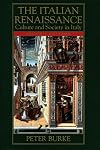
This is a good and fairly readable introduction to the Italian Renaissance; for those interested in the topic, it seems like a decent introduction -- it worked for me. That said, it's got more than its share of problems as well. First, a minor complaint: the art in the book should have been printed in full color, not black and white. Black and white reproductions of Renaissance art are about as worthless as three-dollar bills; the viewer completely misses the beauty of the art and so the show more inclusion of it at all is a waste of time. My major complaint: The constant need to reference Marxist and feminist historiography was obnoxious. Hegel, through Marx, has severely damaged the history of Western culture, and this book is evidence of that. Viewing the Renaissance in the 21st century through the lens of 19th century movements like Marxism and feminism produces anachronism, inaccuracy, and projection -- in other words, it makes for bad history. If you can get past that, it's not a bad book. show less
Leitura excelente para entender bem as questões que envolvem as trocas culturais, que sempre houveram e que continuam agindo no que chamamos de globalização.
Devia ser obrigatório para pseudo ativistas e justiceiros sociais de diversas matizes, que falam muita bobagem, misturando jargões acadêmicos com expressões do 4 ano do ensino básico.
Enfim, um livro pequeno, excelente, que pode ser relido e consultado.
Devia ser obrigatório para pseudo ativistas e justiceiros sociais de diversas matizes, que falam muita bobagem, misturando jargões acadêmicos com expressões do 4 ano do ensino básico.
Enfim, um livro pequeno, excelente, que pode ser relido e consultado.
Historia social del conocimiento : de Gutenberg a Diderot / Peter Burke ; traducción de Isidro Arias Pérez. by Peter Burke
Peter Burke analiza los procesos sociales y culturales que transformaron la producción, preservación y transmisión del conocimiento en Europa entre la invención de la imprenta y la Ilustración. Examina cómo el saber se institucionalizó y cómo surgieron nuevas figuras intelectuales y redes de difusión.
An extremely brief introduction to the Annales school of history. A nice overview, but not terribly analytical. Probably best used to get a sense of who some of the key Annales figures were/are.
Lists
Awards

You May Also Like


Associated Authors
Statistics
- Works
- 71
- Also by
- 7
- Members
- 4,100
- Popularity
- #6,134
- Rating
- 3.9
- Reviews
- 28
- ISBNs
- 520
- Languages
- 20
- Favorited
- 1
