
William Irwin (3) (1970–)
Author of The Simpsons and Philosophy: The D'oh! of Homer
For other authors named William Irwin, see the disambiguation page.
About the Author
William Irwin is Assistant Professor of Philosophy at King's College, Pennsylvania Dr. Conard has published scholarly articles on Kant, Nietzsche, and Quentin Tarantino Dr. Skoble teaches philosophy at the U.S. Military Academy at West Point
Image credit: via Goodreads
Works by William Irwin
The Simpsons and Philosophy: The D'oh! of Homer (2001) — Editor; Contributor — 1,476 copies, 13 reviews
The Matrix and Philosophy: Welcome to the Desert of the Real (2002) — Editor — 897 copies, 7 reviews
The Girl with the Dragon Tattoo and Philosophy: Everything Is Fire (2011) — Series Editor — 54 copies, 1 review
Introducing Philosophy Through Pop Culture: From Socrates to South Park, Hume to House (2010) 37 copies, 1 review
True Detective and Philosophy: A Deeper Kind of Darkness (The Blackwell Philosophy and Pop Culture Series) (2017) — Series Editor — 19 copies
Associated Works
Harry Potter and Philosophy: If Aristotle Ran Hogwarts (2004) — Series editor — 822 copies, 14 reviews
Star Wars and Philosophy: More Powerful Than You Can Possibly Imagine (2005) — Editor — 378 copies, 3 reviews
Watchmen and Philosophy: A Rorschach Test (The Blackwell Philosophy and Pop Culture Series) (2009) 249 copies, 2 reviews
Game of Thrones and Philosophy: Logic Cuts Deeper Than Swords (2012) — Series Editor — 192 copies, 4 reviews
The Big Bang Theory and Philosophy: Rock, Paper, Scissors, Aristotle, Locke (2012) — Series Editor — 155 copies, 3 reviews
The Hobbit and Philosophy: For When You've Lost Your Dwarves, Your Wizard, and Your Way (2012) — Editor — 152 copies, 2 reviews
Twilight and Philosophy: Vampires, Vegetarians, and the Pursuit of Immortality (2009) — Editor — 142 copies, 3 reviews
X-Men and Philosophy: Astonishing Insight and Uncanny Argument in the Mutant X-Verse (The Blackwell Philosophy and Pop Culture Series) (2009) 96 copies, 4 reviews
Terminator and Philosophy: I'll Be Back, Therefore I Am (The Blackwell Philosophy and Pop Culture Series) (2009) 88 copies, 2 reviews
House of Cards and Philosophy: Underwood's Republic (The Blackwell Philosophy and Pop Culture Series) (2014) 27 copies
Westworld and Philosophy: If You Go Looking for the Truth, Get the Whole Thing (The Blackwell Philosophy and Pop Culture Series) (2018) — Series Editor — 24 copies
Black Mirror and Philosophy: Dark Reflections (The Blackwell Philosophy and Pop Culture Series) (2020) — Series Editor — 22 copies
Tagged
Common Knowledge
- Birthdate
- 1970
- Gender
- male
- Education
- Fordham University (BA ∙ Philosophy ∙ 1992)
SUNY Buffalo (PhD ∙ Philosophy ∙ 1996)
Regis High School, New York, New York, USA - Occupations
- professor of philosophy
- Organizations
- King's College, Wilkes-Barre, Pennsylvania, USA
- Nationality
- USA
- Birthplace
- Yonkers, New York, USA
- Places of residence
- Yonkers, New York, USA
New York, New York, USA - Associated Place (for map)
- New York, USA
Members
Reviews
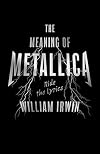
The Meaning of Metallica by William Irwin is a wonderful deep dive into the lyrical legacy of Metallica, and more specifically James Hetfield. You will find some great new avenues into songs while at the same time you will think that some readings are a bit over the top. That is not a negative comment, that is what makes this book fun.
Like any interpretive project, Irwin is not claiming that Hetfield intended the same meanings that are in this book. Even in the instances where Hetfield may show more have been inclined in the direction, he likely had neither the breadth of literary references nor the detailed inclusion of each nuance Irwin highlights. It doesn't mean they aren't there, it simply means these are Irwin's understandings, not Hetfield's intentions. Any overlap is coincidental.
For Metallica fans (past and/or present) this should be thought of as offering more ways into your favorite songs and not an attempt to tell you the "right" way to understand or appreciate them. In many cases, even when I had some understanding that was similar to Irwin's, he offered sources and angles that I had not considered. Even if I ultimately rejected some of those ideas (as far as my way of understanding the song) I still came away with a richer appreciation.
Some readers may quit in the middle of chapter 2 because they don't or can't think about songs at this level. Not a big deal, we take what we want and need from our music. But don't let them convince you this is some arrogant rant that slights everyone except Metallica, it isn't. That is just defensive posturing, ignore them. Yes, Irwin often sounds almost smug, but I liken it to someone who has given a lot of thought to something they love and they can't help coming off like a know-it-all. But ultimately the authorial voice here is one of a very knowledgeable fan who has organized his thoughts into a nice presentation. Appreciate it for what it is.
Reviewed from a copy made available by the publisher via NetGalley. show less
Like any interpretive project, Irwin is not claiming that Hetfield intended the same meanings that are in this book. Even in the instances where Hetfield may show more have been inclined in the direction, he likely had neither the breadth of literary references nor the detailed inclusion of each nuance Irwin highlights. It doesn't mean they aren't there, it simply means these are Irwin's understandings, not Hetfield's intentions. Any overlap is coincidental.
For Metallica fans (past and/or present) this should be thought of as offering more ways into your favorite songs and not an attempt to tell you the "right" way to understand or appreciate them. In many cases, even when I had some understanding that was similar to Irwin's, he offered sources and angles that I had not considered. Even if I ultimately rejected some of those ideas (as far as my way of understanding the song) I still came away with a richer appreciation.
Some readers may quit in the middle of chapter 2 because they don't or can't think about songs at this level. Not a big deal, we take what we want and need from our music. But don't let them convince you this is some arrogant rant that slights everyone except Metallica, it isn't. That is just defensive posturing, ignore them. Yes, Irwin often sounds almost smug, but I liken it to someone who has given a lot of thought to something they love and they can't help coming off like a know-it-all. But ultimately the authorial voice here is one of a very knowledgeable fan who has organized his thoughts into a nice presentation. Appreciate it for what it is.
Reviewed from a copy made available by the publisher via NetGalley. show less
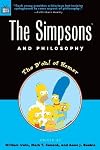
Disappointing
I was not terribly impressed by this book. The problem is not that I'm not a fan of "The Simpsons"; I watch that show in reruns just about every day. The problem is not that I don't find philosophy interesting; I own about 40 books on philosophy and tend to spend a lot of my spare time reading them. I gave the first book in this series (_Seinfeld and Philosophy_) 4 stars. The authors of that book had meaningful things to say about the philosophical aspects of "Seinfeld", but show more they seemed to think it would be hilarious if they liberally and randomly inserted phrases like "not that there's anything wrong with that" into their essays, and that got old really quick. (To get an idea how annoying this can be, think of your acquaintances who can't seem to carry on a conversation without repeating dialogue from _Monty Python and the Holy Grail_.)
In _The Simpsons and Philosophy_, the editors have managed to keep the cuteness under control, but the authors don't establish too many non-obvious connections between philosophy and the show. Part of the problem is that some of them don't seem to be very familiar with the program and with popular culture, in general. For example, the author of one essay asserts that Maude Flanders was killed at a football game and that the running character on the old Letterman show was the "equalizer guy", and seems unaware that the song "Jazzman" that was featured in the episode about the death of Bleeding Gums Murphy was an old Carole King hit. Another essay reveals the shocking fact that "The Simpsons" does not, to the essay's author's dismay, push a consistent Marxist agenda.
Several of the essays make only tangential and superficial reference to the Simpsons. It's hard to suppress the impression that many of the authors are junior faculty members who jumped at the chance to pad their CV's by taking an old essay of theirs and dressing it up with token reference to the Simpsons. There is also an essay or two that reads like another Alan Sokal parody. show less
I was not terribly impressed by this book. The problem is not that I'm not a fan of "The Simpsons"; I watch that show in reruns just about every day. The problem is not that I don't find philosophy interesting; I own about 40 books on philosophy and tend to spend a lot of my spare time reading them. I gave the first book in this series (_Seinfeld and Philosophy_) 4 stars. The authors of that book had meaningful things to say about the philosophical aspects of "Seinfeld", but show more they seemed to think it would be hilarious if they liberally and randomly inserted phrases like "not that there's anything wrong with that" into their essays, and that got old really quick. (To get an idea how annoying this can be, think of your acquaintances who can't seem to carry on a conversation without repeating dialogue from _Monty Python and the Holy Grail_.)
In _The Simpsons and Philosophy_, the editors have managed to keep the cuteness under control, but the authors don't establish too many non-obvious connections between philosophy and the show. Part of the problem is that some of them don't seem to be very familiar with the program and with popular culture, in general. For example, the author of one essay asserts that Maude Flanders was killed at a football game and that the running character on the old Letterman show was the "equalizer guy", and seems unaware that the song "Jazzman" that was featured in the episode about the death of Bleeding Gums Murphy was an old Carole King hit. Another essay reveals the shocking fact that "The Simpsons" does not, to the essay's author's dismay, push a consistent Marxist agenda.
Several of the essays make only tangential and superficial reference to the Simpsons. It's hard to suppress the impression that many of the authors are junior faculty members who jumped at the chance to pad their CV's by taking an old essay of theirs and dressing it up with token reference to the Simpsons. There is also an essay or two that reads like another Alan Sokal parody. show less
I was a bit worried that reading this book would ruin the Simpsons for me but I'm happy to report that I still laugh out loud every time I watch it. The essays were all vastly different - for example some tended to explain characturistics of the Simpsons using different philosophers and some tended to try to explain certain philosophies using the Simpsons as examples. Some worked for me and some didn't. Some of the authors missed the point that the Simpsons is written to be funny - for show more example in "Thus Spake Bart" (a Neitzscean analysis of Barts characture) the author misses the irony in a dialog between Bart and Lisa and attributes Bart's response to the loss of his identity as a rebel (personally I think it's just a gag - just a we all sometimes say things that we don;t really mean for the sake of a cheap laugh. My favourite chapter was the one on semiotics towards the end which explained the difference between the written word (in which the signifier is inherantly abstracted from the signified) and media like photography or moving images in which the signifier seems (on the surface) to be inherant to what is being signified but (for example in advertising) the signifier is more than just a picture of an object, it is a production and the objects are made to look a certain way. I guess that's why visual media is so important to advertising and why western culture is increasingly visual. Intersting (very interesting) :-) show less
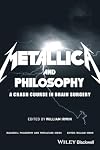
Do you think Metallica is nothing more than meaningless wild noise? Think again! In this book you will find essays from philosophers inspired by Metallica songs. Heavy metal meets Kant and Platon...
Lists
Awards

You May Also Like


Associated Authors
Statistics
- Works
- 19
- Also by
- 14
- Members
- 3,319
- Popularity
- #7,706
- Rating
- 3.6
- Reviews
- 37
- ISBNs
- 114
- Languages
- 15