
About the Author
Image credit: reading at Politics and Prose, Washington, D.C.
Works by Sue Macy
Wheels of Change: How Women Rode the Bicycle to Freedom (With a Few Flat Tires Along the Way) (2012) 314 copies, 34 reviews
The Book Rescuer: How a Mensch from Massachusetts Saved Yiddish Literature for Generations to Come (2019) — Author — 131 copies, 10 reviews
A Whole New Ball Game: The Story of the All-American Girls Professional Baseball League (1993) 124 copies, 4 reviews
Basketball Belles: How Two Teams and One Scrappy Player Put Women's Hoops on the Map (2011) 124 copies, 24 reviews
Trudy's Big Swim: How Gertrude Ederle Swam the English Channel and Took the World by Storm (2017) 63 copies, 6 reviews
Motor Girls: How Women Took the Wheel and Drove Boldly Into the Twentieth Century (2017) 38 copies, 5 reviews
Breaking Through: How Female Athletes Shattered Stereotypes in the Roaring Twenties (2020) 17 copies, 1 review
Tagged
Common Knowledge
- Birthdate
- 1955-05-13
- Gender
- female
- Education
- Princeton University
- Occupations
- children's book author
- Nationality
- USA
- Birthplace
- New York, New York, USA
- Places of residence
- Clifton, New Jersey, USA
- Associated Place (for map)
- USA
Members
Reviews
The Book Rescuer: How a Mensch from Massachusetts Saved Yiddish Literature for Generations to Come by Sue Macy

Author Sue Macy and illustrator Stacy Innerst tell the fascinating and inspiring true story of Aaron Lansky, the founder of the Massachusetts-based Yiddish Book Center, in this engaging picture-book biography. Having grown up on the story of his immigrant grandmother's lost suitcase, full of Yiddish books, Lansky decided to study the language in college, only to find that relevant books were hard to come by. When he discovered his rabbi about to bury a collection of Yiddish-language volumes, show more thinking them no longer of use, Lansky took the lot, and began to collect others. When his collection began to overtake both his own apartment and his parents' house, he founded the Yiddish Book Center in an old factory. This organization has gone on to collect over a million and a half Yiddish-language books, which they have digitized and made available to the public. They sponsor research and conduct education outreach, and have helped to spur a renewed interest in the Yiddish language over the last few decades.
The Book Rescuer: How a Mensch from Massachusetts Saved Yiddish Literature for Generations to Come is the first title I have read from either Macy or Innerst, but I certainly hope to track down more from both. I found it both informative and engaging, and was moved by the story of Lansky's quest to find and preserve a unique linguistic and historic legacy. This is certainly a project I can get behind, both intellectually and emotionally. I also greatly enjoyed the expressive artwork accompanying the text, which was influenced by Marc Chagall's work, and which felt perfectly suited to the story. It was surprising to learn that Lansky had such trouble, when first trying to enlist support from Jewish organizations, given the importance of Yiddish for the Ashkenazi Jewish population of eastern Europe, from which so many American Jews come. Thankfully, his efforts were recognized with a MacArthur Grant, which no doubt led to other recognitions, and furthered the work. Less surprising to me was the fact that the Holocaust played a major role in the twentieth-century decline of the language. Apparently, around eight-five percent of the victims of that atrocity (around five million people) were Yiddish speakers, and the murder of so many, all at one time, had a devastating effect on the language. I say that this is less surprising, because one sees this pattern elsewhere in history, as, for instance, in the Great Famine in Ireland, during which a disproportionate number of the dead and emigrated were Irish speakers, leading to a sudden and drastic decline in the language.
I learned quite a bit from reading this one, from the larger story of Lansky and the founding of the Yiddish Book Center, to such smaller details as the Jewish tradition of burying books, rather than destroying them. This latter isn't explained in the book (a lost opportunity), but I was so struck by the fact that Lansky's rabbi intended to bury the Yiddish books in his possession, that I did a little cursory googling, and discovered that, within Jewish tradition, it is customary to bury old, worn-out prayer books, and other religious volumes, rather than to burn or otherwise destroy them. I'm not sure if this is considered obligatory for non-religious books as well - perhaps the rabbi just had very strong feelings about the books in his keeping? - but it is a fascinating cultural and religious custom. Which brings me to my only criticism of this book. Namely, that despite an extensive array of back matter - statements from Aaron Lansky, Sue Macy and Stacy Innerst; a glossary of Yiddish words; a page providing resources with more information; and a list of source notes - there was no general afterword to give more details, whether about the Yiddish language itself, or about the customs (such as book burying) mentioned but not commented upon in the text. This was a disappointment, and a real missed opportunity. A child who knows nothing of Yiddish, going in to this book, will learn little about it, other than that it was an eastern European Jewish language, one in decline in the mid-twentieth-century. The complex history of the language - the fact that it evolved from German, but is written using the Hebrew abjad, for instance - is nowhere explored, nor is there any discussion of how it has changed in recent decades. I understand that this is a picture-book, and aimed at younger children, so I wasn't expecting a linguistic dissertation, but the absence of any real history of the language felt rather odd, in a book about one man's crusade to save that language.
Leaving that critique aside - I subtracted a half star because of it - this is an excellent book, one I would recommend to picture-book readers who enjoy biography, and to those interested in Jewish history and culture. show less
The Book Rescuer: How a Mensch from Massachusetts Saved Yiddish Literature for Generations to Come is the first title I have read from either Macy or Innerst, but I certainly hope to track down more from both. I found it both informative and engaging, and was moved by the story of Lansky's quest to find and preserve a unique linguistic and historic legacy. This is certainly a project I can get behind, both intellectually and emotionally. I also greatly enjoyed the expressive artwork accompanying the text, which was influenced by Marc Chagall's work, and which felt perfectly suited to the story. It was surprising to learn that Lansky had such trouble, when first trying to enlist support from Jewish organizations, given the importance of Yiddish for the Ashkenazi Jewish population of eastern Europe, from which so many American Jews come. Thankfully, his efforts were recognized with a MacArthur Grant, which no doubt led to other recognitions, and furthered the work. Less surprising to me was the fact that the Holocaust played a major role in the twentieth-century decline of the language. Apparently, around eight-five percent of the victims of that atrocity (around five million people) were Yiddish speakers, and the murder of so many, all at one time, had a devastating effect on the language. I say that this is less surprising, because one sees this pattern elsewhere in history, as, for instance, in the Great Famine in Ireland, during which a disproportionate number of the dead and emigrated were Irish speakers, leading to a sudden and drastic decline in the language.
I learned quite a bit from reading this one, from the larger story of Lansky and the founding of the Yiddish Book Center, to such smaller details as the Jewish tradition of burying books, rather than destroying them. This latter isn't explained in the book (a lost opportunity), but I was so struck by the fact that Lansky's rabbi intended to bury the Yiddish books in his possession, that I did a little cursory googling, and discovered that, within Jewish tradition, it is customary to bury old, worn-out prayer books, and other religious volumes, rather than to burn or otherwise destroy them. I'm not sure if this is considered obligatory for non-religious books as well - perhaps the rabbi just had very strong feelings about the books in his keeping? - but it is a fascinating cultural and religious custom. Which brings me to my only criticism of this book. Namely, that despite an extensive array of back matter - statements from Aaron Lansky, Sue Macy and Stacy Innerst; a glossary of Yiddish words; a page providing resources with more information; and a list of source notes - there was no general afterword to give more details, whether about the Yiddish language itself, or about the customs (such as book burying) mentioned but not commented upon in the text. This was a disappointment, and a real missed opportunity. A child who knows nothing of Yiddish, going in to this book, will learn little about it, other than that it was an eastern European Jewish language, one in decline in the mid-twentieth-century. The complex history of the language - the fact that it evolved from German, but is written using the Hebrew abjad, for instance - is nowhere explored, nor is there any discussion of how it has changed in recent decades. I understand that this is a picture-book, and aimed at younger children, so I wasn't expecting a linguistic dissertation, but the absence of any real history of the language felt rather odd, in a book about one man's crusade to save that language.
Leaving that critique aside - I subtracted a half star because of it - this is an excellent book, one I would recommend to picture-book readers who enjoy biography, and to those interested in Jewish history and culture. show less
The Book Rescuer: How a Mensch from Massachusetts Saved Yiddish Literature for Generations to Come by Sue Macy
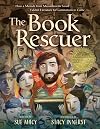
Over the last forty years, Aaron Lansky has jumped into dumpsters, rummaged around musty basements, and crawled through cramped attics. He did all of this in pursuit of a particular kind of treasure, and he's found plenty. Lansky's treasure was any book written Yiddish, the language of generations of European Jews. When he started looking for Yiddish books, experts estimated there might be about 70,000 still in existence. Since then, the MacArthur Genius Grant recipient has collected close show more to 1.5 million books, and he's finding more every day. Told in a folkloric voice reminiscent of Patricia Polacco, this story celebrates the power of an individual to preserve history and culture, while exploring timely themes of identity and immigration. show less
Wheels of Change: How Women Rode the Bicycle to Freedom (With a Few Flat Tires Along the Way) by Sue Macy
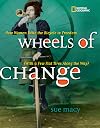
A delightful and engaging look into women's early struggles for equality through the history of the bicycle and its emergence in the late 19th century. Wheels of Change captures the excitement and enthusiasm for cycling pervasive in the late 1800s while poking fun at the rigid conservatism that led to arguments over the appropriate weight of women's "wheeling" undergarments, among other comically true topics. The book is effective in its use of a scrapbook-like style, using images from show more advertisements, newspaper clippings, photographs, and notable quotes alongside historical descriptions of cycling and its influence on the changing roles of women in society. show less
Wheels of Change: How Women Rode the Bicycle to Freedom (With a Few Flat Tires Along the Way) by Sue Macy
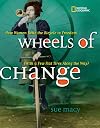
Do you remember the freedom you felt once you were old enough to get a two-wheeled bike and allowed to zoom around your neighborhood? Wheels of Change: How Women Rode the Bicycle to Freedom (With a Few Flat tires Along the Way) by Sue Macy recalls when women first got their own set of wheels and set off unescorted into the world.
And that whole unescorted thing really ticked off conservatives at the time. As Macy notes in chapter 2, The Devil's Advance Agent, in the late 1800s women and men show more dated while being chaperoned by adults, usually in the home of the young woman. With the advent of the bicycle and society's approval for women to jump on board with this new fad, the reach of chaperones was cut. Thus begins the spiral to fogged up car windows on a Friday night. One has to remember that this was at the same time most physical activity, especially sporting activities, was seen as bad for women's bodies and especially their reproductive systems.
One also must remember that in the late 1800s women were wearing HUGE dresses. How is a lady supposed to ride a bicycle? Macy shows photos of bicycles that were designed for side-saddle as well as with contraptions so that dresses wouldn't get caught in the wheels or gears. Then the young women of the late 1800s rediscovered Amelia Bloomers invention - Lady Pants! - or bloomers.
This is a fun trip through the joint history of the bicycle and women's rights. From wheels to bloomers to votes for women, it's all interconnected. You'll be amazed at how similar the conversations we are having today about women's rights sound a lot like the ones in the late 1800s about women riding bicycles.
This a National Geographic book for kids. But don't let that stop those without kids from not buying this book.
Disclaimers: A publicist offered me a copy for review for women's history month. Obviously, I'm late writing this baby up. show less
And that whole unescorted thing really ticked off conservatives at the time. As Macy notes in chapter 2, The Devil's Advance Agent, in the late 1800s women and men show more dated while being chaperoned by adults, usually in the home of the young woman. With the advent of the bicycle and society's approval for women to jump on board with this new fad, the reach of chaperones was cut. Thus begins the spiral to fogged up car windows on a Friday night. One has to remember that this was at the same time most physical activity, especially sporting activities, was seen as bad for women's bodies and especially their reproductive systems.
One also must remember that in the late 1800s women were wearing HUGE dresses. How is a lady supposed to ride a bicycle? Macy shows photos of bicycles that were designed for side-saddle as well as with contraptions so that dresses wouldn't get caught in the wheels or gears. Then the young women of the late 1800s rediscovered Amelia Bloomers invention - Lady Pants! - or bloomers.
This is a fun trip through the joint history of the bicycle and women's rights. From wheels to bloomers to votes for women, it's all interconnected. You'll be amazed at how similar the conversations we are having today about women's rights sound a lot like the ones in the late 1800s about women riding bicycles.
This a National Geographic book for kids. But don't let that stop those without kids from not buying this book.
Disclaimers: A publicist offered me a copy for review for women's history month. Obviously, I'm late writing this baby up. show less
Lists
Awards


Miss Mary Reporting: The True Story of Sportswriter Mary Garber (Five to Nine, Information Books, Biography and Memoir – 2017)
The Book Rescuer: How a Mensch from Massachusetts Saved Yiddish Literature for Generations to Come (2020)


Miss Mary Reporting: The True Story of Sportswriter Mary Garber (Kindergarten to Second Grade – 2017)
The Book Rescuer: How a Mensch from Massachusetts Saved Yiddish Literature for Generations to Come (3-5 – 2020)
Wheels of Change: How Women Rode the Bicycle to Freedom (With a Few Flat Tires Along the Way) (2012)


Miss Mary Reporting: The True Story of Sportswriter Mary Garber (Selection – Early Readers–Nonfiction – 2017)
Wheels of Change: How Women Rode the Bicycle to Freedom (With a Few Flat Tires Along the Way) (Top Ten – 2012)
Trudy's Big Swim: How Gertrude Ederle Swam the English Channel and Took the World by Storm (Selection – 2018)


You May Also Like


Associated Authors
Statistics
- Works
- 21
- Members
- 1,570
- Popularity
- #16,442
- Rating
- 4.0
- Reviews
- 107
- ISBNs
- 74