
Jacques-Yves Cousteau (1910–1997)
Author of Silent World (National Geographic Adventure Classics)
About the Author
Jacques Cousteau, 1910 - 1997 French marine explorer, writer, and film producer, Cousteau has popularized the undersea world for people of all ages. In 1943, he was partially responsible for the invention of the Aqua-lung, making it possible to extend the duration of underwater swimming. After show more World War II, he persuaded the French naval minister to create a marine study center at Toulon. Several years of study dramatized the need for application research, so with a 25-million-franc gift, the ferry Calypso was purchased. Its voyage to the Red Sea resulted in a film that won the Grand Prix at the Paris documentary film festival. It was followed in 1956 by The Silent World, an Oscar winner. Ensuing explorations resulted in over 36 films. The Undersea World of Jacques Cousteau (1967) documented a scientific world cruise from the Red Sea through the Indian Ocean to the Pacific Ocean, as far north as Alaska. A 1972 television series filmed the expedition in the Antarctic and along the Chilean coast, and a 1975 archaeological expedition took Cousteau and his team to Greek waters. Cousteau has also written over 15 books, including a 20-volume encyclopedia, The Ocean World of Jacques Cousteau. He has produced numerous videotapes and has written a column, "Pulse of the Sea," for the Saturday Review, in addition to numerous articles for National Geographic magazine from 1952 to 1966. In 1974, he founded the Cousteau Society to preserve the oceans. He estimates that in his lifetime he has spent over seven years underwater, and that "during that time I have observed and studied closely, and with my own two eyes I have seen the oceans sicken." (Bowker Author Biography) show less
Image credit: Photo by PH2 CLARENCE F. ARNOLD, cropped by uploader (defenseimagery.mil)
Series
Works by Jacques-Yves Cousteau
The Human, the Orchid, and the Octopus: Exploring and Conserving Our Natural World (1998) 131 copies, 5 reviews
Three Adventures: Galapagos, Titicaca, the Blue Holes (The Undersea Discoveries of Jacques-Yves Cousteau) (1973) 90 copies
Diving Companions: Sea Lion, Elephant Seal, Walrus (The Undersea discoveries of Jacques-Yves Cousteau) (1971) 87 copies
The Cousteau Almanac of the Environment: An Inventory of Life on a Water Planet (1981) 35 copies, 1 review
O MAR, OUTRO MUNDO 4 copies
Geheimnisse und Rätsel des Meeres. Unter Haien, Walen, Robben und Delphinen. 75 Farbfotos. (1982) 3 copies
MARE ULTIMA SPERANZA 2 copies
The act of life 2 copies
Nogrimušie dārgumi 2 copies
Coffret Cousteau - 3 films, 3 chefs-d'oeuvre : Le monde du silence, Voyage au bout du monde, Le monde sans soleil (2011) — Director — 2 copies
Klusuma valstībā ; Dzīvā jūra 2 copies
o mar,outro mundo 1 copy
Det Bästas Bokval (1958) vol 8 : Den tysta världen; Syndabocken; Farliga affärer; Digby; Bortrövad 1 copy
Merten salaisuudet : [elämän kehto] / Jacques Cousteau ; [suom.toim. Eero Kärnä, Hannu Säilä] 1 copy
Das lebende Meer 1 copy
UN TRESOR ENGLOUTI 1 copy
Oceani 1 copy
Syvä Meri 1 copy
El Mundo Silencioso 1 copy
various books 1 copy
O Mar, Outro Mundo 1 copy
Undraheimur Undirdjúpanna 1 copy
O Rei dos Mares BRD MATSEN 1 copy
Enciclopedia del mar 1 copy
Rapture 1 copy
Mundo submarino ii (coleccion El mundo de los animales y su medio ambiente, volumen 2) (1993) 1 copy, 1 review
Mundo submarino i (coleccion El mundo de los animales y su medio ambiente, volumen 1) (1993) 1 copy, 1 review
Svet tišine 1 copy
El Calypso 1 copy
La planète Océan 1 copy
Menfish 1 copy
Envoi: A Lesson From The Sea 1 copy
Poklad na stříbrné mělčině 1 copy
Calypso [dt.] Cousteau, Jacques-Yves, u. Philippe Diolé ; Abenteuer eines Forschungsschiffes. Ins Dt. übertr. v. Gerda Kurz u. Siglinde Summerer. Mit 160 Abb., davon 116 in… (1973) — Author — 1 copy
živo more 1 copy
Associated Works
The Best of Both Worlds: An Anthology of Stories for All Ages (1968) — Contributor — 25 copies, 1 review
Reader's Digest Condensed Books 1953 v02: Black Widow / The Silent World / East of Eden/ Karen / The Curve and the Tusk (1953) — Author — 13 copies
Adventures in Two Worlds / The Bridges at Toko-ri / Kiss Me Again, Stranger / Rivets / The Silent World / Story of Aviation / The Swimming Pool / 7 Short Stories of De Maupassant (1953) — Contributor — 12 copies
De nalatenschap van de Tilsits; Het magische mes; De zwijgende wereld; Een spin aan de lamp — Contributor — 1 copy, 1 review
Tagged
Common Knowledge
- Legal name
- Cousteau, Jacques Yves
- Birthdate
- 1910-06-11
- Date of death
- 1997-06-25
- Gender
- male
- Education
- École Navale
- Occupations
- author
photographer
diver
filmmaker - Organizations
- Académie française (1988)
French Navy
Cousteau Society
l'Équipe Cousteau - Awards and honors
- Presidential Medal of Freedom (1985)
Commandeur des Arts et des Lettres - Relationships
- Cousteau, Philippe (son)
Cousteau, Jean-Michel (son) - Nationality
- France
- Places of residence
- Saint-André-de-Cubzac, Gironde, France (birth)
- Burial location
- Saint-André-de-Cubzac Cemetery, Saint-André-de-Cubzac, France
- Map Location
- France
Members
Reviews

An older book about whales. By the famous French explorer who invented the Aqualung and made early documentaries of sea life. He invented the aqualung. This book describes a number of ocean expeditions the author made with his team, in pursuit of whales. His attempts to film whales swimming free in the oceans were among the first ever done- they had to find the whales, get close enough and then stay in range... They had some incredible encounters and learned some things about whales that show more nobody knew before (although the book feels seriously outdated to this reader). In different parts of the book they find and follow around humpbacks, grey whales, right whales, sperm whales, orcas, dolphins, finback whales and others. They found a way into some secluded lagoons in Baja California where grey whales give birth and raise their young. Made an attempt to save an injured grey whale calf that had beached, the mother nowhere in sight- but it only lived a few days. There’s descriptions of the gear they used, the differences between the whales, what was known about whale physiology and social behavior (not much on this last point, and some of the information given is just wrong).There’s lots about the sounds whales make, especially the humpback songs, and how whales reacted to recordings played back to them. The author surmises that soon mankind will decipher the language of whales- well here we are fifty years later, not yet! The author writes a lot in this book about how profoundly emotional he and the team members felt in the presence of the whales, that they often were observed and scrutinized, and in awe of the animals’ great size and apparent gentleness. Just by the way whales would look closely at them, they felt indicated a high intelligence. And they often related maneuvers the whales made as a group to shake off the trailing boats, which pointed at an obvious plan and collaboration among the pod or school. It’s kind of dismaying that with all the respect and admiration they claimed to feel towards the whales, they would still find it okay to lasso a calf, or try and stand on a wild whale's back. I guess they thought it wouldn’t hurt and took pride in the daring of these antics, and I’m sad that this is what stood out to me upon closing the book, when really there are many interesting passages and firsthand observations that were at the time, stunning revelations about whales. The pictures are somewhat blurred and grainy, but some are quite compelling in spite of that. show less

The Silent World was Jacques Cousteau's first book and his introduction to the English speaking world (although a French national he wrote the book in English). The documentary of the same name, showing events detailed in the book, was released in 1956 and won an Academy Award, launching Cousteau on his famed career. The Silent World has never gone out of print (estimates at over 5 million copies sold) and Cousteau went on to publish over 50 books and countless documentaries as well as a show more tireless advocate of ocean conservation.
In 1943 in southern France in the middle of WWII, Cousteau and friends invented modern scuba-diving. It seems unlikely with France effectively out of the war under Axis occupation, many Frenchmen had a lot of time but not a lot of resources, even basics such as food were in short supply. Cousteau, in his early 30s, found himself in a sort of proto-hippie group who lived on the beach diving for fish and showing off how deep they could free dive, manly men doing manly things while they sat out the war. Eventually they started experimenting to find ways to go deeper (stay under longer) and Cousteau commissioned the first "aqua-lung", basically the first modern scuba tank with a breathing regulator. Prior to this assisted diving was tethered to a breathing tube at the surface. Suddenly Cousteau and his two diving buddies, Frederic Dumas and Phillipe Taillez, were exploring the undersea world in ways never done before: free-floating like a fish with extended lengths underwater. They did a lot of experimentation with equipment and the effects of depth on the human bodily, discovering the rules of diving that are still followed to this day.
The Silent World is a memoir of the most interesting and dangerous experiences during that golden 10 year period between 1943 and 53 when scuba diving went from a new invention to an established and important occupation. After the war there was a lot of wrecks that needed salvaging and harbors to be de-mined. Cousteau took part in underwater archeology trips. A daring and almost fatal descent into a freshwater sinkhole cave. Wreck diving, encounters with sharks and whales. In terms of underwater exploration, Cousteau and his team were like Neal Armstrong on the moon or Christopher Columbus - but more than just explorers they were film-makers and popularizer's of the beauty of the ocean. He soon gave up his harpoon and hunted the depths with a camera, often saying people preserve what they like, and he hoped to show the oceans in a way people would like. It's easy to imagine this book being written by someone else, a dry technical manual that is outdated - but Cousteau's book remains timeless, it speaks to the imagination of limitless possibility, beauty of the ocean and excitement of discovery. I have no doubt in 50 more years it will still be in print and widely read and enjoyed.
--Review by Stephen Balbach, via CoolReading (c) 2008 cc-by-nd show less
In 1943 in southern France in the middle of WWII, Cousteau and friends invented modern scuba-diving. It seems unlikely with France effectively out of the war under Axis occupation, many Frenchmen had a lot of time but not a lot of resources, even basics such as food were in short supply. Cousteau, in his early 30s, found himself in a sort of proto-hippie group who lived on the beach diving for fish and showing off how deep they could free dive, manly men doing manly things while they sat out the war. Eventually they started experimenting to find ways to go deeper (stay under longer) and Cousteau commissioned the first "aqua-lung", basically the first modern scuba tank with a breathing regulator. Prior to this assisted diving was tethered to a breathing tube at the surface. Suddenly Cousteau and his two diving buddies, Frederic Dumas and Phillipe Taillez, were exploring the undersea world in ways never done before: free-floating like a fish with extended lengths underwater. They did a lot of experimentation with equipment and the effects of depth on the human bodily, discovering the rules of diving that are still followed to this day.
The Silent World is a memoir of the most interesting and dangerous experiences during that golden 10 year period between 1943 and 53 when scuba diving went from a new invention to an established and important occupation. After the war there was a lot of wrecks that needed salvaging and harbors to be de-mined. Cousteau took part in underwater archeology trips. A daring and almost fatal descent into a freshwater sinkhole cave. Wreck diving, encounters with sharks and whales. In terms of underwater exploration, Cousteau and his team were like Neal Armstrong on the moon or Christopher Columbus - but more than just explorers they were film-makers and popularizer's of the beauty of the ocean. He soon gave up his harpoon and hunted the depths with a camera, often saying people preserve what they like, and he hoped to show the oceans in a way people would like. It's easy to imagine this book being written by someone else, a dry technical manual that is outdated - but Cousteau's book remains timeless, it speaks to the imagination of limitless possibility, beauty of the ocean and excitement of discovery. I have no doubt in 50 more years it will still be in print and widely read and enjoyed.
--Review by Stephen Balbach, via CoolReading (c) 2008 cc-by-nd show less
The Human, the Orchid, and the Octopus: Exploring and Conserving Our Natural World by Jacques Cousteau

A little dated in parts, this was my first foray into a Jacques Cousteau book. For me, Cousteau shined best in this book when recounting his own past. If I can find an autobiography by the man I'd love to read it - his life anecdotes read like a modern day Verne character. Active in WW2, then an explorer of the deeps and all the wonders therein.
The Human, the Orchid, and the Octopus: Exploring and Conserving Our Natural World by Jacques Cousteau
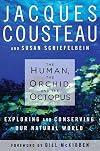
Potent, truth filled masterpiece from Cousteau and Schiefelbein. Contains many heavy, serious passages concerning how the world became what it is. Many personal stories of risk, along with tragedy, mixed with opinion of risk assessment. Stories of all kinds creatures from his travels. Cousteau lets us in on his ideal dream of the future (one of the wildest dreams I ever read).
“In managing those risks fearlessness helps keep our minds clear, but relying on fearlessness alone would amount to show more foolhardiness. As we can’t reduce the frequency of nature’s surprises, we increase the thoroughness of our preparations.”(page 65)
In depth insight into the fishing industry. Distinguishing between applied science and pure science. Also learned the history of nuclear energy and bomb use along with politics, motivations involved. Cousteau was in it, he stood and fought.
A lot of history, research, current events, future predictions, and a look back at those predictions he made.
Cousteau justified to me that exploration is necessary due to vast amounts of environmental coverups (or outright ocean dumpings). He knows because he did everything and he been everywhere. He went out there, experienced for himself, and fought to spread awareness to the world. Much respect to Jacques Cousteau and Susan Schiefelbein. show less
“In managing those risks fearlessness helps keep our minds clear, but relying on fearlessness alone would amount to show more foolhardiness. As we can’t reduce the frequency of nature’s surprises, we increase the thoroughness of our preparations.”(page 65)
In depth insight into the fishing industry. Distinguishing between applied science and pure science. Also learned the history of nuclear energy and bomb use along with politics, motivations involved. Cousteau was in it, he stood and fought.
A lot of history, research, current events, future predictions, and a look back at those predictions he made.
Cousteau justified to me that exploration is necessary due to vast amounts of environmental coverups (or outright ocean dumpings). He knows because he did everything and he been everywhere. He went out there, experienced for himself, and fought to spread awareness to the world. Much respect to Jacques Cousteau and Susan Schiefelbein. show less
Lists
Awards


You May Also Like


Associated Authors
Statistics
- Works
- 160
- Also by
- 18
- Members
- 4,587
- Popularity
- #5,483
- Rating
- 3.9
- Reviews
- 34
- ISBNs
- 271
- Languages
- 12
- Favorited
- 3

