
Robert S. Phillips (1) (1938–)
Author of Aspects of Alice: Lewis Carroll's Dream Child as Seen Through the Critics' Looking-glasses, 1865-1971
For other authors named Robert S. Phillips, see the disambiguation page.
Works by Robert S. Phillips
Aspects of Alice: Lewis Carroll's Dream Child as Seen Through the Critics' Looking-glasses, 1865-1971 (1971) — Editor — 124 copies, 3 reviews
Associated Works
The Year's Best Fantasy and Horror: Sixteenth Annual Collection (2003) — Contributor — 241 copies, 2 reviews
The Arbor House Treasury of Horror and the Supernatural (1981) — Contributor — 218 copies, 3 reviews
Tagged
Common Knowledge
- Legal name
- Phillips, Robert Schaeffer
- Birthdate
- 1938-02-02
- Gender
- male
- Education
- Syracuse University (B.A.|English|1960)
Syracuse University (M.A.|American literature|1964) - Occupations
- professor (English ∙ creative writing)
poet
advertising
editor - Organizations
- University of Houston
Grey Advertising
J. Walter Thompson - Awards and honors
- American Academy of Arts and Letters Academy Award (Literature, 1987)
- Nationality
- USA
- Birthplace
- Milford, Delaware, USA
- Associated Place (for map)
- Delaware, USA
Members
Reviews
Aspects of Alice: Lewis Carroll's dreamchild as seen through the critics' looking-glasses by Robert Phillips

"What I tell you three times is true" is a correct statement only if what you are told is actually true.
That silly statement reflects the difficulty with any collection of essays on Lewis Carroll and the Alice books. Criticism is often a very useful thing -- but sometimes, especially when one is desperate to find a new idea to make one's way into print, the result is not worth the paper it's printed on. And that affects this book. Robert S. Phillips has gathered about three dozen articles show more and excerpts about the Alice books, from a wide variety of sources, broken up into categories such as biographical essays, literary criticism, and psychoanalysis.
It's sad to see that there is nothing of significance on logic, mathematics, or word games -- the keys to understanding the books, but admittedly easier for mathematicians than literary types. It's a major hole that detracts from this book very much. Some of the essays on other topics are very valuable -- it's nice to see the full version of T. B. Strong's description of his friend Dodgson (Carroll), for instance. But some of the rest -- well, the word "Ugh" springs to mind. Lanning's "Did Mark Twain Write Alice's Adventures in Wonderland" is ridiculous, and Leslie's "Lewis Carroll and the Oxford Movement" (which claims that Alice is about that attempt to bring Anglicanism closer to Roman Catholicism) is an absurd bore.
And then there is the section on "Freudian Interpretations." Eight articles on that. News flash, folks: Freud was wrong. Psychodynamic therapy is dying out, because it doesn't work. Dodgson was neurotic -- very much so -- but it wasn't because he was whatnot-retentive; it was because he had autism! So the eight Freudian articles are complete bunk. And monotonous, because they all say the same thing. Saying it eight times does not make it true; it makes it repetitive.
That doesn't mean the book is useless. This book manages to gather most of the really stupid interpretations of Alice -- i.e. the ones that have done incredible damage -- and stick them all in one place so readers can get a good overview of their complete pointlessness. For someone who wants to refute the idiocy, this is a very useful book. But if you want to actually learn something about Charles Dodgson, Alice Liddell, and Alice's Adventures, either cut the book in half at about page 275 and skip all the stuff after that -- or read a genuine study of Dodgson, such as Morton Cohen's biography. show less
That silly statement reflects the difficulty with any collection of essays on Lewis Carroll and the Alice books. Criticism is often a very useful thing -- but sometimes, especially when one is desperate to find a new idea to make one's way into print, the result is not worth the paper it's printed on. And that affects this book. Robert S. Phillips has gathered about three dozen articles show more and excerpts about the Alice books, from a wide variety of sources, broken up into categories such as biographical essays, literary criticism, and psychoanalysis.
It's sad to see that there is nothing of significance on logic, mathematics, or word games -- the keys to understanding the books, but admittedly easier for mathematicians than literary types. It's a major hole that detracts from this book very much. Some of the essays on other topics are very valuable -- it's nice to see the full version of T. B. Strong's description of his friend Dodgson (Carroll), for instance. But some of the rest -- well, the word "Ugh" springs to mind. Lanning's "Did Mark Twain Write Alice's Adventures in Wonderland" is ridiculous, and Leslie's "Lewis Carroll and the Oxford Movement" (which claims that Alice is about that attempt to bring Anglicanism closer to Roman Catholicism) is an absurd bore.
And then there is the section on "Freudian Interpretations." Eight articles on that. News flash, folks: Freud was wrong. Psychodynamic therapy is dying out, because it doesn't work. Dodgson was neurotic -- very much so -- but it wasn't because he was whatnot-retentive; it was because he had autism! So the eight Freudian articles are complete bunk. And monotonous, because they all say the same thing. Saying it eight times does not make it true; it makes it repetitive.
That doesn't mean the book is useless. This book manages to gather most of the really stupid interpretations of Alice -- i.e. the ones that have done incredible damage -- and stick them all in one place so readers can get a good overview of their complete pointlessness. For someone who wants to refute the idiocy, this is a very useful book. But if you want to actually learn something about Charles Dodgson, Alice Liddell, and Alice's Adventures, either cut the book in half at about page 275 and skip all the stuff after that -- or read a genuine study of Dodgson, such as Morton Cohen's biography. show less
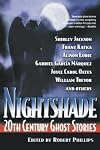
A relatively low rating, I suppose, for a collection that actually contains many excellent stories, including: "Enoch Soames" by Max Beerbohm, "The Supper at Elsinore" by Isak Dinesen, "The Highboy", by Allison Lurie and "The Leaf-Sweeper" by Muriel Spark. The problem is three-fold: (1) the good stories are easily available in dozens of other collections; (2) a number of the others are rather weak, usually as a result of lame attempts at comedy; (3) the editor, Robert Phillips, has embedded show more herein his own original tale "Wolfie" that is outclassed by its companions in every way. It's a little like holding a gala debutante party for a wallflower. show less
Nightshade is an interesting combination of varying length ghost stories. Some of the stories were tens of pages long, some were only two pages long. Just as they varied in length, they varied in my enjoyment. Though I read through all of the stories, some really bored me. I think part of the reason was that some were more literary for literary sake, rather than frightening or enjoyable ghost stories. Others, though, were great, such as The Highboy, which was about a haunted and evil piece show more of furniture. The book had a nice combination of authors from various backgrounds and writing subjects, some rather famous such as Franz Kafka and Ray Bradbury. Most of the authors I had never heard of, though that isn't saying much.
Overall, there were probably more good stories than bad, but it was close, so I rated it 3 1/2 stars. show less
Overall, there were probably more good stories than bad, but it was close, so I rated it 3 1/2 stars. show less
Aspects of Alice Lewis Carroll's dreamchild as seen through the critics' looking-glasses, 1865-1971 by Robert Phillips

Admittedly, I didn't read the whole book. I was mainly interested in Sir Shane Leslie's "Lewis Carroll and the Oxford Movement" (London Mercury 28, 233-39. RPT in Phillips). He (en.wikipedia.org/wiki/Shane_Leslie) sees many of relations between that religious struggle (which originated in Oxford in c. 1832) and the Alice books. Shane's article (p. 257-266) is highly speculative. But who am I to criticize that? My own guesses (www.snrk.de) about textual and pictorial allusions (to religious show more disputes, to Charles Darwin etc.) in Lewis Carroll's and Henry Holiday's "The Hunting of the Snark" are not much better.
Interestingly, Leslie wrote that Carroll's "Easter Greeting" (www.snrk.de/snarkhunt/#easter) was added to the 1876 edition of "Alice in Wonderland". In the notes (p. 493), the editor Robert Philips correctly points out that the "Easter Greeting" was added to "The Hunting of the Snark" (1876).
I also will read the other articles in teh book and hope to learn more about what has inspired Carroll's writings. show less
Interestingly, Leslie wrote that Carroll's "Easter Greeting" (www.snrk.de/snarkhunt/#easter) was added to the 1876 edition of "Alice in Wonderland". In the notes (p. 493), the editor Robert Philips correctly points out that the "Easter Greeting" was added to "The Hunting of the Snark" (1876).
I also will read the other articles in teh book and hope to learn more about what has inspired Carroll's writings. show less
Awards

You May Also Like
Associated Authors
Statistics
- Works
- 18
- Also by
- 10
- Members
- 372
- Popularity
- #64,809
- Rating
- 3.9
- Reviews
- 6
- ISBNs
- 38
- Languages
- 1