
Red Smith (1905–1982)
Author of Red Smith on Baseball: The Game's Greatest Writer on the Game's Greatest Years
About the Author
Walter Wellesley Smith (Red Smith) was born on Septmber 25, 1905 in Green Bay Wisconsin. He attended the University of Notre Dame and graduated in 1927. He began his sports writing career at the St. Louis Journal, then the Philadelphia Record and the New York Herald Tribune. He wrote three columns show more a week that were printed in 275 newspapers. Throughout his writing career Red Smith earned several awards. In 1976 he won the Pulitzer Prize for Commentary. He also received the J. G. Taylor Spink Award from the Baseball Hall of Fame in 1976. This is baseball's highest honor for print journalists. His title's include The Best of Red Smith, Views of Sport amd Out of the Red. He died on January 15, 1982. (Bowker Author Biography) show less
Series
Works by Red Smith
Red Smith on Baseball: The Game's Greatest Writer on the Game's Greatest Years (2000) 82 copies, 1 review
The New York Times Book of Baseball History: Major League Highlights from the Pages of The New York Times (1975) 11 copies
The Best of Red Smith 6 copies
Pokemon Go: Diary Of A Wimpy Pikachu 2: Pokemon Go Adventure (Pokemon Books) (Volume 3) (2016) 5 copies
Red Smith Rdr V750 4 copies
Pokemon Go: Diary Of A Wimpy Pikachu 4: Pokemon Go Revenge (Pokemon Books) (Volume 7) (2016) 3 copies
Pokemon Go: Diary Of A Wimpy Pikachu 3: Pokemon Go Escapee (Pokemon Books) (Volume 6) (2016) 3 copies
Pokemon Go: Diary Of A Wimpy Pikachu 5: Pokemon Go Unity: (An Unofficial Pokemon Book) (Pokemon Books) (Volume 13) (2016) 2 copies
This Was Racing 1 copy
Associated Works
Pitching in a Pinch, or, Baseball from the Inside (1912) — Introduction, some editions — 107 copies, 6 reviews
The Baseball Anthology: 125 Years of Stories, Poems, Articles, Photographs, Drawings, Interviews, Cartoons, and Other Memorabilia (1994) — Contributor — 62 copies
Baseball between the Lines: Baseball in the Forties and Fifties, As Told by the Men Who Played It (1976) — Introduction — 43 copies
Cajun Capers: Cajun Music 1928-1954 — Contributor — 4 copies
Tagged
Common Knowledge
- Legal name
- Smith, Walter W.
- Birthdate
- 1905-09-25
- Date of death
- 1982-01-15
- Gender
- male
- Education
- University of Notre Dame
- Occupations
- sports journalist
- Awards and honors
- Pulitzer Prize (Commentary, 1976)
- Nationality
- USA
- Places of residence
- New York, New York, USA
- Burial location
- Long Ridge Union Cemetery, Stamford, Connecticut, USA
- Associated Place (for map)
- USA
Members
Reviews
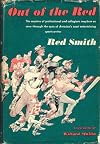
Out of the Red by Red Smith
Published in 1950, Out of the Red is a collection of columns written from 1946 through 1949 by one of America's pre-eminent sportswriters of that, or any, era.
Rather than being arranged in chronological order, the columns are grouped here by subject matter: predominantly baseball, boxing, college football, horse racing, fly fishing and basketball (which Smith famously abhorred). These columns, being published immediately post-WW2, very much reflect mainstream show more American attitudes of the era, which do not always wear well. For one thing, what we see reflected is very much a scotch and soda, back-slapping, mutuel window, locker room "man's world." Women are barely there, unless they're hosting cocktail parties for charitable organizations. And although Smith is scornful of Major League Baseball's pre-Jackie Robinson Jim Crow paradigm, in later columns Smith's own racism comes to the surface several times.
Smith, though, could indeed turn a phrase. For example:
"In the eighth Hermanski smashed a drive to the scoreboard. Henrich backed against the board and leaped either four or fourteen feet into the air. He stayed aloft so long he looked like an empty uniform hanging it its locker. When he came down he had the ball."
Smith's 1946 pre-Kentucky Derby column began like this:
"A consignment of apprentice horse lovers who have been touring the bourbon quarries and oats disposal plants of the bluegrass country pulled in here a trifle lame today and the bellhop rooming one of them clutched the newcomer's lapels before he grabbed his luggage.
'Look,' this one-man reception committee whispered huskily, 'Get down on Golden Man in the fifth today. And I'll see you afterward. Don't forget my number.'
You knew then you were in Louisville, which may be the only town in America where the tips go from bellhop to tourist instead of vice versa"
The writing is not uniformly excellent, however. Smith is much better at describing events and scenes and people he enjoys and/or approves of, even when poking fun at them (and at himself) than events he doesn't care for. In those cases, he can quickly go from entertainingly humorous to unentertainingly snide.
So this is a time capsule, really, into a certain segment of American life in the immediate post-WW2 era, in sports and in overall attitudes. It's a look back to the time when the Harvard-Yale football game was still a major sporting event, and when boxing matches proliferated, boxers, trainers and managers had colorful tales to tell, and gamblers' activities often brought suspicion to individual fight results. But it was also still the time when men would naturally assume that they were speaking to, and about, other men--other white men--essentially exclusively. A slap on the back and pass the flask. Who ya got in the sixth?
Accordingly, this collection ends up being a look at that era, faults and all, with a lot of very good, often humorous, writing baked in. In that way, this collection provides a history lesson of sorts. The ability to be entertained despite the sometimes unappealing paradigms of the day will of course vary by reader. show less
Published in 1950, Out of the Red is a collection of columns written from 1946 through 1949 by one of America's pre-eminent sportswriters of that, or any, era.
Rather than being arranged in chronological order, the columns are grouped here by subject matter: predominantly baseball, boxing, college football, horse racing, fly fishing and basketball (which Smith famously abhorred). These columns, being published immediately post-WW2, very much reflect mainstream show more American attitudes of the era, which do not always wear well. For one thing, what we see reflected is very much a scotch and soda, back-slapping, mutuel window, locker room "man's world." Women are barely there, unless they're hosting cocktail parties for charitable organizations. And although Smith is scornful of Major League Baseball's pre-Jackie Robinson Jim Crow paradigm, in later columns Smith's own racism comes to the surface several times.
Smith, though, could indeed turn a phrase. For example:
"In the eighth Hermanski smashed a drive to the scoreboard. Henrich backed against the board and leaped either four or fourteen feet into the air. He stayed aloft so long he looked like an empty uniform hanging it its locker. When he came down he had the ball."
Smith's 1946 pre-Kentucky Derby column began like this:
"A consignment of apprentice horse lovers who have been touring the bourbon quarries and oats disposal plants of the bluegrass country pulled in here a trifle lame today and the bellhop rooming one of them clutched the newcomer's lapels before he grabbed his luggage.
'Look,' this one-man reception committee whispered huskily, 'Get down on Golden Man in the fifth today. And I'll see you afterward. Don't forget my number.'
You knew then you were in Louisville, which may be the only town in America where the tips go from bellhop to tourist instead of vice versa"
The writing is not uniformly excellent, however. Smith is much better at describing events and scenes and people he enjoys and/or approves of, even when poking fun at them (and at himself) than events he doesn't care for. In those cases, he can quickly go from entertainingly humorous to unentertainingly snide.
So this is a time capsule, really, into a certain segment of American life in the immediate post-WW2 era, in sports and in overall attitudes. It's a look back to the time when the Harvard-Yale football game was still a major sporting event, and when boxing matches proliferated, boxers, trainers and managers had colorful tales to tell, and gamblers' activities often brought suspicion to individual fight results. But it was also still the time when men would naturally assume that they were speaking to, and about, other men--other white men--essentially exclusively. A slap on the back and pass the flask. Who ya got in the sixth?
Accordingly, this collection ends up being a look at that era, faults and all, with a lot of very good, often humorous, writing baked in. In that way, this collection provides a history lesson of sorts. The ability to be entertained despite the sometimes unappealing paradigms of the day will of course vary by reader. show less
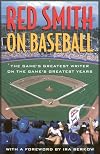
Roger Angell is the greatest writer ever on baseball, but he wrote his essays for the demanding standards and generous deadlines of the New Yorker. Writing for a newspaper is another challenge, and I don't know of another writer who consistently excelled in that format more than Red Smith. But he loses a star for the repetitive variations on the theme of the end of season pile-up on the pitcher's mound at the end of the last game of the World Series, as well as for worshiping at the altars show more of Dimaggio and Stengel, although perhaps perpetuating those cults was the price of access in those days. Nearly docked the book another star because of the sloppy copy-editing, as well as for the painful irony of the dust-jacket photo. Dodger Stadium, Los Angeles? Did the book designer read Smith's excoriating lacerations of O'Malley in the run-up to absconding from Brooklyn? Apparently not. Aside from these gaffes, recommended for anyone who loves good writing and the ineffable beauty of baseball. show less

A collection of the sports columns of Red Smith, from 1934 to around the mid-'70's, grouped by sport and category. Red Smith is probably my favorite sports columnist (actually, the only one whose name readily comes to mind). His writing is straight, unpretentious, spiced with jargon and the finely-turned phrase, intelligent, pithy, and filled with his own opinion - this sets him apart from many modern columnists who seem unaware that columns are vehicles of opinion, not objective fact. My show more favorites are his baseball columns, but I found pleasure in many unexpected places - some of his fishing columns, for example. I wish that I'd been expansive enough in my youthful reading to have discovered him while he was alive. show less

As the title indicates, this is a selection of sportswriter Red Smith's favorite sports stories. There are some gems here, mostly from the first half of the 20th century. My favorites are the baseball stories, particularly Jimmy Breslin's story about the 1962 New York Mets (the worst team ever), Grantland Rice's homage to Babe Ruth, and John Updike's coverage of Ted Williams' final season and game. But there are many others I liked, and the best of them bring out hidden aspects of the sports show more that make me want to learn more about them. show less
Lists
You May Also Like


Associated Authors
Statistics
- Works
- 27
- Also by
- 12
- Members
- 393
- Popularity
- #61,673
- Rating
- 3.8
- Reviews
- 8
- ISBNs
- 29
- Favorited
- 1