
George F. Will (1) (1941–)
Author of Men at Work: The Craft of Baseball
For other authors named George F. Will, see the disambiguation page.
About the Author
George F. Will writes a twice-weekly column that is syndicated in over 450 newspapers and a biweekly column in Newsweek. He has received several awards including the Pulitzer Prize for Commentary, the Bradley Prize for Outstanding Intellectual Achievement, the National Headliners Award, and a show more Silurian Award. Five collections of his Newsweek and newspaper columns have been published and he has written several other works including A Nice Little Place on the North Side: Wrigley Field at One Hundred. He also appears each Sunday on the ABC News program This Week. (Bowker Author Biography) show less
Image credit: Photo by Scott Ableman
Works by George F. Will
Bunts: Curt Flood, Camden Yards, Pete Rose and Other Reflections on Baseball (1998) 322 copies, 3 reviews
Restoration: Congress, Term Limits and the Recovery of Deliberative Democracy (1992) 148 copies, 1 review
Earth to Dr. Elders . . . 1 copy
Associated Works
Booknotes: America's Finest Authors on Reading, Writing, and the Power of Ideas (1997) — Contributor — 455 copies, 5 reviews
The image: A guide to pseudo-events in America (1961) — Afterword, some editions — 280 copies, 1 review
On the Firing Line: The Public Life of Our Public Figures (1989) — Contributor — 126 copies, 1 review
Elmore Leonard's Dutch Treat: Three Novels: The Hunted, Swag, Mr. Majestyk (1985) — Introduction — 86 copies
Athwart History: Half a Century of Polemics, Animadversions, and Illuminations: A William F. Buckley Jr. Omnibus (2010) — Preface — 69 copies
The New Leviathan: The State Versus the Individual in the 21st Century (2012) — Foreword — 10 copies
Tagged
Common Knowledge
- Legal name
- Will, George Frederick
- Birthdate
- 1941-05-04
- Gender
- male
- Education
- Trinity College (BA|Religion|1962)
Magdalen College, Oxford (1962-64)
Princeton University (MA)
Princeton University (PhD)
University Laboratory High School of Urbana, Illinois - Occupations
- columnist
journalist
television news analyst
professor - Organizations
- National Review (editor)
Washington Post Writers Group
The Washington Post
Newsweek (editor, columnist) - Awards and honors
- Pulitzer Prize for Commentary
Francis Boyer Award (1995) - Relationships
- Moynihan, Daniel Patrick (friend)
Will, F.L. (father) - Nationality
- USA
- Birthplace
- Champaign, Illinois, USA
- Places of residence
- Champaign, Illinois, USA
- Associated Place (for map)
- Champaign, Illinois, USA
Members
Reviews
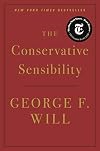
If there is anyone on Earth who can rationally explain the conservative movement in the USA, it is George Will. Highly principled, extraordinarily erudite and calmly eloquent, Will has taken on this job/love in The Conservative Sensibility. There is an enormous amount of thought and analysis here. Will deconstructs sentences, picks out individual words for scrutiny, and when necessary, looks at greater context. Numerous paragraphs revolve around a single word from something someone said or show more wrote. In some ways, it resembles the universe; both barely perceptible particles and also gigantic conceptions. Will loves things and people to be properly organized and labeled. Every player in the book seems to have his or (rarely) her label, mostly progressive (bad) or conservative (good). Liberal swings both ways and needs further elaboration. It is a monumental work if only because it keeps the reader’s interest for 500 pages.
The central point of it all is that the Founders decided there were a number of natural rights that needed embedding in the Constitution. Government was to be forever inferior to individual rights. And if we today could only appreciate that they already understood everything back then, and if we would simply stick with them, it would be a happier, wealthier, better country. His thoughts on it cover most everything: religion, speech, education, the universe, capitalism, the New Deal, the Great Society, war and imperialism, even briefly touching on race.
In the red corner, Will has (Founder) James Madison; in the blue corner, Woodrow Wilson. For Will, Wilson was the first Progressive corruption of Madison’s pure thoughts on liberty and government. But Woodrow Wilson was a garden variety racist, whose first book studied the governments of the Aryan races, of which there were none. He does not represent anyone’s views, and his actions are suspect.
Nonetheless, Will scores lots of points. The Constitution does not list what government will do for you, but what it cannot do to you, he points out. He cites Randy Barnett, a Constitutional lawyer, that there are two Constitutions, the Democratic Constitution and the Republican Constitution. The Democrat thinks “We the people” means government comes before individual rights and the Republican puts individual rights before government, despite the “we”. It’s a constant battle. Will enjoys the jousting: “Americans who find perpetual arguing stressful or otherwise unsatisfying should find another country,” he says in the lightest moment in the book.
But then the fault lines start cracking open. Without recognizing the irony, Will states bluntly that the most destructive social problem facing the USA is the disintegration of the family. “No one understands what opaque tangle of factors has caused this,” he claims. He says in the 1950s, 4% were born out of wedlock, while today 40% are - and no one knows why. Similarly, no one has any solutions. This is the only thing Will says he is unsure of, and he repeats it. The irony comes when he acknowledges it even applies to black families, which have long suffered this way.
In a word: poverty. Over and over, endlessly, poverty, both absolute and relative has been shown to reduce brain function, language manipulation, school achievements, parenting and family values. There is far more involvement with the justice system, and more family breakups. It’s what blacks have suffered since the Civil War. But Will insists no one knows. He even cites studies that show it clearly and unambiguously, but he uses them instead to show that public (government) schools don’t fix the problem. Precarity plays no role. Discrimination plays no role. Personal debt plays no role.
This is so absurd as to be laughable. The precarity of the workforce leads to less marriage, fewer homes purchased, and more abandonment. That working class kids graduate school in massive debt sets the stage. That 40% of jobs are minimum wage or less, with no job security or benefits cements it in place. That 30% of car payments are 90 days late raises tensions. Individual natural rights are meaningless in resolving these issues or creating any level of satisfaction, let alone the pursuit of happiness. Will shows himself such an elitist he cannot place himself in anyone’s shoes who is not a multimillionaire. It remains a mystery.
On racism, he says “America then was often barbaric. It is not anymore. “ He completely ignores the hundreds of blacks killed for no reason by both police and civilians, and used as slave labor in prisons for the crime of being unable to make bail on trivial crimes whites don’t get nailed for. He glowingly cites Founder John Adams claiming America was “not a conquered, but a discovered country,” totally ignoring the fifty million natives who lived there.
There follows an insane analysis of income taxes that is totally divorced from reality. Will says the reason the poor don’t save money is that they pay no tax. It discourages them from saving. Overbearing government is the reason we need taxes; government is in competition with the rich for wealth, so it raises taxes. Government actually wants to supplant markets for itself. Progressive taxation, like free public education, has wormed its way into the economy and become accepted, when it is clearly distorting natural rights in the Constitution. The poor and middle classes are jealous of the rich, and that drives the imposition of progressive taxation. The experts he quotes validate these positions with sarcasm. It is the absolutely typical irrational American hatred of the poor on display.
From there, Will decides that racist idiotic Supreme Court decisions somehow represent the will of the tyrannical progressive majority, while fair decisions represent Republican values. The conservative sensibility unravels.
He spends a lot of time on human nature, arguing that if human nature were mutable, society would collapse and government would be impossible. But it won’t change, ever. That is why these natural rights are forever needed and sacrosanct. On the other hand, it is precisely because human nature is unchanging that we need regulation to control its excesses. But Will doesn’t admit to that.
On education, he says we are too forward looking. We need to look backward, starting right at birth, inculcating the history of the USA and its enumerated Constitutional rights. For higher education, he says we need to teach three things: “how to praise“ (and that most things are not praiseworthy), “a lively sense of historical contingencies,” and a “talent for pessimism.” Pessimism, it transpires, is the mark of a true conservative, who lives in lifelong fear his rights are disappearing, if only because nothing lasts forever. “Most new ideas are false; hence most ‘improvements’ make things worse,” is his mantra.
He decries multiculturalism in universities. He hates that everything has become interpretation and facts have become fungible. Well guess what: that is a function of the free market. If there is demand for feminist studies, or for black studies, the market will force the sellers of those services to adapt or be bypassed. When the student is the customer, focusing on the constitutional history of the USA loses its domination. Be careful what you wish for.
He keeps coming back to trust in government, that Americans used to appreciate and trust government. Since the Reagan era, that trust has steadily eroded to where it is at its lowest point, and is still falling. Will attributes this to the ever-growing size of government, and how Americans hate that. But it’s not true at all. What Americans hate is that government doesn’t work, because lawmakers keep chopping funding, making mandated functions impossible. Crippling lawful programs and agencies cannot possibly result in higher public satisfaction. It has nothing to do with progressives; it is intellectual dishonesty. This is straight out of the Republican playbook. First, lower taxes. Second, run a huge deficit because of smaller receipts. Third, cut back programs so the deficit isn’t as unwieldy. Fourth, repeat. “Conservatives hunt for a governmental cause for every problem,“ he cites journalist Jonathan Rauch saying.
He also harps on majority rule. He says in modern democracies, where majorities rule…. But nowhere does the majority rule. If it did, the USA would not keep starting new wars. Tax cuts would not go to the rich, healthcare would be a right, not a privilege of the rich. Legislatures would not pass laws the electorate despises.
He uses the large OECD figure of American men 25-54 outside the labor force (ahead only of Italy in last place) to show that government spending has made American men lazy. But, he acknowledges, all the other OECD countries are far more progressive and interventionist than the USA, with more male participation. So what has he proven?
The conservative sensibility that Will espouses is black or white. There is no gray. If you don’t like his stance, you are for overbearing government and against the Constitution. There’s no wiggle room for those who disagree. It is either natural rights or tyrannical majority rule. There is no possibility, say, of having health benefits or preferring that the country stop trying to spread democracy by war, while also believing in individual rights.
Stunningly absent is any discussion of the 2nd amendment in the Bill of Rights. Gun-lovers say it is their God-given Constitutional right. But not a word from George Will. There is nothing on the outrage of corporations achieving constitutional natural rights of persons, which has an enormously rich trial history. And nothing on the Trump administration.
The Conservative Sensibility is a wonderful challenge to read, but it’s camouflage for faulty reasoning.
David Wineberg show less
The central point of it all is that the Founders decided there were a number of natural rights that needed embedding in the Constitution. Government was to be forever inferior to individual rights. And if we today could only appreciate that they already understood everything back then, and if we would simply stick with them, it would be a happier, wealthier, better country. His thoughts on it cover most everything: religion, speech, education, the universe, capitalism, the New Deal, the Great Society, war and imperialism, even briefly touching on race.
In the red corner, Will has (Founder) James Madison; in the blue corner, Woodrow Wilson. For Will, Wilson was the first Progressive corruption of Madison’s pure thoughts on liberty and government. But Woodrow Wilson was a garden variety racist, whose first book studied the governments of the Aryan races, of which there were none. He does not represent anyone’s views, and his actions are suspect.
Nonetheless, Will scores lots of points. The Constitution does not list what government will do for you, but what it cannot do to you, he points out. He cites Randy Barnett, a Constitutional lawyer, that there are two Constitutions, the Democratic Constitution and the Republican Constitution. The Democrat thinks “We the people” means government comes before individual rights and the Republican puts individual rights before government, despite the “we”. It’s a constant battle. Will enjoys the jousting: “Americans who find perpetual arguing stressful or otherwise unsatisfying should find another country,” he says in the lightest moment in the book.
But then the fault lines start cracking open. Without recognizing the irony, Will states bluntly that the most destructive social problem facing the USA is the disintegration of the family. “No one understands what opaque tangle of factors has caused this,” he claims. He says in the 1950s, 4% were born out of wedlock, while today 40% are - and no one knows why. Similarly, no one has any solutions. This is the only thing Will says he is unsure of, and he repeats it. The irony comes when he acknowledges it even applies to black families, which have long suffered this way.
In a word: poverty. Over and over, endlessly, poverty, both absolute and relative has been shown to reduce brain function, language manipulation, school achievements, parenting and family values. There is far more involvement with the justice system, and more family breakups. It’s what blacks have suffered since the Civil War. But Will insists no one knows. He even cites studies that show it clearly and unambiguously, but he uses them instead to show that public (government) schools don’t fix the problem. Precarity plays no role. Discrimination plays no role. Personal debt plays no role.
This is so absurd as to be laughable. The precarity of the workforce leads to less marriage, fewer homes purchased, and more abandonment. That working class kids graduate school in massive debt sets the stage. That 40% of jobs are minimum wage or less, with no job security or benefits cements it in place. That 30% of car payments are 90 days late raises tensions. Individual natural rights are meaningless in resolving these issues or creating any level of satisfaction, let alone the pursuit of happiness. Will shows himself such an elitist he cannot place himself in anyone’s shoes who is not a multimillionaire. It remains a mystery.
On racism, he says “America then was often barbaric. It is not anymore. “ He completely ignores the hundreds of blacks killed for no reason by both police and civilians, and used as slave labor in prisons for the crime of being unable to make bail on trivial crimes whites don’t get nailed for. He glowingly cites Founder John Adams claiming America was “not a conquered, but a discovered country,” totally ignoring the fifty million natives who lived there.
There follows an insane analysis of income taxes that is totally divorced from reality. Will says the reason the poor don’t save money is that they pay no tax. It discourages them from saving. Overbearing government is the reason we need taxes; government is in competition with the rich for wealth, so it raises taxes. Government actually wants to supplant markets for itself. Progressive taxation, like free public education, has wormed its way into the economy and become accepted, when it is clearly distorting natural rights in the Constitution. The poor and middle classes are jealous of the rich, and that drives the imposition of progressive taxation. The experts he quotes validate these positions with sarcasm. It is the absolutely typical irrational American hatred of the poor on display.
From there, Will decides that racist idiotic Supreme Court decisions somehow represent the will of the tyrannical progressive majority, while fair decisions represent Republican values. The conservative sensibility unravels.
He spends a lot of time on human nature, arguing that if human nature were mutable, society would collapse and government would be impossible. But it won’t change, ever. That is why these natural rights are forever needed and sacrosanct. On the other hand, it is precisely because human nature is unchanging that we need regulation to control its excesses. But Will doesn’t admit to that.
On education, he says we are too forward looking. We need to look backward, starting right at birth, inculcating the history of the USA and its enumerated Constitutional rights. For higher education, he says we need to teach three things: “how to praise“ (and that most things are not praiseworthy), “a lively sense of historical contingencies,” and a “talent for pessimism.” Pessimism, it transpires, is the mark of a true conservative, who lives in lifelong fear his rights are disappearing, if only because nothing lasts forever. “Most new ideas are false; hence most ‘improvements’ make things worse,” is his mantra.
He decries multiculturalism in universities. He hates that everything has become interpretation and facts have become fungible. Well guess what: that is a function of the free market. If there is demand for feminist studies, or for black studies, the market will force the sellers of those services to adapt or be bypassed. When the student is the customer, focusing on the constitutional history of the USA loses its domination. Be careful what you wish for.
He keeps coming back to trust in government, that Americans used to appreciate and trust government. Since the Reagan era, that trust has steadily eroded to where it is at its lowest point, and is still falling. Will attributes this to the ever-growing size of government, and how Americans hate that. But it’s not true at all. What Americans hate is that government doesn’t work, because lawmakers keep chopping funding, making mandated functions impossible. Crippling lawful programs and agencies cannot possibly result in higher public satisfaction. It has nothing to do with progressives; it is intellectual dishonesty. This is straight out of the Republican playbook. First, lower taxes. Second, run a huge deficit because of smaller receipts. Third, cut back programs so the deficit isn’t as unwieldy. Fourth, repeat. “Conservatives hunt for a governmental cause for every problem,“ he cites journalist Jonathan Rauch saying.
He also harps on majority rule. He says in modern democracies, where majorities rule…. But nowhere does the majority rule. If it did, the USA would not keep starting new wars. Tax cuts would not go to the rich, healthcare would be a right, not a privilege of the rich. Legislatures would not pass laws the electorate despises.
He uses the large OECD figure of American men 25-54 outside the labor force (ahead only of Italy in last place) to show that government spending has made American men lazy. But, he acknowledges, all the other OECD countries are far more progressive and interventionist than the USA, with more male participation. So what has he proven?
The conservative sensibility that Will espouses is black or white. There is no gray. If you don’t like his stance, you are for overbearing government and against the Constitution. There’s no wiggle room for those who disagree. It is either natural rights or tyrannical majority rule. There is no possibility, say, of having health benefits or preferring that the country stop trying to spread democracy by war, while also believing in individual rights.
Stunningly absent is any discussion of the 2nd amendment in the Bill of Rights. Gun-lovers say it is their God-given Constitutional right. But not a word from George Will. There is nothing on the outrage of corporations achieving constitutional natural rights of persons, which has an enormously rich trial history. And nothing on the Trump administration.
The Conservative Sensibility is a wonderful challenge to read, but it’s camouflage for faulty reasoning.
David Wineberg show less
A Nice Little Place on the North Side: A History of Triumph, Mostly Defeat, and Incurable Hope at Wrigley Field by George F. Will
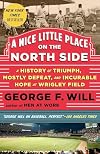
George Will grew up in Champaign, Illinois in a place where most people become fans of the powerhouse St. Louis Cardinals. Will, however, chose to become a die hard Cubs fan and thus follow the long road of defeat after defeat year after year. In gthis book he puts forth the theory that one of the reasons the team didn't produce is because Wrigley Field is such a pleasant place to spend an afternoon that the fans really didn't care if the team won or lost. They just enjoyed the experience of show more the ballpark.
Mr. Will knows his baseball and this slim volume is full of laugh out loud anecdotes of the team. My favorite was when Bill Veeck, Sr. who was President of the Cubs was at the end of his life during Prohibition, his son Bill, Jr. approached Al Capone (who was a huge Cub fan ans held season tickets to a field box) for some champagne to ease his father's final days. The mobster sent a case of French champagne to the Veeck house every day for the last ten days of Bill Sr.'s life.
This book is a must read for every Cubs fan and everyone who just loves baseball as well. show less
Mr. Will knows his baseball and this slim volume is full of laugh out loud anecdotes of the team. My favorite was when Bill Veeck, Sr. who was President of the Cubs was at the end of his life during Prohibition, his son Bill, Jr. approached Al Capone (who was a huge Cub fan ans held season tickets to a field box) for some champagne to ease his father's final days. The mobster sent a case of French champagne to the Veeck house every day for the last ten days of Bill Sr.'s life.
This book is a must read for every Cubs fan and everyone who just loves baseball as well. show less
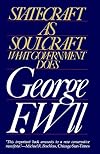
At a time when US identity is being challenged from within by an predictably unpredictable President, this classic provides a challenge that all Americans should be asked to reckon with: who are we, why are we here, what sets our nation apart, aside from our material well being? Whatever your opinion of George Will as a Washington Post writer and regular talking head on the networks, separate it from George Will the Princeton PhD and son of a philosopher who wrote this excellent contemporary show more (1983) work on the role of government, specifically that of the United States. Our Constitution was borne of the Enlightenment, out of a collective study of political philosophy and debate thereof. Will reminds us that the U.S. was founded on ideas, ideals, and values. As the title "Statecraft as Soulcraft," suggests, in the creation of the state we draw upon basic values that we work to enshrine in our institutions. Over time, however, our appetites have crept in and we've expanded government to address material fears -- hunger, exposure to the elements, and economic lassitude -- rather than continue to strive for ideals. However agnostic we claim it to be, the state is indirectly influencing the souls of its citizens as well. Will sees conservatives as conservators of the values upon which the US was founded, not blindly holding them sacred, but serving as custodians of the philosophic flame that lit the Framers' way, giving way only to well-reasoned argument; like the fitfully expanding circle of all "men" who are created equal in the United States. Not a long book, but it is particularly dense with philosophic reference and argument. Will is a masterful writer and it's a pleasure to read, wherever you are on the political spectrum. show less

George Will is an understated, underappreciated inspiration to all the young rational optimists out there, but I fear his message is getting lost in the noise of short-term discourse. Too often what passes for criticism of the kinds of points of view like what Will espouses is merely an ad hominem disregard of classical conservative thinking. That's putting it much too kindly. Smart political discussion is being buried by angry extremist factions. Maybe what's needed is for Will's oratory show more and intellectual spirit to find a home in the minds of younger, more charismatic reformers. Will simply comes across as too old school, too bow-tie-Princeton to connect broadly with the younger generation. Note: I may have spoken too soon with that last sentence because as I write this, in July 2020, George Will has recently been a prominent voice of reason on the political right for publicly critiquing the Trump administration and arguing for the GOP as a whole to vote in new members and reset itself.
The Conservative Sensibility isn't a quick read. It's biblical in length, but also in how one reads it—a little bit at a time and pausing often to reflect on what is being said. Building a government from a Declaration and a Constitution is a frustrating endeavor, one which necessitates a long view.
Chapter 7. This part contains the best, most intellectually honest argument for pessimism I've ever read. And then later on in Chapter 10 a recap, "This book is, among other things, a summons to pessimism." As an optimist, this is saying a lot. show less
The Conservative Sensibility isn't a quick read. It's biblical in length, but also in how one reads it—a little bit at a time and pausing often to reflect on what is being said. Building a government from a Declaration and a Constitution is a frustrating endeavor, one which necessitates a long view.
Chapter 7. This part contains the best, most intellectually honest argument for pessimism I've ever read. And then later on in Chapter 10 a recap, "This book is, among other things, a summons to pessimism." As an optimist, this is saying a lot. show less
Lists
Awards


You May Also Like


Associated Authors
Statistics
- Works
- 23
- Also by
- 16
- Members
- 3,242
- Popularity
- #7,883
- Rating
- 3.9
- Reviews
- 45
- ISBNs
- 79
- Languages
- 2
- Favorited
- 11