
Richard Seaford
Author of Money and the Early Greek Mind: Homer, Philosophy, Tragedy
About the Author
Richard Seaford is Emeritus Professor of Ancient Greek at the University of Exeter.
Works by Richard Seaford
Reciprocity and Ritual: Homer and Tragedy in the Developing City-State (Clarendon Paperbacks) (1994) 20 copies
The Origins of Philosophy in Ancient Greece and Ancient India: A Historical Comparison (2019) 15 copies, 1 review
Selfhood and the Soul: Essays on Ancient Thought and Literature in Honour of Christopher Gill (2017) — Editor — 11 copies
Cosmology and the Polis: The Social Construction of Space and Time in the Tragedies of Aeschylus (2012) 9 copies
Ancient Greece and global warming 2 copies
Associated Works
The Oresteia: Agamemnon, Women at the Graveside, Orestes in Athens (0458) — Introduction, some editions — 11,712 copies, 87 reviews
The Gods of Ancient Greece: Identities and Transformations (Edinburgh Leventis Studies) (2010) — Contributor — 20 copies
The Origins of Theater in Ancient Greece and Beyond: From Ritual to Drama (2007) — Contributor — 12 copies
Debt in the Ancient Mediterranean and Near East: Credit, Money, and Social Obligation (2022) — Contributor — 7 copies
Light and Darkness in Ancient Greek Myth and Religion (Greek Studies: Interdisciplinary Approaches) (2010) — Contributor — 6 copies
A Companion to Aeschylus (Blackwell Companions to the Ancient World) (2022) — Contributor — 4 copies
Ancient Greek Literature and the Foreign: Athenian Dialogues II (Trends in Classics - Supplementary Volumes, 130) (2022) — Contributor — 2 copies
The Play of Texts and Fragments: Essays in Honour of Martin Cropp (Mnemosyne, Supplements, 314) (2009) — Contributor — 1 copy
Faces of Silence in Ancient Greek Literature: Athenian Dialogues I (Trends in Classics - Supplementary Volumes, 100) (2020) — Contributor — 1 copy
Tagged
Common Knowledge
- Gender
- male
Members
Reviews
The Origins of Philosophy in Ancient Greece and Ancient India: A Historical Comparison by Richard Seaford
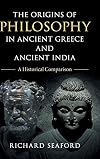
This is a dense, academic but rewarding book in which a prominent scholar of classics (Emeritus Professor of Ancient Greek) extends his range to compare and contrast the early development of philosophy in two apparently unconnected ancient cultures (Ancient India and Greece).
He is not a Sanskrit scholar and is using Sanskrit texts in translation (whereas he is expert in Ancient Greek) but there is no reason to believe that his use of these and secondary texts is inadequate for the task he show more has set himself.
I write 'unconnected' because Seaford is dismissive of any influence of one on the other, a position that is highly relevant to his thesis. I am a little less persuaded (see below) but the thesis is certainly exceptionally well argued and plausible. It is certainly not to be dismissed.
Using both the presocratic philosophers and poets of ancient Greece and the Sanskrit writings of the Brahmin class and the later 'new religions' of ancient India that culminated in Buddhism as his sources, Seaford has one big hedgehog idea.
This is that the rise of philosophical abstraction is intimately tied to the socio-economic process of monetisation. He is not an absolutist about this and he reasonably hedges a little towards the end but he is clear on his book's purpose - to make that link.
The evidence he adduces - based on detailed textual analysis and considerable learning in two separate cultures - certainly seems powerful. The abstract mysterious nature of money (not exactly the same as coinage) helps create new thinking about reality, introduces philosophy.
I am not going to try to repeat or rehearse his arguments here for two simple reasons. First, I am not qualified to do so. I am not professional philosopher enough to be a sound critic. Second, he does it in such a way that any summary would be inadequate.
Let me leave it that the book probably will require a second reading and much slower study to be fully understood (which could be said about most good works of philosophy) and that it falls into that camp (mine too) that would say that thought cannot be abstracted from the human condition.
It is wholly plausible that any generalised presentation of reality arises from the social and material position in the world of the thinker, whether as a personality type or as someone with a particular position in society. There is much evidence of the latter in Seaford's analysis.
Money, debt, transactionalism, power and class all conform themselves (in his vision) from one state of being (or non-being in the case of money) to another and it is plausible to believe that, thinking being ideology as much as philosophy, thought would accommodate new social realities.
His account of the link between Plato's thinking and his attitude to slaves or Parmenides' thought arising from his position as aristocrat is as helpful as his description of the synarchic relationship between Brahmins and Kshatriya or why Achilles was so upset at Agamemnon.
The transformation of thought from a religion of gods and communal relations to one of individual relations with a reality presumed to be outside of communal relations or expressive of a new form of transactional communal relations is also plausible.
So why do I still have doubts? Partly because I am always suspicious of any intellectual map being claimed for the territory that is life. I am suspicious of surviving texts within any set of particular class and power relations being truly representative of what people in general thought or were.
Rather than speaking of religion or philosophy (although both are involved here), I tend to see this book as possibly a description of ideology and ideology is only dubiously to be accepted as reality. Ideology, in particular, is the often inaccurate map of a territory rather than the territory itself.
Second, I have a smidgeon of doubt about influence between the cultures because absence of evidence is not evidence of absence. Seaford is absolutely right about the progress of the two cultures towards monetisation but he may underestimate the possibility of elite exchange of ideas.
After all, merchant and traders may only write accounts but they are intelligent, curious and practical (entrepreneurial) and can be expected to be swift to learn neighbouring languages and exchange ideas with wealthy peers when doing the ancient equivalent of the business lunch.
The first Greek philosophers were not accidentally practical men in a trading port. Some ideas put forward as independently generated seem very close to similar ideas far away that were perhaps merely transformed to meet local cultural and ideological conditions.
Perhaps it was trade and exchange (rather than just monetisation) that drove both monetisation and a new ideology that created the space for coinage on the one hand and abstract philosophy on the other and if Greek coins could influence, why not Indian or Greek philosophy?
The argument that there is no Persian philosophical tradition between Greece and India does not persuade because something can pass through a catalyst. All Persia had to provide was the route to the nodes of stable settlement on either side.
This is not to say that I think there necessarily was a flow of trading influence but only that the evidence is insufficient to dismiss the idea and that the silences may hide a flow of ideas that became transformed into local ideologies to local taste.
However, given what we know, a link between monetisation and the earliest philosophy in two cultural zones is highly plausible. Seaford argues his case exquisitely but I ended the book feeling that it was 'not proven', even that Seaford wanted his idea to be true so much that it became true.
Putting the core argument aside, one of the great virtues of the book is the exposition of, first, the development of the thinking of the early Indian poets and philosophers and then of their Greek counterparts from Homer to Plato.
Taken as a whole, Seaford analyses and categorises the different schools of thought and sets them in a sequence that shows the processes by which one type of society had the thought processes amongst part of its elite transformed into another set of ideas in another type of society.
Each thinker or set of thinking is shown to be coherent and challenging to their predecessors and contemporaries and also to have some form of socio-political aspect to their thinking as they did. They become comprehensibly creatures of their time.
This is where the thesis of monetisation as central to the creation of new ways of abstract thinking starts to become increasingly plausible. The process of moving from one way of thinking to another does seem to be perfectly analogical with specific socio-economic changes.
The question is obviously whether correlation is causation and we all know that it need not be. Perhaps both processes are derivative of a third lost process where the philosopher and the monetiser are both creatures of some other change - trading or technological or of power relations.
Our texts are still those of a very few philosophers and Brahmins made to stand for the many. Archaeology tells us little of thought (except as accounts and royal or aristocratic posturing) so we may be forgiven for wondering if we can ever know the truth of the matter.
But if we cannot certainly know the truth, we can, with caution, go for the most reasonably plausible theory that covers all the facts that we do have. In which case, Seaford's book stands as the best probable thesis for lack of negative evidence. It will do. show less
He is not a Sanskrit scholar and is using Sanskrit texts in translation (whereas he is expert in Ancient Greek) but there is no reason to believe that his use of these and secondary texts is inadequate for the task he show more has set himself.
I write 'unconnected' because Seaford is dismissive of any influence of one on the other, a position that is highly relevant to his thesis. I am a little less persuaded (see below) but the thesis is certainly exceptionally well argued and plausible. It is certainly not to be dismissed.
Using both the presocratic philosophers and poets of ancient Greece and the Sanskrit writings of the Brahmin class and the later 'new religions' of ancient India that culminated in Buddhism as his sources, Seaford has one big hedgehog idea.
This is that the rise of philosophical abstraction is intimately tied to the socio-economic process of monetisation. He is not an absolutist about this and he reasonably hedges a little towards the end but he is clear on his book's purpose - to make that link.
The evidence he adduces - based on detailed textual analysis and considerable learning in two separate cultures - certainly seems powerful. The abstract mysterious nature of money (not exactly the same as coinage) helps create new thinking about reality, introduces philosophy.
I am not going to try to repeat or rehearse his arguments here for two simple reasons. First, I am not qualified to do so. I am not professional philosopher enough to be a sound critic. Second, he does it in such a way that any summary would be inadequate.
Let me leave it that the book probably will require a second reading and much slower study to be fully understood (which could be said about most good works of philosophy) and that it falls into that camp (mine too) that would say that thought cannot be abstracted from the human condition.
It is wholly plausible that any generalised presentation of reality arises from the social and material position in the world of the thinker, whether as a personality type or as someone with a particular position in society. There is much evidence of the latter in Seaford's analysis.
Money, debt, transactionalism, power and class all conform themselves (in his vision) from one state of being (or non-being in the case of money) to another and it is plausible to believe that, thinking being ideology as much as philosophy, thought would accommodate new social realities.
His account of the link between Plato's thinking and his attitude to slaves or Parmenides' thought arising from his position as aristocrat is as helpful as his description of the synarchic relationship between Brahmins and Kshatriya or why Achilles was so upset at Agamemnon.
The transformation of thought from a religion of gods and communal relations to one of individual relations with a reality presumed to be outside of communal relations or expressive of a new form of transactional communal relations is also plausible.
So why do I still have doubts? Partly because I am always suspicious of any intellectual map being claimed for the territory that is life. I am suspicious of surviving texts within any set of particular class and power relations being truly representative of what people in general thought or were.
Rather than speaking of religion or philosophy (although both are involved here), I tend to see this book as possibly a description of ideology and ideology is only dubiously to be accepted as reality. Ideology, in particular, is the often inaccurate map of a territory rather than the territory itself.
Second, I have a smidgeon of doubt about influence between the cultures because absence of evidence is not evidence of absence. Seaford is absolutely right about the progress of the two cultures towards monetisation but he may underestimate the possibility of elite exchange of ideas.
After all, merchant and traders may only write accounts but they are intelligent, curious and practical (entrepreneurial) and can be expected to be swift to learn neighbouring languages and exchange ideas with wealthy peers when doing the ancient equivalent of the business lunch.
The first Greek philosophers were not accidentally practical men in a trading port. Some ideas put forward as independently generated seem very close to similar ideas far away that were perhaps merely transformed to meet local cultural and ideological conditions.
Perhaps it was trade and exchange (rather than just monetisation) that drove both monetisation and a new ideology that created the space for coinage on the one hand and abstract philosophy on the other and if Greek coins could influence, why not Indian or Greek philosophy?
The argument that there is no Persian philosophical tradition between Greece and India does not persuade because something can pass through a catalyst. All Persia had to provide was the route to the nodes of stable settlement on either side.
This is not to say that I think there necessarily was a flow of trading influence but only that the evidence is insufficient to dismiss the idea and that the silences may hide a flow of ideas that became transformed into local ideologies to local taste.
However, given what we know, a link between monetisation and the earliest philosophy in two cultural zones is highly plausible. Seaford argues his case exquisitely but I ended the book feeling that it was 'not proven', even that Seaford wanted his idea to be true so much that it became true.
Putting the core argument aside, one of the great virtues of the book is the exposition of, first, the development of the thinking of the early Indian poets and philosophers and then of their Greek counterparts from Homer to Plato.
Taken as a whole, Seaford analyses and categorises the different schools of thought and sets them in a sequence that shows the processes by which one type of society had the thought processes amongst part of its elite transformed into another set of ideas in another type of society.
Each thinker or set of thinking is shown to be coherent and challenging to their predecessors and contemporaries and also to have some form of socio-political aspect to their thinking as they did. They become comprehensibly creatures of their time.
This is where the thesis of monetisation as central to the creation of new ways of abstract thinking starts to become increasingly plausible. The process of moving from one way of thinking to another does seem to be perfectly analogical with specific socio-economic changes.
The question is obviously whether correlation is causation and we all know that it need not be. Perhaps both processes are derivative of a third lost process where the philosopher and the monetiser are both creatures of some other change - trading or technological or of power relations.
Our texts are still those of a very few philosophers and Brahmins made to stand for the many. Archaeology tells us little of thought (except as accounts and royal or aristocratic posturing) so we may be forgiven for wondering if we can ever know the truth of the matter.
But if we cannot certainly know the truth, we can, with caution, go for the most reasonably plausible theory that covers all the facts that we do have. In which case, Seaford's book stands as the best probable thesis for lack of negative evidence. It will do. show less
Lists
You May Also Like


Associated Authors
Statistics
- Works
- 12
- Also by
- 29
- Members
- 207
- Popularity
- #106,919
- Rating
- 4.0
- Reviews
- 1
- ISBNs
- 45
- Languages
- 2