
Geoffrey Household (1900–1988)
Author of Rogue Male
About the Author
Series
Works by Geoffrey Household
Catholic Family Book Club - St. Francis of Assisi, Nor Scrip Nor Shoes, The Salvation of Pisco Gabar, Brother Petroc's Return (1960) — Contributor — 3 copies
The Lost Continent [Short story] 2 copies
ESPANJAN LUOLA 1 copy
Ihmismetsästys 1 copy
Keep Walking [Short Story] 1 copy
Fantasy And Science Fiction 1 copy
Children's Crusade 1 copy
Associated Works
The Saturday Evening Post Reader of Fantasy and Science Fiction (1963) — Contributor — 104 copies, 1 review
Reader's Digest Great Stories of Mystery and Suspense, 1977, Volume 1 (1977) — Author — 31 copies, 1 review
The Saturday Evening Post Stories 1957 — Contributor — 1 copy
Tagged
Common Knowledge
- Canonical name
- Household, Geoffrey
- Legal name
- Household, Geoffrey Edward West
- Other names
- Hilcot, David
- Birthdate
- 1900-11-30
- Date of death
- 1988-10-04
- Gender
- male
- Education
- Clifton College
University of Oxford (BA|1922 - Magdalen College) - Occupations
- spy
novelist
short story writer
importer (fruit)
salesman - Agent
- Bill Hamilton (AM Heath)
- Short biography
- After graduation from Oxford, Geoffrey Household went to Spain, where he worked for the United Fruit Company. He moved to the USA in 1929 and wrote children's encyclopedias and radio plays. He also worked as a traveling salesman. During World War II, he served in British Intelligence in several European countries. After the war ended, he concentrated on his writing and produced numerous novels, short stories, and an autobiography. He's best remembered today for his thriller Rogue Male (1939).
- Nationality
- UK
- Birthplace
- Bristol, England, UK
- Places of residence
- Bucharest, Romania
Spain
Banbury, Oxfordshire, England, UK - Place of death
- Wardington, Oxfordshire, England, UK
- Map Location
- England, UK
Members
Reviews

Intense story of a sportsman who has to go on the run after narrowly escaping death at the hands of a foreign power who believes he was attempting to assassinate their leader (never named, but as this book was published in 1939, Hitler is the obvious real-life parallel.) This is a claustrophobic first-person story where the narrator's only trusted friend is a cat, and he holes up in a grave-like burrow for weeks on end. While there is considerable action, the story is told at a slow, highly show more detailed pace. What makes the book so fascinating, besides the extremely literate prose of author Household, is the self-discovery the protagonist makes during the course of the novel. While outwardly a tale of suspense, this is even more a psychological study of a man awakening to a new (truer?) knowledge of his own identity. show less

At the start of WWII, an English sportsman crosses over from Poland and gets very close to assassinating an European dictator. Even though at that point the nationality of that dictator is unknown, the following events leave only Germany as a possibility (Russia is to away for the trip home with the ship. Technically speaking he claims that he was just trying to see if he can get close enough, just as a sportsman - but a man with an optical gun pointed to the head of a country will never show more believed when he says so. And when he is caught, he is tortured and left for dead (in a pretty inventive way) but he beats all odds and survives. And at this point the novel opens. It takes very little time for the secret services in the country to realize what happened and to start the hunt.
But behind the hunt (which is executed very well - both in the enemy territory and in England) there is another story - the story of a shattered love, the story of what the main protagonist was not ready to admit even to himself, the story of what he was doing at that forest with a gun. It's a complex tale - with a thriller at the top, masking the psychological novel under it.
If someone expects high speed chase with cars and trains and whatsnot around Europe, they will remain disappointed. Most of the story is stationary; the only movement is to get everyone in position before the real game begins. And throughout most of the story, there is an easy way out - a way that the unnamed protagonist does not want to take. Because his life is not the most important thing in the world.
The protagonist narrates the story - the book is his diary. That centers the view that we can see and leave a lot of actions unseen until they start influencing the protagonist. And it is the diary's writer choice to remain unnamed - even if his name will probably save him, it is not how that game is played. At the end of the novel is somewhat open-ended - if it was written nowadays, I would expect the second novel within a year. But the story is told, it is just that there is the possibility for something else happening later (and when it was written, it was really open-ended - with the war still going and the dictator still alive).
It is a marvelous little novel - part thriller (imagine a current action movie chase minus the cars), part spy novel (because there is no other explanation for some of the protagonist action), part psychological suspense story that will become so popular in the decades since the writing of the novel. I will definitely check some other books from the Household.
Edition notes: I read this novel in the edition published by Folio Society in 2013. Rooney's choice to illustrate the book in black and white fits the mood of the novel. The page and a half illustrations are showing the vastness of the landscape (each of the full page illustrations have a small part on the facing page, needed to close the picture and provide the detail that make the picture part of the novel. I am not very good with art - but in that book, the art complimented the story without repeating it (while at the same time still showing pictures from the novel itself). show less
But behind the hunt (which is executed very well - both in the enemy territory and in England) there is another story - the story of a shattered love, the story of what the main protagonist was not ready to admit even to himself, the story of what he was doing at that forest with a gun. It's a complex tale - with a thriller at the top, masking the psychological novel under it.
If someone expects high speed chase with cars and trains and whatsnot around Europe, they will remain disappointed. Most of the story is stationary; the only movement is to get everyone in position before the real game begins. And throughout most of the story, there is an easy way out - a way that the unnamed protagonist does not want to take. Because his life is not the most important thing in the world.
The protagonist narrates the story - the book is his diary. That centers the view that we can see and leave a lot of actions unseen until they start influencing the protagonist. And it is the diary's writer choice to remain unnamed - even if his name will probably save him, it is not how that game is played. At the end of the novel is somewhat open-ended - if it was written nowadays, I would expect the second novel within a year. But the story is told, it is just that there is the possibility for something else happening later (and when it was written, it was really open-ended - with the war still going and the dictator still alive).
It is a marvelous little novel - part thriller (imagine a current action movie chase minus the cars), part spy novel (because there is no other explanation for some of the protagonist action), part psychological suspense story that will become so popular in the decades since the writing of the novel. I will definitely check some other books from the Household.
Edition notes: I read this novel in the edition published by Folio Society in 2013. Rooney's choice to illustrate the book in black and white fits the mood of the novel. The page and a half illustrations are showing the vastness of the landscape (each of the full page illustrations have a small part on the facing page, needed to close the picture and provide the detail that make the picture part of the novel. I am not very good with art - but in that book, the art complimented the story without repeating it (while at the same time still showing pictures from the novel itself). show less
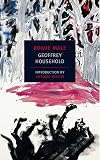
A great literate action story. The main character is so thoroughly disaffected and alienated from himself that his motivation, though powerful is initially a mystery both to us and to himself. Told in a deft oblique style that circles ever closer to plain statement of fact as the story grows in intensity.

Edition: Folio Society (2013), Hardcover, 172 pages.
Original publication date: 1939
From the FS site: "Rogue Male opens, literally, with a cliffhanger. The narrator has just been thrown off the edge of a precipice and is clinging on by the fingertips. He survives the fall and struggles through a muddy stream before climbing a tree, there to hide from the uniformed figures searching below. It transpires that he has just tried to assassinate the leader of an unnamed country with a hunting show more rifle. There follows a fast-paced cat-and-mouse chase across Europe as the hero struggles to evade the authorities and carry out his mission – ‘to do justice where no other hand could reach.’"
When we have that first vision of the unnamed narrator, he's been submitted to interrogation under brutal torture (the fingertips in question have had the nails removed) and conveniently left for dead. The novel is in the form of a memoir, which he writes while in hiding to try to make sense of events and also as a way to avoid giving way to insanity. Well he might make that effort too, because his solution to staying away from his pursuers is to literally burrow himself underground somewhere in Dorset, where he spends weeks and months in a hole in the ground not much larger than the size of a coffin; living off tins of food in his own filth and stench and unable to go aboveground or show himself anywhere as a wanted man. The narrative is completely gripping, and though we never find out the identity of the narrator, nor that of the leader he may or may not have had the intention of assassinating, we are privy to his musings as he takes us through the course of events which has led him to his present situation, and his reflections on what his true motivations might have been.
Other than a ripping good yarn, one thing that greatly appealed to me about this short novel was that it allowed me to completely put aside my own sense of morality and prejudices and enter into the mind of a man with almost complete opposite background, world experience and choice pastimes. Here is a very wealthy man from an ancient aristocratic English family, educated in the best 'public' schools and then at an Oxbridge college, whose favourite activity is traveling the world to track and kill 'big game'—incidentally, according to wikipedia, the term 'Big Game' is historically associated with the hunting of Africa's Big Five game; lions, African elephants, Cape Buffaloes, leopards and rhinos—iin other words, animals now on the verge of extinction. I'm sure I don't need to point out that as an animal lover who eats meat most infrequently, I cannot abide the idea of hunting as a leisure activity. But Household's writing grabbed hold of me from the beginning, and I was immediately concerned with this man staying alive and living to tell his tale. And when his true motivations came to the fore, was even be able to sympathize with him. Also didn't hurt that according to some, the leader he had in his sights, finger on the trigger was no other than Hitler, "though the anonymous narrator does not consider himself an assassin but ‘a sportsman who couldn’t resist the temptation to stalk the impossible.’"
Excellent and strongly recommended.
The Folio edition, needless to say, is simply gorgeous. The illustrations throughout always cross over the full spread, sometimes with the text wrapping around the element on the page facing the main picture, a great visual device for a book about a man on the run. show less
Original publication date: 1939
From the FS site: "Rogue Male opens, literally, with a cliffhanger. The narrator has just been thrown off the edge of a precipice and is clinging on by the fingertips. He survives the fall and struggles through a muddy stream before climbing a tree, there to hide from the uniformed figures searching below. It transpires that he has just tried to assassinate the leader of an unnamed country with a hunting show more rifle. There follows a fast-paced cat-and-mouse chase across Europe as the hero struggles to evade the authorities and carry out his mission – ‘to do justice where no other hand could reach.’"
When we have that first vision of the unnamed narrator, he's been submitted to interrogation under brutal torture (the fingertips in question have had the nails removed) and conveniently left for dead. The novel is in the form of a memoir, which he writes while in hiding to try to make sense of events and also as a way to avoid giving way to insanity. Well he might make that effort too, because his solution to staying away from his pursuers is to literally burrow himself underground somewhere in Dorset, where he spends weeks and months in a hole in the ground not much larger than the size of a coffin; living off tins of food in his own filth and stench and unable to go aboveground or show himself anywhere as a wanted man. The narrative is completely gripping, and though we never find out the identity of the narrator, nor that of the leader he may or may not have had the intention of assassinating, we are privy to his musings as he takes us through the course of events which has led him to his present situation, and his reflections on what his true motivations might have been.
Other than a ripping good yarn, one thing that greatly appealed to me about this short novel was that it allowed me to completely put aside my own sense of morality and prejudices and enter into the mind of a man with almost complete opposite background, world experience and choice pastimes. Here is a very wealthy man from an ancient aristocratic English family, educated in the best 'public' schools and then at an Oxbridge college, whose favourite activity is traveling the world to track and kill 'big game'—incidentally, according to wikipedia, the term 'Big Game' is historically associated with the hunting of Africa's Big Five game; lions, African elephants, Cape Buffaloes, leopards and rhinos—iin other words, animals now on the verge of extinction. I'm sure I don't need to point out that as an animal lover who eats meat most infrequently, I cannot abide the idea of hunting as a leisure activity. But Household's writing grabbed hold of me from the beginning, and I was immediately concerned with this man staying alive and living to tell his tale. And when his true motivations came to the fore, was even be able to sympathize with him. Also didn't hurt that according to some, the leader he had in his sights, finger on the trigger was no other than Hitler, "though the anonymous narrator does not consider himself an assassin but ‘a sportsman who couldn’t resist the temptation to stalk the impossible.’"
Excellent and strongly recommended.
The Folio edition, needless to say, is simply gorgeous. The illustrations throughout always cross over the full spread, sometimes with the text wrapping around the element on the page facing the main picture, a great visual device for a book about a man on the run. show less
Lists
Folio Society (1)
1930s (1)
Awards


You May Also Like


Associated Authors
Statistics
- Works
- 51
- Also by
- 29
- Members
- 2,734
- Popularity
- #9,396
- Rating
- 3.8
- Reviews
- 91
- ISBNs
- 181
- Languages
- 9
- Favorited
- 3