
A. M. Burrage (1889–1956)
Author of One Who Saw: A Ghost Story for Christmas (Seth's Christmas Ghost Stories)
About the Author
Works by A. M. Burrage
The Little Blue Flames: and Other Uncanny Tales by A. M. Burrage (British Library Hardback Classics) (2022) 24 copies
A.M. Burrage - The Waxwork & Other Stories: Classics From The Master Of Horror Fiction (A.M. Burrage Classic Collection) (Volume 1) (2013) 6 copies
Browdean Farm 2 copies
Playmates 2 copies
The Room Over the Kitchen 1 copy
The House of Treburyan 1 copy
The House by the Crossroads 1 copy
Wrastler's End 1 copy
Furze Hollow 1 copy
Footprints 1 copy
The Yellow Curtains 1 copy
The Summer-House 1 copy
The Gamblers' Room 1 copy
The Wrong Station 1 copy
The Green Scarf 1 copy
The Tryst 1 copy
The Hiding Hole 1 copy
The Soldier 1 copy
The Protector 1 copy
The Bungalow at Shammerton 1 copy
The Girl in Blue 1 copy
The Woman with Three Eyes 1 copy
The Pit in the Garden 1 copy
The Affair at Penbillo 1 copy
Adeldom verplicht 1 copy
A.M. Burrage - The Acquital & Other Stories: Classics From The Master Of Horror (A.M. Burrage Classic Collection) (2013) 1 copy
Der Todesbote 1 copy
The Third Visitation 1 copy
Associated Works
The Mammoth Book of Haunted House Stories (2000) — Contributor, some editions — 319 copies, 9 reviews
Alfred Hitchcock Presents: 13 More Stories They Wouldn't Let Me Do On TV (1959) — Contributor — 92 copies, 2 reviews
There Is a Graveyard That Dwells in Man: More Strange Fiction and Hallucinatory Tales (2020) — Contributor — 63 copies
The Moons at Your Door: An Anthology of Hallucinatory Tales (Strange Attractor Press) (2016) — Contributor — 53 copies, 1 review
Giving Up the Ghosts: Short-Lived Occult Detective Series by Six Renowned Authors (2015) — Contributor — 8 copies
THE ASH-TREE PRESS ANNUAL MACABRE 2005: HAVEN'T I READ THIS BEFORE? (2005) — Contributor — 7 copies, 1 review
Tagged
Common Knowledge
- Legal name
- Burrage, Alfred McLelland
- Other names
- X, Ex-Private
Lelland, Frank - Birthdate
- 1889-07-01
- Date of death
- 1956-12-18
- Gender
- male
- Occupations
- writer
- Relationships
- Burrage, E. Harcourt (uncle)
- Nationality
- UK
- Birthplace
- Hillingdon, London, England, UK
- Place of death
- London, England, UK
- Associated Place (for map)
- London, England, UK
Members
Reviews
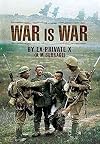
WAR IS WAR is a fascinating look inside the trenches of WWI, written by a 28 year-old private, who was quite the exception in the enlisted ranks of the time. A.M. Burrage was a professional writer by trade, who served in the Artists Rifles but failed to earn a commission. So he ended up in the front lines with the rank and file men, and in fact was right in the thick of things in some of the fiercest battles of the war, including Passchendale, made famous by the war poets of the time, and, show more many years later, by Pat Barker's REGENERATION trilogy of novels.
In fact, Burrage continued to write his stories and submit them to the popular magazines of the day while he was literally in the front-line trenches. Throughout his narrative, even in the most trying of times, Burrage displays a wickedly wry sense of humor and a kind of early wisdom that shines through on nearly every page. He also refuses to resort to commonplace profanity or obscenity in his writings, although he acknowledges using it, knowing that any soldier who doesn't swear cannot be trusted. Remaining true to his literary bent, Burrage took Chaucer's CANTERBURY TALES in his kit and read it through repeatedly. He also read Robert Browning's poetry, noting -
"Browning helped me to believe that memories of the old comfortable life were not merely the memories of dreams. There were still English homes, and beds, and garden chairs, green lawns and clusters of flowers, food which did not look as if it came out of a pig-trough, ripe-lipped dainty girls, people who did not qualify every noun with a filthy adjective. Some of us would win back to these delights. Surely they could not kill us all."
Burrage tells you at the outset what an inept and bad soldier he was, how cowardly and fearful he felt much of the time. Nevertheless he did his best, first as a reluctant rifleman, and later as a stretcher-bearer. He was hospitalized twice, the first time for "trench fever," a disabling flu-like ailment transmitted by lice - and everyone in the trenches was lice-ridden. The second and last time he was shot near the kidney, which turned out to be a minor wound, but at the same time he was crippled by trench foot, which turned out to be his "blighty," sending him back to England.
Ruthlessly frank in his description of war and the commonality of death, Burrage tells us, "When a man is killed, we rush to him to see if he's got any food in his haversack, or, that priceless possession, a safety-razor."
Or, about the realization of what his real job is, and the reality of war -
"... the job of the infantry isn't to kill. It is the artillery and the machine-gun corps who do the killing. We are merely there to be killed. We are the little flags which the General sticks on the war-map to show the position of the front-line … We find for ourselves the truth we have already been told - that there is no romance in the war. It is an inglorious hotchpotch of misery ad dreariness, varied occasionally by short spells of stark dreadfulness."
Years later, he is disdainful, if not angry, at the war 'experts,' who wrote about war from afar, even one of his favorite writers, Sir Arthur Conan Doyle, gets trashed -
"Sir Arthur Conan Doyle, in his HISTORY OF THE WAR, dismissed us with the remark that we 'seemed to find some difficulty in getting forward.' The difficulty consisted mainly of being killed in heaps … he should have left the war to the soldiers. You cannot write about the war by merely reading the newspaper reports and looking at maps."
WAR IS WAR, which was written nearly a hundred years ago is, I think, as a first-hand account, one of the best of the memoirs of the Great War. I was often reminded of a WWI novel I read a few years back, Frederick Manning's HER PRIVATES WE, a caustic, ribald and disturbing account of the horrors of trench warfare. Hemingway praised it as one of the best of its kind. I'm so pleased that the English publisher, Pen & Sword Military Books, has brought Burrage's book back into print. Very highly recommended, especially for historians and war buffs.
- Tim Bazzett, author of the Cold War memoir, SOLDIER BOY: AT PLAY IN THE ASA show less
In fact, Burrage continued to write his stories and submit them to the popular magazines of the day while he was literally in the front-line trenches. Throughout his narrative, even in the most trying of times, Burrage displays a wickedly wry sense of humor and a kind of early wisdom that shines through on nearly every page. He also refuses to resort to commonplace profanity or obscenity in his writings, although he acknowledges using it, knowing that any soldier who doesn't swear cannot be trusted. Remaining true to his literary bent, Burrage took Chaucer's CANTERBURY TALES in his kit and read it through repeatedly. He also read Robert Browning's poetry, noting -
"Browning helped me to believe that memories of the old comfortable life were not merely the memories of dreams. There were still English homes, and beds, and garden chairs, green lawns and clusters of flowers, food which did not look as if it came out of a pig-trough, ripe-lipped dainty girls, people who did not qualify every noun with a filthy adjective. Some of us would win back to these delights. Surely they could not kill us all."
Burrage tells you at the outset what an inept and bad soldier he was, how cowardly and fearful he felt much of the time. Nevertheless he did his best, first as a reluctant rifleman, and later as a stretcher-bearer. He was hospitalized twice, the first time for "trench fever," a disabling flu-like ailment transmitted by lice - and everyone in the trenches was lice-ridden. The second and last time he was shot near the kidney, which turned out to be a minor wound, but at the same time he was crippled by trench foot, which turned out to be his "blighty," sending him back to England.
Ruthlessly frank in his description of war and the commonality of death, Burrage tells us, "When a man is killed, we rush to him to see if he's got any food in his haversack, or, that priceless possession, a safety-razor."
Or, about the realization of what his real job is, and the reality of war -
"... the job of the infantry isn't to kill. It is the artillery and the machine-gun corps who do the killing. We are merely there to be killed. We are the little flags which the General sticks on the war-map to show the position of the front-line … We find for ourselves the truth we have already been told - that there is no romance in the war. It is an inglorious hotchpotch of misery ad dreariness, varied occasionally by short spells of stark dreadfulness."
Years later, he is disdainful, if not angry, at the war 'experts,' who wrote about war from afar, even one of his favorite writers, Sir Arthur Conan Doyle, gets trashed -
"Sir Arthur Conan Doyle, in his HISTORY OF THE WAR, dismissed us with the remark that we 'seemed to find some difficulty in getting forward.' The difficulty consisted mainly of being killed in heaps … he should have left the war to the soldiers. You cannot write about the war by merely reading the newspaper reports and looking at maps."
WAR IS WAR, which was written nearly a hundred years ago is, I think, as a first-hand account, one of the best of the memoirs of the Great War. I was often reminded of a WWI novel I read a few years back, Frederick Manning's HER PRIVATES WE, a caustic, ribald and disturbing account of the horrors of trench warfare. Hemingway praised it as one of the best of its kind. I'm so pleased that the English publisher, Pen & Sword Military Books, has brought Burrage's book back into print. Very highly recommended, especially for historians and war buffs.
- Tim Bazzett, author of the Cold War memoir, SOLDIER BOY: AT PLAY IN THE ASA show less
Smee by EX-PRIVATE X

A solid country house Christmas ghost story that has its atmospheric charms and even (if you look hard enough) a hint of interwar eroticism as well as some period stiff upper lip. Very British.

I was pleasantly surprised by this. I'd read bits of Burrage in numerous Ghost story anthologies, but to be honest was more interested in getting hold of the Equation volume more for completists sake (and it was a bit of a bargain). I wasn't prepared for how good - and versatile - a writer Burrage is. As with a lot of writers from that time, the quality is variable but stuff like "The Garden of Fancy" is particularly good because there's a tangible oddness and novelty to the story whilst show more also being particularly satisfying as both a conventional short story and as a bit of weird fiction. Am definitely going to try and track down more... show less
A 'waxwork' shocker that manages to maintain its creepy air of 'grand guignol' horror to the end.
Lists
You May Also Like


Associated Authors
Statistics
- Works
- 53
- Also by
- 64
- Members
- 228
- Popularity
- #98,696
- Rating
- 3.8
- Reviews
- 4
- ISBNs
- 26
- Favorited
- 1