
About the Author
Neal Pollack is the author of the bestselling memoir Alternadad and several books of satirical fiction, including The Neal Pollack Anthology of American Literature and the rock novel Never Mind the Pollacks. He lives in Los Angeles with his wife and son.
Image credit: Credit: David Shankbone, Sept. 2007
Series
Works by Neal Pollack
The Neal Pollack Anthology of American Literature: The Collected Writings of Neal Pollack (2000) 310 copies, 2 reviews
Alternadad: The True Story of One Family's Struggle to Raise a Cool Kid in America (2007) 172 copies, 7 reviews
Time to Rock 1 copy
Associated Works
Created in Darkness by Troubled Americans: The Best of McSweeney's Humor Category (2004) — Contributor — 888 copies, 16 reviews
Maybe Baby: 28 Writers Tell the Truth About Skepticism, Infertility, Baby Lust, Childlessness, Ambivalence, and How They Made the Biggest Decision of Their Lives (2006) — Contributor — 132 copies, 4 reviews
One Big Happy Family: 18 Writers Talk About Open Adoption, Mixed Marriage, Polyamory, Househusbandry, Single Motherhood, and Other Realities of Truly Modern Love (2009) — Contributor — 116 copies, 6 reviews
A Fictional History of the United States with Huge Chunks Missing (2006) — Contributor — 77 copies, 2 reviews
Reality Matters: 19 Writers Come Clean About the Shows We Can't Stop Watching (2010) — Contributor — 25 copies, 1 review
Tagged
Common Knowledge
- Birthdate
- 1970-03-01
- Gender
- male
- Education
- Northwestern University
- Occupations
- lyricist
reporter - Organizations
- Writer's Guild Of America
PEN - Nationality
- USA
- Places of residence
- Los Angeles, California, USA
- Associated Place (for map)
- California, USA
Members
Reviews

In Neal Pollack’s novel Repeat, failed Hollywood screenwriter Brad Cohen ends up living the first forty years of his life over and over again in a ‘continuous time loop’. Pollack rebels against the initial instinct to resort to the repetitive actions of someone trying to accomplish the same thing over and over again, and this is probably what keeps the novel - for the most part - fresh. However, the avoidance of expectation throws a logical monkey wrench into the works from a narrative show more standpoint; before his ‘time loop’ begins, we are given a lengthy introduction to the main character’s waning career as a novelist and screenwriter, one of the main reasons he comes to consider himself an abject failure on the eve of his fortieth birthday. With the amount of time spent on this major aspect of the character, you would reasonably expect many of his ‘repeats’ to involve improving as a writer. Likewise, for a man separated from the love of his life by an infinite time loop, you would expect repeated attempts at igniting that romance again. Unfortunately, these are just some of the many expectations left wanting in a novel that, for the most part, tries to be funnier and deeper than it actually is.
The bulk of Repeat, instead of sincerely delving into the metaphysical aspects of living one’s life over and over again, weighs heavily on self-referential name dropping and self-deprecating reflections that make it more and more apparent that the author’s biggest crime against his audience is not just making himself the main character and doing away with all of his thinly-veiled subterfuge. The narcissistic navel-gazing hits a brief fever-pitch in a chapter near the end of the book comprised of an article by an nameless Chicago journalist (guess who) that wraps up with a befuddled Brad Cohen providing the author’s doppelganger with Wikipedia-worthy description of his future achievements. It’s a stab at being cute/clever that falls far from Breakfast of Champions, and makes the following yoga-centric chapter (Hint: Pollack is into yoga) nearly unbearable.
Self-deprecation is also a form of self-defense, and Pollack uses it to beat his critics to the punch early in the novel by having failed screenwriter Brad Cohen repeatedly weathering accusations that his television pilot concept sounds like a rehash of Groundhog Day. Whether it’s a thinly-veiled attempt to deflect his own insecurities or a stab at going ‘Meta’, it’s a comparison the reader doesn’t need spelled out. Perhaps Pollack’s mirror-gazing approach is to blame for what I found to be the biggest flaw in the story of Brad Cohen’s one hundred relived lifetimes, which is a lack of human connections. One of the biggest comments you will see in reviews of the book is unavoidable comparisons to Groundhog Day and It’s a Wonderful Life, but the one parallel absent from Pollack’s novel that these other referenced works feature is an attention to human relationships. While Brad Cohen’s wife and daughters are part of the launching-pad that he jettisons on his return to the womb, there is only one instance either described or eluded to that involves him trying to reunite with his wife throughout his entire 4,000 year journey. Great attention is given to financial success, professional achievement, and unrestrained hedonism, yet what is invariably glossed over is the potential for establishing, reestablishing, developing, or even investigating relationships with other people, familial or otherwise. Outside of his first life repeat’s journey through birth and infancy with an adult mind (his Mother’s nipple and diapers play a significant role in the humor throughout), Brad Cohen’s obsession with becoming a Jeopardy champion takes up more print space than his relationship with his parents, despite being forced to spend roughly a third of each repeated life living with them. This lack of intimacy extends to childhood friends, adult friends, or any kind of relationship that isn’t directly related to the overriding obsession with fortune and fame. Pollack’s character ricochets between materialistic hedonism and minimalist Zen philosophy without any substantive attempts to live any kind of life that involves forging new bonds. While it can argued that this is a flaw inherent in the character’s psyche, this is an assumption that shouldn’t have to be made on behalf of the author.
Despite these criticisms, I would not say that Repeat was unenjoyable, only that the novel is overall – much like Brad Cohen’s repeated lives - a hit-or-miss experience. Also, to be fair, injecting yourself into the company of iconic classics such as Groundhog Day and It’s a Wonderful Life is an open invitation to falling short, regardless of how you try to diffuse that level of expectation in advance. Not being familiar with any of Pollack’s other works, I can only assume that this is not his best or worst attempt, and I don’t see any reason to treat it as either. It’s a passable novel, and if you’re looking to pass time (but not lifetimes), then you could do far worse. show less
The bulk of Repeat, instead of sincerely delving into the metaphysical aspects of living one’s life over and over again, weighs heavily on self-referential name dropping and self-deprecating reflections that make it more and more apparent that the author’s biggest crime against his audience is not just making himself the main character and doing away with all of his thinly-veiled subterfuge. The narcissistic navel-gazing hits a brief fever-pitch in a chapter near the end of the book comprised of an article by an nameless Chicago journalist (guess who) that wraps up with a befuddled Brad Cohen providing the author’s doppelganger with Wikipedia-worthy description of his future achievements. It’s a stab at being cute/clever that falls far from Breakfast of Champions, and makes the following yoga-centric chapter (Hint: Pollack is into yoga) nearly unbearable.
Self-deprecation is also a form of self-defense, and Pollack uses it to beat his critics to the punch early in the novel by having failed screenwriter Brad Cohen repeatedly weathering accusations that his television pilot concept sounds like a rehash of Groundhog Day. Whether it’s a thinly-veiled attempt to deflect his own insecurities or a stab at going ‘Meta’, it’s a comparison the reader doesn’t need spelled out. Perhaps Pollack’s mirror-gazing approach is to blame for what I found to be the biggest flaw in the story of Brad Cohen’s one hundred relived lifetimes, which is a lack of human connections. One of the biggest comments you will see in reviews of the book is unavoidable comparisons to Groundhog Day and It’s a Wonderful Life, but the one parallel absent from Pollack’s novel that these other referenced works feature is an attention to human relationships. While Brad Cohen’s wife and daughters are part of the launching-pad that he jettisons on his return to the womb, there is only one instance either described or eluded to that involves him trying to reunite with his wife throughout his entire 4,000 year journey. Great attention is given to financial success, professional achievement, and unrestrained hedonism, yet what is invariably glossed over is the potential for establishing, reestablishing, developing, or even investigating relationships with other people, familial or otherwise. Outside of his first life repeat’s journey through birth and infancy with an adult mind (his Mother’s nipple and diapers play a significant role in the humor throughout), Brad Cohen’s obsession with becoming a Jeopardy champion takes up more print space than his relationship with his parents, despite being forced to spend roughly a third of each repeated life living with them. This lack of intimacy extends to childhood friends, adult friends, or any kind of relationship that isn’t directly related to the overriding obsession with fortune and fame. Pollack’s character ricochets between materialistic hedonism and minimalist Zen philosophy without any substantive attempts to live any kind of life that involves forging new bonds. While it can argued that this is a flaw inherent in the character’s psyche, this is an assumption that shouldn’t have to be made on behalf of the author.
Despite these criticisms, I would not say that Repeat was unenjoyable, only that the novel is overall – much like Brad Cohen’s repeated lives - a hit-or-miss experience. Also, to be fair, injecting yourself into the company of iconic classics such as Groundhog Day and It’s a Wonderful Life is an open invitation to falling short, regardless of how you try to diffuse that level of expectation in advance. Not being familiar with any of Pollack’s other works, I can only assume that this is not his best or worst attempt, and I don’t see any reason to treat it as either. It’s a passable novel, and if you’re looking to pass time (but not lifetimes), then you could do far worse. show less

Pollack is not what you’d imagine to be a yoga type. As he explains in the first chapter of his memoir, earlier in his career he tried to be the “bad boy” punk rocker of contemporary literature, which didn’t work out too well for him. He came to yoga via his local 24-hour gym in Austin at just the right time in his life, when he really needed to make a change, and he embraced it wholeheartedly, much to the annoyance of his long-suffering wife.
That doesn’t mean he embraced all of show more yoga culture, which can be as self-indulgent and silly as any other multi-million-dollar industry. He writes about yoga rock festivals, acro-yoga, show-offs and teachers who talk too much about themselves in class with appropriate disdain. He doesn’t go easy on himself, either, such as when he spends quite a few very funny pages describing his efforts to suppress his farting in class.
But that doesn’t mean there’s not a lot of good in yoga, too, and Pollack writes about that aspect openly and without snark, from the really interesting teachers he is fortunate enough to have, to the gradual changes yoga makes on his own personality. In short, he stops being an asshole because of yoga. And as he keeps pointing out, yoga people are nice. We need a lot more nice people in this world.
I have studied yoga off and on for several years, so for me it was particularly interesting when Pollack discussed the philosophy and history of yoga, although I have to wonder if he skims too much over these concepts for the layperson to follow. No matter. Pollack’s funny, entertaining memoir has inspired me to make yoga a regular part of my life again. After all, if this guy can do it, then I certainly can. show less
That doesn’t mean he embraced all of show more yoga culture, which can be as self-indulgent and silly as any other multi-million-dollar industry. He writes about yoga rock festivals, acro-yoga, show-offs and teachers who talk too much about themselves in class with appropriate disdain. He doesn’t go easy on himself, either, such as when he spends quite a few very funny pages describing his efforts to suppress his farting in class.
But that doesn’t mean there’s not a lot of good in yoga, too, and Pollack writes about that aspect openly and without snark, from the really interesting teachers he is fortunate enough to have, to the gradual changes yoga makes on his own personality. In short, he stops being an asshole because of yoga. And as he keeps pointing out, yoga people are nice. We need a lot more nice people in this world.
I have studied yoga off and on for several years, so for me it was particularly interesting when Pollack discussed the philosophy and history of yoga, although I have to wonder if he skims too much over these concepts for the layperson to follow. No matter. Pollack’s funny, entertaining memoir has inspired me to make yoga a regular part of my life again. After all, if this guy can do it, then I certainly can. show less

A wild ride of a book, this novel flies through the history of rock ‘n’ roll on the heels of Neal Pollack, “the greatest music critic of all time,” as he follows his spirit guide, a mythical blues singer named Clambone, in search of the ultimate Truth about music and America. The novel takes the guise of a biography of Pollack writen by another music critic, Paul St. Pierre, after Pollack’s death at the height of his degradation.
Pollack manages to be present as every rock legend is show more getting his or her start, so Elvis, Dylan, Mick, Lou Reed, Iggy, the Ramones and Kurt Cobain (among many others) all appear as characters in his travels through the wasteland of rock – and they all seem to despise Pollack equally. This book is definitely not meant to be taken literally or seriously, but rather serves as an epic retelling of the rise and fall of rock ‘n’ roll, and if experienced in that vein, it is actually quite exhilarating and funny, even spiritual at times. I only wish I knew more about music, so I could have caught more of the inside jokes. show less
Pollack manages to be present as every rock legend is show more getting his or her start, so Elvis, Dylan, Mick, Lou Reed, Iggy, the Ramones and Kurt Cobain (among many others) all appear as characters in his travels through the wasteland of rock – and they all seem to despise Pollack equally. This book is definitely not meant to be taken literally or seriously, but rather serves as an epic retelling of the rise and fall of rock ‘n’ roll, and if experienced in that vein, it is actually quite exhilarating and funny, even spiritual at times. I only wish I knew more about music, so I could have caught more of the inside jokes. show less
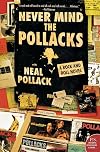
As I've been getting more and more into not just reading books, but also reading about books (on fine blogs like Bookslut and 50 Books), I've noticed that there are a few names that are often used as examples of both what is right and what is wrong with writers today - "you either love 'em or hate 'em" kind of authors. Neil Pollack's name seemed to come up more than most, so when I saw Never Mind at a used book sale for $4, I picked it up. After reading it I can see how it would be hard to show more have something other than complete love or all-out hate for its author.
Never Mind, The Gump-like story of a pompous, know-it-all rock critic (is there any other kind?) weaving his through most of Rock and Roll's seminal moments, is a book that is completely off-the-wall, only understandable to those who grew up reading Rolling Stone (back when it was still cool to read RS), sometimes extremely gross, and often times nonsensical. It's also hilarious. Laugh-out-loud-page-after-page hilarious. Pollack's knowledge of the subject matter and his boldness in insulting his target audience - music snobs (of which he's obviously one) - and most importantly the fact that the book is hilarious (did I mention that already?) puts him firmly in my "what's right with writers today" column. show less
Never Mind, The Gump-like story of a pompous, know-it-all rock critic (is there any other kind?) weaving his through most of Rock and Roll's seminal moments, is a book that is completely off-the-wall, only understandable to those who grew up reading Rolling Stone (back when it was still cool to read RS), sometimes extremely gross, and often times nonsensical. It's also hilarious. Laugh-out-loud-page-after-page hilarious. Pollack's knowledge of the subject matter and his boldness in insulting his target audience - music snobs (of which he's obviously one) - and most importantly the fact that the book is hilarious (did I mention that already?) puts him firmly in my "what's right with writers today" column. show less
Lists
Awards

You May Also Like


Associated Authors
Statistics
- Works
- 20
- Also by
- 18
- Members
- 1,020
- Popularity
- #25,252
- Rating
- 3.4
- Reviews
- 38
- ISBNs
- 45
- Languages
- 4
- Favorited
- 2
