
About the Author
Works by Jean Clair
Balthus : [cat. exp., Paris, Centre Pompidou, 5 nov 1983 - 23 janvier 1984; New York, Metropolitan Museum of Art, 21 fév - 13 mai 1984] (1983) — Editor — 90 copies, 1 review
La Biennale di Venezia : 46. esposizione internazionale d'arte : identity and alterity : figures of the body 1895 - 1995 (1995) 28 copies, 1 review
Le Musée Picasso 4 copies
Cosmos: From Goya to De Chirico, from Friedrich to Kiefer : art in pursuit of the infinite (2000) 4 copies
Picasso [exposition:] Fondation Pierre Gianadda, Martigny, 29 juin au 4 novembre 2001 (2001) 3 copies
Wunderblock : e. Geschichte d. modernen Seele : [Katalog zur Ausstellung der Wiener Festwochen in Zusammenarbeit mit d. Historischen Museum der Stadt Wien, 27. April - 6. Aug.… (1989) 3 copies, 1 review
Marcel Delmotte: 1901-1984: oeuvres de 1919 a 1950: [exposition], 25 novembre 1987-30 janvier 1988 1 copy
Réception de M. Jean Clair: discours prononcés dans la séance publique le jeudi 18 juin 2009 1 copy
Associated Works
Les Realismes, 1919-1939: [exposition], Centre Georges Pompidou, 17 decembre 1980-20 avril 1981, Staatliche Kunsthalle Berlin, 10 mai-30 juin 1981 (French Edition) (1980) — Contributor — 29 copies, 1 review
Tagged
Common Knowledge
- Legal name
- Régnier, Gérard
- Other names
- Clair, Jean
- Birthdate
- 1940-10-20
- Gender
- male
- Organizations
- Académie française (2008)
- Nationality
- France
Members
Reviews

Balthus is an artist who is bound to disturb you. His lifelong preoccupation with painting prepubescent girls nude or in highly suggestive poses may actually anger you, especially if you think beyond the paintings and into their creation. His painting ‘The Guitar Lesson’ from 1934 shocks us with such overt sadism. Again and again he shows us girls with their legs spread, in outright provocation (as in ‘The Golden Days’ (1944-45), or ‘Therese Dreaming’ (1938)), or in what are show more ostensibly more innocent works (as in ‘The Children’ (1937), or ‘The Game of Patience’ (1943)). His models were mostly neighbor girls over the decades - Therese Blanchard, Georgette, Jeannette Aldry, Marie-Pierre Colle, and Frederique Tison among others - and one wonders what their parents were thinking. The expression of Frederique Tison in ‘Girl in White’ (1955) shows us a very sad painting if you ask me, as the 17-year-old girl (who had posed for him since the age of 9) seems resigned to the gaze of the 47-year-old painter.
Great art pushes boundaries, is provocative, and causes introspection. Balthus clearly does all that, and with skill as a painter. Is he to be praised as a great artist, or condemned as one encouraging pedophilia, if not (possibly) practicing it? Is there a message or statement he’s making in these images? In ‘The Street’ (1933), with the original version having the man’s hand between the girl’s legs (he altered it at the owner’s request 20 years later), is his point that while this violence is happening to a girl, the rest of the world is disinterested, their heads turned and going about their business? In ‘Girl With a Cat’ (1937), are Therese’s eyes telling us that if we’re thinking dirty thoughts while gazing upon her with our adult eyes, we’re the ones who are perverts? Or are those thoughts a reflection of the discomfort we feel as adults when girls occasionally reveal themselves, innocently, or later, when they inevitably do begin to blossom, but are still children?
The book itself, published after a 1984 exhibition in Paris and New York and written by Sabine Rewald, an expert in Balthus’s work, is well formatted, has a great introduction, 51 full page color reproductions, and 151 black and white illustrations. It provides insightful commentary, and does a great job showing earlier artwork that inspired specific pieces by Balzac, as well as his own sketches and studies. It was interesting to find that Rainer Maria Rilke had been his mother’s lover, and encouraged his art at an early age. In reviewing and rating the book, how much should this weigh in, versus some of the content?
Balthus’s position that the paintings were not meant to be erotic is laughable. Some apologists point out that at the start of his career, the French age of consent was 13 – does this excuse him somewhat, or does it illustrate how hopelessly wrong he was, that this material does not stand the test of time, especially as we’re more sensitized to the violence against women and girls in society?
Answers to these questions are hard to come by. At first I thought that Rewald didn’t go far enough to explain Balthus’s rationale, or to provide a judgment of him one way or another. However, I came to realize that that in itself was the right answer – for art is in the eye of the beholder, and it’s up to the viewer, or reader, to judge. And as an aside, Rewald continued to write about Balthus after 1984, and this excellent article from 1998 expands on her themes, as well as provides additional examples of the treatment of puberty in art (from Rops, Schiele, Munch, Dix, Kirchner, and others).
www.metmuseum.org/pubs/journals/1/pdf/1513021.pdf.bannered.pdf
As for the art itself, my favorites in this collection:
Andre Derain (1936)
Therese (1938) … a more subtle version
The Cherry Tree (1940)
The Game of Patience (1943)
Nude with Cat (1949)
The Room (1952-54) … wow, on the scorn and judgment in the look on the little girl!
The Dream I (1955)
The Turkish Room (1963) … he would marry the model, Setsuko, despite a 35 year age gap
Katia Reading (1968-76)
It’s not for everyone, and it’s art that you may be seriously conflicted by, but if Balthus is an artist you’re interested in trying to fathom, this would be a good book to start with. show less
Great art pushes boundaries, is provocative, and causes introspection. Balthus clearly does all that, and with skill as a painter. Is he to be praised as a great artist, or condemned as one encouraging pedophilia, if not (possibly) practicing it? Is there a message or statement he’s making in these images? In ‘The Street’ (1933), with the original version having the man’s hand between the girl’s legs (he altered it at the owner’s request 20 years later), is his point that while this violence is happening to a girl, the rest of the world is disinterested, their heads turned and going about their business? In ‘Girl With a Cat’ (1937), are Therese’s eyes telling us that if we’re thinking dirty thoughts while gazing upon her with our adult eyes, we’re the ones who are perverts? Or are those thoughts a reflection of the discomfort we feel as adults when girls occasionally reveal themselves, innocently, or later, when they inevitably do begin to blossom, but are still children?
The book itself, published after a 1984 exhibition in Paris and New York and written by Sabine Rewald, an expert in Balthus’s work, is well formatted, has a great introduction, 51 full page color reproductions, and 151 black and white illustrations. It provides insightful commentary, and does a great job showing earlier artwork that inspired specific pieces by Balzac, as well as his own sketches and studies. It was interesting to find that Rainer Maria Rilke had been his mother’s lover, and encouraged his art at an early age. In reviewing and rating the book, how much should this weigh in, versus some of the content?
Balthus’s position that the paintings were not meant to be erotic is laughable. Some apologists point out that at the start of his career, the French age of consent was 13 – does this excuse him somewhat, or does it illustrate how hopelessly wrong he was, that this material does not stand the test of time, especially as we’re more sensitized to the violence against women and girls in society?
Answers to these questions are hard to come by. At first I thought that Rewald didn’t go far enough to explain Balthus’s rationale, or to provide a judgment of him one way or another. However, I came to realize that that in itself was the right answer – for art is in the eye of the beholder, and it’s up to the viewer, or reader, to judge. And as an aside, Rewald continued to write about Balthus after 1984, and this excellent article from 1998 expands on her themes, as well as provides additional examples of the treatment of puberty in art (from Rops, Schiele, Munch, Dix, Kirchner, and others).
www.metmuseum.org/pubs/journals/1/pdf/1513021.pdf.bannered.pdf
As for the art itself, my favorites in this collection:
Andre Derain (1936)
Therese (1938) … a more subtle version
The Cherry Tree (1940)
The Game of Patience (1943)
Nude with Cat (1949)
The Room (1952-54) … wow, on the scorn and judgment in the look on the little girl!
The Dream I (1955)
The Turkish Room (1963) … he would marry the model, Setsuko, despite a 35 year age gap
Katia Reading (1968-76)
It’s not for everyone, and it’s art that you may be seriously conflicted by, but if Balthus is an artist you’re interested in trying to fathom, this would be a good book to start with. show less

Katalog zur Ausstellung der Wiener Festwochen in Zusammenarbeit mit dem Historischen Museum der Stadt Wien, 27. April bis 6. August 1989, Reithalle in den ehemaligen Hofstallungen, Messepalast.
Descartes lokalisierte sie noch in der Zirbeldrüse, Nachgeborene waren sich nicht mehr so sicher: Das 19. Jahrhundert begab sich auf die Suche nach der Seele, mit merkwürdigen Maschinen und Wissenschaften, beflügelt von der Technologie der Zeit. Die Wiener Ausstellung »Wunderblock. Eine Geschichte show more der modernen Seele« illustriert die Irrungen und Wirrungen der Seelenforschung bis Sigmund Freud, mit rund 500 Exponaten aus aller Welt, Gemälden, Apparaten, Präparaten, von Franz Anton Mesmers magnetischem Fluidum-»Baquet« (Zuber) bis zum »Orgon«-Kasten des Wilhelm Reich, von »Onaniebandagen« bis zu den »Charakterköpfen« des Franz Xaver Messerschmidt. Der Titel »Wunderblock« bezieht sich auf ein Trickgerät des 19. Jahrhunderts, auf dem Geschriebenes scheinbar verschwindet, bei spezieller Beleuchtung aber wieder auftaucht - für Freud eine »Versinnlichung unseres seelischen Wahrnehmungsapparats« show less
Descartes lokalisierte sie noch in der Zirbeldrüse, Nachgeborene waren sich nicht mehr so sicher: Das 19. Jahrhundert begab sich auf die Suche nach der Seele, mit merkwürdigen Maschinen und Wissenschaften, beflügelt von der Technologie der Zeit. Die Wiener Ausstellung »Wunderblock. Eine Geschichte show more der modernen Seele« illustriert die Irrungen und Wirrungen der Seelenforschung bis Sigmund Freud, mit rund 500 Exponaten aus aller Welt, Gemälden, Apparaten, Präparaten, von Franz Anton Mesmers magnetischem Fluidum-»Baquet« (Zuber) bis zum »Orgon«-Kasten des Wilhelm Reich, von »Onaniebandagen« bis zu den »Charakterköpfen« des Franz Xaver Messerschmidt. Der Titel »Wunderblock« bezieht sich auf ein Trickgerät des 19. Jahrhunderts, auf dem Geschriebenes scheinbar verschwindet, bei spezieller Beleuchtung aber wieder auftaucht - für Freud eine »Versinnlichung unseres seelischen Wahrnehmungsapparats« show less
46a Biennale di Venezia. 46ª Esposizione internazionale d'arte. Identità e alterità. Figure del corpo (1895-1995) by Jean Clair

Language: - pages - - Catalogo pubblicato in occasione della quarantaseiesima edizione della Biennale di Venezia (1995). Per celebrare il Centenario è stata allestita una grande rassegna storica, in grado di ripercorrere le tappe principali dell'arte del secolo scorso. La mostra, dal titolo `Identità e alterità`, è stata curata da Jean Clair. Il catalogo, ampiamente illustrato a colori e bianco/nero, contiene contributi di Jean Clair, Claude Lévi-Strauss, Marc Fumaroli, Maurizio show more Bettini, Paolo Fabbri, Gunter Metken, Philippe Comar, Marcel Brisebois, Didier Ottinger, Cathrin Pichler, Adalgisa Lugli, Manlio Brusatin. Sono documentate opere dei maggiori artisti figurativi del Novecento. show less
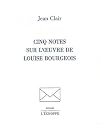
This book is about Bourgeois' sculpture Arch of Hysteria, made in 1993. The first edition of this book(let) was presented for the exhibition Francis Bacon, Louise Bourgeois, Franz-Xavier Messerschmidt, at Gallery Cheim & Read, New York, in 1998.
Awards

You May Also Like


Associated Authors
Statistics
- Works
- 108
- Also by
- 8
- Members
- 967
- Popularity
- #26,625
- Rating
- 3.8
- Reviews
- 9
- ISBNs
- 180
- Languages
- 10