
Leonard Richardson
Author of RESTful Web Services
About the Author
Image credit: Photo by Sumana Harihareswara
Works by Leonard Richardson
Let Us Now Praise Awesome Dinosaurs 2 copies
Mallory 1 copy
Associated Works
Clarkesworld: Issue 191 (August 2022) — Author — 1 copy
Tagged
Common Knowledge
- Birthdate
- 1979-07-09
- Gender
- male
- Relationships
- Harihareswara, Sumana (spouse)
- Nationality
- USA
- Associated Place (for map)
- USA
Members
Reviews

What kinds of videogames would aliens make? Maybe I'm simply unaware of it, but I'm pretty sure this topic has never been tackled by science fiction before. In Constellation Games, humanity makes contact with the Constellation, a Star Trek-esque conglomeration of alien species working together in a post-scarcity society. The first thought of the government is that it's an invasion. The first thought of Ariel Blum, a freelance computer programmer who mostly works on a series of Brazilian show more games about ponies for girls, is that he wants to review the aliens' games on his blog.
Constellation Games alternates between Ariel's blog and straight first-person narration from Ariel, with chat conversations and letters and such interspersed. The Constellation takes a multifaceted approach to their contact with Earth, and so Ariel soon finds himself in possession of a replica of a millions-of-years-old Constellation gaming console, along with tons of games. It's a short hop from the idea of reviewing a game to porting one; he wants to help his fellow human understand aliens by releasing one of their games.
Without a doubt, the best parts of Constellation Games are the game reviews. There are several alien species in the Constellation and we not only see games for multiple species, but games that one of those species made off another, and yet Richardson never fails to communicate the alien nature of the games while still making them seem like plausible games. I loved these sections: the game Sayable Spice, where the player collects components of taste molecules, comes up a lot, but Blum (and Richardson) show how a good game doesn't just have an interesting mechanic; it can say something, too. There's one bit where Ariel plays a game called Gatekeeper where you guard the boundary between life and death, "let[ting] normal traffic through, while flicking away dead people who shouldn't be living (zombies) and living people who shouldn't be dying (suicides?)" (33). Ariel's alien contact, Curic, sends him a message to dispute that they are not zombies, they're people who "want a refund." Ariel says that's the same thing, and she replies:
Curic: Zombies are fully dead people who come back to life for no reason.
What you are seeing is when one half of a person dies, the other half wants a refund.
Otherwise the entire person will die in a few hours.
ABlum: who gives out the refunds?
Curic: There are no refunds.
That's the point of the game. (35)
A whole alien biology and culture, expressed via inscrutable game mechanics!
Even aside from that, it's a surprisingly good novel. I guess I was expecting something like Taft 2012, the last high-concept sf novel I read, but Richardson gives Blum a strong narrative voice, that while idiosyncratic, never grates, and surrounds him with characters that perhaps initially seem stereotypical, but soon begin to betray extra levels of depth, both human and alien. Tetsuo Milk, the alien paleontologist who eventually becomes a history lecturer at the University of Texas, was probably my favorite, and the transcript of his first lecture is amazing. There are even some bits that approach being genuinely moving. It's also funny at times-- you can't underestimate the importance of that! The Constellation are a well fleshed out group of aliens, who avoid feeling too stereotypical in their types of social interactions (I loved the idea of "overlays").
At 357 pages, the plot meanders a bit. The back cover and some early passages imply there's a conspiracy to uncover, but that turns out to not be true at all; the plot is much more character focused. As such, the book ends the way that people's experiences actually end: frustratingly open-ended. What happens to Ariel and his friends next? I find myself wanting to know, but I'm not dissatisfied with the way the book ended; it came to the exact right spot.
Constellation Games is a love letter to videogames and certain elements of geek culture, that's for sure, but it's not a polemic; it shows both the marvelous possibilities of gaming, but also how it often fails to achieve its full potential-- and why. It's an engaging, original way to explore an alien society, but also ourselves, like all the best science fiction should. I rocketed through it (often drawn into a chapter on the basis of just reading that next game review), and I'd happily read more sf by Richardson should he choose to write it. show less
Constellation Games alternates between Ariel's blog and straight first-person narration from Ariel, with chat conversations and letters and such interspersed. The Constellation takes a multifaceted approach to their contact with Earth, and so Ariel soon finds himself in possession of a replica of a millions-of-years-old Constellation gaming console, along with tons of games. It's a short hop from the idea of reviewing a game to porting one; he wants to help his fellow human understand aliens by releasing one of their games.
Without a doubt, the best parts of Constellation Games are the game reviews. There are several alien species in the Constellation and we not only see games for multiple species, but games that one of those species made off another, and yet Richardson never fails to communicate the alien nature of the games while still making them seem like plausible games. I loved these sections: the game Sayable Spice, where the player collects components of taste molecules, comes up a lot, but Blum (and Richardson) show how a good game doesn't just have an interesting mechanic; it can say something, too. There's one bit where Ariel plays a game called Gatekeeper where you guard the boundary between life and death, "let[ting] normal traffic through, while flicking away dead people who shouldn't be living (zombies) and living people who shouldn't be dying (suicides?)" (33). Ariel's alien contact, Curic, sends him a message to dispute that they are not zombies, they're people who "want a refund." Ariel says that's the same thing, and she replies:
Curic: Zombies are fully dead people who come back to life for no reason.
What you are seeing is when one half of a person dies, the other half wants a refund.
Otherwise the entire person will die in a few hours.
ABlum: who gives out the refunds?
Curic: There are no refunds.
That's the point of the game. (35)
A whole alien biology and culture, expressed via inscrutable game mechanics!
Even aside from that, it's a surprisingly good novel. I guess I was expecting something like Taft 2012, the last high-concept sf novel I read, but Richardson gives Blum a strong narrative voice, that while idiosyncratic, never grates, and surrounds him with characters that perhaps initially seem stereotypical, but soon begin to betray extra levels of depth, both human and alien. Tetsuo Milk, the alien paleontologist who eventually becomes a history lecturer at the University of Texas, was probably my favorite, and the transcript of his first lecture is amazing. There are even some bits that approach being genuinely moving. It's also funny at times-- you can't underestimate the importance of that! The Constellation are a well fleshed out group of aliens, who avoid feeling too stereotypical in their types of social interactions (I loved the idea of "overlays").
At 357 pages, the plot meanders a bit. The back cover and some early passages imply there's a conspiracy to uncover, but that turns out to not be true at all; the plot is much more character focused. As such, the book ends the way that people's experiences actually end: frustratingly open-ended. What happens to Ariel and his friends next? I find myself wanting to know, but I'm not dissatisfied with the way the book ended; it came to the exact right spot.
Constellation Games is a love letter to videogames and certain elements of geek culture, that's for sure, but it's not a polemic; it shows both the marvelous possibilities of gaming, but also how it often fails to achieve its full potential-- and why. It's an engaging, original way to explore an alien society, but also ourselves, like all the best science fiction should. I rocketed through it (often drawn into a chapter on the basis of just reading that next game review), and I'd happily read more sf by Richardson should he choose to write it. show less
 This review was written for LibraryThing Early Reviewers.
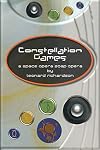
Yes, the cover is ugly – an amateurish looking bunch of buttons with alien symbols on them on a sickly sage green background. (Seemingly more blue, though, in the actual published version judging by the publisher’s website.)
Yes, the subtitle, “a space opera soap opera”, is too cute and misleading for what the book is.
Yes, the cover description is professionally done but doesn’t inspire one with confidence as to whether the book will really deliver on its promise. Frankly, I show more wouldn’t have bought this book myself.
But this is a good book. It’s a funny book and an inventive one.
Narrator Ariel Blum is an acid tongued, sarcastic narrator – not normally the kind I like to spend time with, but I’ll grant he’s realistic, and I liked all the programming and engineering jargon he laced his speech with. When aliens show up and begin mining the moon for materials to build a space station, he has the insight that if the aliens have computers they have computer games. And Ariel knows his computer games. As a game programmer and obsessive game reviewer, he wants to study alien videogames.
What he finds out in those games about alien cultures, biologies, environments, and the effect of first contact with the alien coalition known as the Constellation is the most inventive part of this story. Apart from Ian Banks’ The Player of Games and Fritz Leiber’s “Knight to Move”, I’m not personally acquainted with any stories that use games to expose elements of alien culture (and the Science Fiction Encylopedia seems to confirm this). That aliens would indeed have videogames now seems, at this point in our technological development, obvious, but only Richardson seems to have done anything significant with it.
Helping Blum is Curic, an alien whose bicameral mind has enrolled her in two conspiracies as to what to do with humans now that contact has been made. The problem is that most Constellation alien contacts find fossilized civilizations, long gone by the time the Constellation gets there. And, for the few they find alive, culture shock is a problem, and there are other threats to both human and alien cultures.
Besides Curic, Blum strikes a friendship up with the alien anthropologist Tetsuo who teaches him about alien videogames and insists, with frequently bizarre results, on teaching human college courses. His mate, Ashley, an alien paleontologist, is not sure what to do about his enthusiasms.
On the human side, there is Blum’s friend Jenny and why she is not his girlfriend, given the nature of their relationship, is unclear until the end. Blum’s friend Bai does have a girlfriend – a virtual one who resides on his phone. And Blum, after making contact on his own with the aliens, comes to the unwelcome attention of two agents of the newly organized Bureau of Extraterrestrial Affairs.
There is plenty of room for humor with cultural misunderstandings, alien-human interaction, and bizarre personal obsessions. But it isn’t a frivolous, light read. The story, told in a combination of first-person narration, blog posts, e-mails, and text messages, gets complicated. One peculiarity is that, while Blum makes some insightful comments on the attraction of human videogames, he does not, as far as I can tell, name a single real one though this story is set in the very near future. And you do have to pay attention to the various alien factions and games.
And the end is surprisingly moving as something is said about the nature of love and its place in an uncaring universe.
Don’t let the packaging put you off on this one. It’s worth reading. show less
Yes, the subtitle, “a space opera soap opera”, is too cute and misleading for what the book is.
Yes, the cover description is professionally done but doesn’t inspire one with confidence as to whether the book will really deliver on its promise. Frankly, I show more wouldn’t have bought this book myself.
But this is a good book. It’s a funny book and an inventive one.
Narrator Ariel Blum is an acid tongued, sarcastic narrator – not normally the kind I like to spend time with, but I’ll grant he’s realistic, and I liked all the programming and engineering jargon he laced his speech with. When aliens show up and begin mining the moon for materials to build a space station, he has the insight that if the aliens have computers they have computer games. And Ariel knows his computer games. As a game programmer and obsessive game reviewer, he wants to study alien videogames.
What he finds out in those games about alien cultures, biologies, environments, and the effect of first contact with the alien coalition known as the Constellation is the most inventive part of this story. Apart from Ian Banks’ The Player of Games and Fritz Leiber’s “Knight to Move”, I’m not personally acquainted with any stories that use games to expose elements of alien culture (and the Science Fiction Encylopedia seems to confirm this). That aliens would indeed have videogames now seems, at this point in our technological development, obvious, but only Richardson seems to have done anything significant with it.
Helping Blum is Curic, an alien whose bicameral mind has enrolled her in two conspiracies as to what to do with humans now that contact has been made. The problem is that most Constellation alien contacts find fossilized civilizations, long gone by the time the Constellation gets there. And, for the few they find alive, culture shock is a problem, and there are other threats to both human and alien cultures.
Besides Curic, Blum strikes a friendship up with the alien anthropologist Tetsuo who teaches him about alien videogames and insists, with frequently bizarre results, on teaching human college courses. His mate, Ashley, an alien paleontologist, is not sure what to do about his enthusiasms.
On the human side, there is Blum’s friend Jenny and why she is not his girlfriend, given the nature of their relationship, is unclear until the end. Blum’s friend Bai does have a girlfriend – a virtual one who resides on his phone. And Blum, after making contact on his own with the aliens, comes to the unwelcome attention of two agents of the newly organized Bureau of Extraterrestrial Affairs.
There is plenty of room for humor with cultural misunderstandings, alien-human interaction, and bizarre personal obsessions. But it isn’t a frivolous, light read. The story, told in a combination of first-person narration, blog posts, e-mails, and text messages, gets complicated. One peculiarity is that, while Blum makes some insightful comments on the attraction of human videogames, he does not, as far as I can tell, name a single real one though this story is set in the very near future. And you do have to pay attention to the various alien factions and games.
And the end is surprisingly moving as something is said about the nature of love and its place in an uncaring universe.
Don’t let the packaging put you off on this one. It’s worth reading. show less
This review was written for LibraryThing Early Reviewers.
What a waste of time. The entire book reads like a frustrated high school debater saying, "You're right, but I still think it would be better if I was right instead."
Richardson & Ruby "coin" the term Resource Oriented Architectures, by pointing out that it is actually a term previous used by a 2004 paper from James Snell, but they don't like the way he defined it so they are going to abscond with it and rework it.
They give very little insight into the possible benefits of their style of show more RESTful services, instead they spend a lot of time deriding "Big Style" web services, RESTful-RPC hybids, and other non-pure systems.
What I found really enlightening is how much the authors struggled to find successful RESTful examples. Everything from flickr, to Google, to del.icio.us, to Amazon have been doing it wrong and at best, the authors explain, are only half-assing it with RESTful-RPC.
All that tells me is that either the authors are the smartest guys in the world and can see what some of the web's best engineers cannot; or, REST simply isn't that compelling.
The book also simply is a failure at explaining what REST is and isn't. They make confusing and arbitrary delineations between one design decisions being RESTful and another not.
For example:
http://www.somesite.com/rest-service?method=search&q=penguins
and
http://www.somesite.com/rest-services/search?q=penguins
The first one, not RESTful, second one yes. The authors explain that the method should be the HTTP method: GET, PUT, POST, DELETE, etc.
The second URI invokes GET on the resource /search and passes some "scoping" information as "q=penguins." So for the search we can a scope of penguins.
I say that the first is the same. You invoke GET on /rest-service and pass a scope of ?method=search&q=penguins. At some point you are just going to get into semantics, especially once you get past trivial search examples.
They do similar fudging with RESTful services need to be stateless., but they use examples that must have some idea of who is doing them. If you pass the sessionID as a URI param, ok, as a cookie, you are not RESTful. Which makes sense in terms of caching servers, but on write operations, why do you want to cache?
The whole book is about proselytizing REST, usually by denouncing the false religions. It does not offer the reader a new set of skills and an honest discussion of what REST is good for and when should look elsewhere. There is not good discussion of the limitations of REST.
What do I do when the data I need to pass in exceeds the 1024 limit of a URL? What if I would want to create a set of simple atomic methods, but I have clients that would like to make coarse grain calls by bundling many requests into one call? What if I would like to allow clients to pipe these bundles request together. And what is the difference between the buzz phrase "Javascript on Demand (JoD)" and all that other JS that I just fetched from the web. show less
Richardson & Ruby "coin" the term Resource Oriented Architectures, by pointing out that it is actually a term previous used by a 2004 paper from James Snell, but they don't like the way he defined it so they are going to abscond with it and rework it.
They give very little insight into the possible benefits of their style of show more RESTful services, instead they spend a lot of time deriding "Big Style" web services, RESTful-RPC hybids, and other non-pure systems.
What I found really enlightening is how much the authors struggled to find successful RESTful examples. Everything from flickr, to Google, to del.icio.us, to Amazon have been doing it wrong and at best, the authors explain, are only half-assing it with RESTful-RPC.
All that tells me is that either the authors are the smartest guys in the world and can see what some of the web's best engineers cannot; or, REST simply isn't that compelling.
The book also simply is a failure at explaining what REST is and isn't. They make confusing and arbitrary delineations between one design decisions being RESTful and another not.
For example:
http://www.somesite.com/rest-service?method=search&q=penguins
and
http://www.somesite.com/rest-services/search?q=penguins
The first one, not RESTful, second one yes. The authors explain that the method should be the HTTP method: GET, PUT, POST, DELETE, etc.
The second URI invokes GET on the resource /search and passes some "scoping" information as "q=penguins." So for the search we can a scope of penguins.
I say that the first is the same. You invoke GET on /rest-service and pass a scope of ?method=search&q=penguins. At some point you are just going to get into semantics, especially once you get past trivial search examples.
They do similar fudging with RESTful services need to be stateless., but they use examples that must have some idea of who is doing them. If you pass the sessionID as a URI param, ok, as a cookie, you are not RESTful. Which makes sense in terms of caching servers, but on write operations, why do you want to cache?
The whole book is about proselytizing REST, usually by denouncing the false religions. It does not offer the reader a new set of skills and an honest discussion of what REST is good for and when should look elsewhere. There is not good discussion of the limitations of REST.
What do I do when the data I need to pass in exceeds the 1024 limit of a URL? What if I would want to create a set of simple atomic methods, but I have clients that would like to make coarse grain calls by bundling many requests into one call? What if I would like to allow clients to pipe these bundles request together. And what is the difference between the buzz phrase "Javascript on Demand (JoD)" and all that other JS that I just fetched from the web. show less
The book is interesting mostly for reasons, first of all it features video games as a cultural Rosetta Stone. The thesis is that one would be able to help widely different advanced cultures understand each other through a game's design and play. The other thing is that the alien races here are truly alien. They think and act differently than humans and that is a difficult idea to show in a novel.
Unfortunately the author doesn't have a consistent style or tone throughout the novel and it gets show more distracting. At first it is an epistolary story told in emails and blog posts. Then it adds "real life" sections which change the tone abruptly.
Also it morphs from a commentary about video games, alien first contact story, love story, singularity, and probably a few other things that I've forgotten. More focus on a couple of things would have made this novel stronger.
Still worth reading, but with some caution. show less
Unfortunately the author doesn't have a consistent style or tone throughout the novel and it gets show more distracting. At first it is an epistolary story told in emails and blog posts. Then it adds "real life" sections which change the tone abruptly.
Also it morphs from a commentary about video games, alien first contact story, love story, singularity, and probably a few other things that I've forgotten. More focus on a couple of things would have made this novel stronger.
Still worth reading, but with some caution. show less
Lists
Awards

You May Also Like


Associated Authors
Statistics
- Works
- 9
- Also by
- 6
- Members
- 1,153
- Popularity
- #22,290
- Rating
- 3.7
- Reviews
- 26
- ISBNs
- 25
- Languages
- 3

