
Debbie Levy
Author of I Dissent: Ruth Bader Ginsburg Makes Her Mark
About the Author
Image credit: DebbieBy Rhododendrites - Own work, CC BY-SA 4.0, https://commons.wikimedia.org/w/index.php?curid=79387537 Levy at BookExpo at the Javits Center in New York City, May 2019.
Works by Debbie Levy
Tagged
Common Knowledge
- Gender
- female
Members
Reviews
The author begins her story by showing, on one side of the 2-page spread, the future Supreme Court Justice, born in 1933, as a disputatious young girl. On the other, we see her as a much older disputatious justice. She writes:
“You could say that Ruth Bader Ginsburg’s life has been . . . one disagreement after another.
This is how Ruth Bader Ginsburg changed her life - and ours.”
She then takes us through Ruth’s childhood in Brooklyn, New York, in a neighborhood full of immigrants, show more who, while different in some ways, in one way were the same: boys were expected to grow up to do big things, and women were expected to find husbands.
Ruth’s mother disagreed, and took her to the library where she discovered stories of female heroes.
But Ruth had another obstacle to overcome: whenever they left the city, they encountered signs barring entrance to Jews (as she was), blacks, Mexicans, etc. As the author wrote: “She never forgot the sting of prejudice.”
Ruth objected to prejudice of any kind, and to the other injustices she encountered in school. She was told not to write with her left hand, even though she was left-handed. She was made to learn sewing and cooking in school, while boys got to take shop and work with tools. She wanted to sing, but her teacher said she could not carry a tune. In all of these areas, Ruth protested whenever she could.
At college, she met Marty Ginsburg, who agreed that Ruth should have the opportunity to go to law school, and eventually they married. At law school, Ruth was one of only nine women in a group of 500 men. But she tied for first place in the class.
Nonetheless, after graduation, no one would hire her. Men did not want to work with a woman [not to mention, one probably smarter than any of them]; she was a mother (law firms thought that would distract her); and she was Jewish, at a time when many firms didn’t hire Jews. Finally a judge hired her, and then she became a law professor.
Ruth also went to the Supreme Court to advocate for rights for women, arguing her first case in 1973. The author writes:
“Ruth did not win every case, but she won enough. With each victory, women and men and girls and boys enjoyed a little more equality.”
In 1993, she was appointed to the Supreme Court by President Bill Clinton, becoming the second woman ever, after Sandra Day O'Connor, to serve on that body, and the first Jewish woman ever to be appointed to the Court. She began to wear two different collars over her robes: one when she agreed with the Court’s decision, and a different one when she dissented.
The author (who, it should be noted, formerly practiced law) reports that now Justice Ginsburg is the oldest member of the Court. “Some people have said she should quit because of her age. Justice Ginsburg begs to differ.”
Throughout the book, large words are depicted over the text that illustrate the theme the author has made central to Ginsburg’s life: “I disagree!” “I object!” “I beg to differ!” “I do not concur!”
In an Afterword, the author provides additional details about Ginsburg’s life, and about the sociopolitical context in which she grew up. She also includes references to some of the cases Ginsburg argued before the Court as a lawyer, and some of the cases on which she made an impact while she has been serving as Supreme Court Justice. In addition, there is a bibliography and a list of sources.
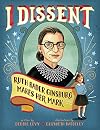
The illustrations by Elizabeth Baddeley are made with pencil, ink and watercolor, employing an entertaining “comic book” style that will appeal to kids.
Evaluation: The author said in an interview that the story of the life of Ruth Bader Ginsburg (RBG) offers the inspiring lesson that “[d]isagreeing [especially if you are a girl] does not make you disagreeable, and important change happens one disagreement at a time.” Standing up for what is right is a great lesson to impart to children. At the same time, she notes, “simply disagreeing without more isn’t really enough if you want to change your life or anyone else’s.” So on the back of the book, she includes a quote from RBG: “Fight for the things that you care about. But do it in a way that will lead others to join you.” show less
“You could say that Ruth Bader Ginsburg’s life has been . . . one disagreement after another.
This is how Ruth Bader Ginsburg changed her life - and ours.”
She then takes us through Ruth’s childhood in Brooklyn, New York, in a neighborhood full of immigrants, show more who, while different in some ways, in one way were the same: boys were expected to grow up to do big things, and women were expected to find husbands.
Ruth’s mother disagreed, and took her to the library where she discovered stories of female heroes.
But Ruth had another obstacle to overcome: whenever they left the city, they encountered signs barring entrance to Jews (as she was), blacks, Mexicans, etc. As the author wrote: “She never forgot the sting of prejudice.”
Ruth objected to prejudice of any kind, and to the other injustices she encountered in school. She was told not to write with her left hand, even though she was left-handed. She was made to learn sewing and cooking in school, while boys got to take shop and work with tools. She wanted to sing, but her teacher said she could not carry a tune. In all of these areas, Ruth protested whenever she could.
At college, she met Marty Ginsburg, who agreed that Ruth should have the opportunity to go to law school, and eventually they married. At law school, Ruth was one of only nine women in a group of 500 men. But she tied for first place in the class.
Nonetheless, after graduation, no one would hire her. Men did not want to work with a woman [not to mention, one probably smarter than any of them]; she was a mother (law firms thought that would distract her); and she was Jewish, at a time when many firms didn’t hire Jews. Finally a judge hired her, and then she became a law professor.
Ruth also went to the Supreme Court to advocate for rights for women, arguing her first case in 1973. The author writes:
“Ruth did not win every case, but she won enough. With each victory, women and men and girls and boys enjoyed a little more equality.”
In 1993, she was appointed to the Supreme Court by President Bill Clinton, becoming the second woman ever, after Sandra Day O'Connor, to serve on that body, and the first Jewish woman ever to be appointed to the Court. She began to wear two different collars over her robes: one when she agreed with the Court’s decision, and a different one when she dissented.
The author (who, it should be noted, formerly practiced law) reports that now Justice Ginsburg is the oldest member of the Court. “Some people have said she should quit because of her age. Justice Ginsburg begs to differ.”
Throughout the book, large words are depicted over the text that illustrate the theme the author has made central to Ginsburg’s life: “I disagree!” “I object!” “I beg to differ!” “I do not concur!”
In an Afterword, the author provides additional details about Ginsburg’s life, and about the sociopolitical context in which she grew up. She also includes references to some of the cases Ginsburg argued before the Court as a lawyer, and some of the cases on which she made an impact while she has been serving as Supreme Court Justice. In addition, there is a bibliography and a list of sources.
The illustrations by Elizabeth Baddeley are made with pencil, ink and watercolor, employing an entertaining “comic book” style that will appeal to kids.
Evaluation: The author said in an interview that the story of the life of Ruth Bader Ginsburg (RBG) offers the inspiring lesson that “[d]isagreeing [especially if you are a girl] does not make you disagreeable, and important change happens one disagreement at a time.” Standing up for what is right is a great lesson to impart to children. At the same time, she notes, “simply disagreeing without more isn’t really enough if you want to change your life or anyone else’s.” So on the back of the book, she includes a quote from RBG: “Fight for the things that you care about. But do it in a way that will lead others to join you.” show less
From the first page, I Dissent declares itself a celebration of resistance. Two versions of Ruth Bader Ginsburgs stand side by side—one a child wearing a hair ribbon and Mary Janes, the other a Supreme Court justice wearing a black robe and lace collar. Both raise an index finger in fiery remonstration, and words of rebellion are splashed all around them: Disagreed, Disapproved, Differed, Dissented, Objected. We know Ginsburg as a passionate voice of dissent on the Supreme Court, but show more author Debbie Levy shows us how early that seed was planted.
Tracing Ginsburg's rebellious spirit to her youth, Levy takes us back to 1940s Brooklyn (nicely rendered by illustrator Elizabeth Baddeley), where trips to the local library instill in Ginsburg a deep love of reading and introduce her to a host of female role models. We glimpse the personal milestones of law degree, marriage, and motherhood, as well as her growing awareness of discrimination in its many forms and her groundbreaking work for the equal treatment of women in the workforce. By the time Ginsburg gets to the Supreme Court, our admiration for her is unequivocal.
I think this book is well written and wonderfully accessible. It's inspiring without being preachy or didactic, and I like how Levy humanizes the larger-than-life Ginsburg with details we can relate to. (The parts about her less-than-stellar singing and cooking are a hoot, and the "snapshot" of Ginsburg and Justice Scalia parasailing together is delightful.) For young readers seeking more detail about this fascinating jurist, Levy offers an illuminating post-script as well as a selected bibliography that includes books, articles, interviews, and videos. show less
Tracing Ginsburg's rebellious spirit to her youth, Levy takes us back to 1940s Brooklyn (nicely rendered by illustrator Elizabeth Baddeley), where trips to the local library instill in Ginsburg a deep love of reading and introduce her to a host of female role models. We glimpse the personal milestones of law degree, marriage, and motherhood, as well as her growing awareness of discrimination in its many forms and her groundbreaking work for the equal treatment of women in the workforce. By the time Ginsburg gets to the Supreme Court, our admiration for her is unequivocal.
I think this book is well written and wonderfully accessible. It's inspiring without being preachy or didactic, and I like how Levy humanizes the larger-than-life Ginsburg with details we can relate to. (The parts about her less-than-stellar singing and cooking are a hoot, and the "snapshot" of Ginsburg and Justice Scalia parasailing together is delightful.) For young readers seeking more detail about this fascinating jurist, Levy offers an illuminating post-script as well as a selected bibliography that includes books, articles, interviews, and videos. show less
Speak purposefully and carry a big legal pad.
Ruth Bader Ginsburg’s 1940s Brooklyn neighborhood was filled with the traditional sights and aromas of many different immigrant cultures alongside her Jewish background, but in one respect her life was different. Her mother believed women should pursue opportunities outside the traditional ones. Ruth read voraciously in her neighborhood library, but it was on car trips with her family that she was exposed to racial and religious prejudices, show more effectively communicated with signage in the illustrations. Rebelling against writing with her right hand, the left-handed Ruth went on to earn a law degree—rare for women at that time—and teach law. She made it her mission to fight in the courts for equal rights for women and people of color. In 1993, President Bill Clinton appointed her to the Supreme Court, the first Jewish woman to sit. In her many opinions, she “sings out for equality.” Levy’s breezy text highlights Ginsburg’s childhood, schooling, family (with a husband as the cook), and career. Baddeley’s mixed-media art is colorful, lively, and retro in feel. The judicious use of large and varied display types throughout the pages emphasizes Ginsburg’s thoughts and actions, often evoking picket signs of protest.
Read this and be inspired to work for justice through the legal system. (author’s note, photographs, notes on Supreme Court cases, bibliography, quotation sources) (Picture book/biography. 7-10)
-Kirkus Review show less
Ruth Bader Ginsburg’s 1940s Brooklyn neighborhood was filled with the traditional sights and aromas of many different immigrant cultures alongside her Jewish background, but in one respect her life was different. Her mother believed women should pursue opportunities outside the traditional ones. Ruth read voraciously in her neighborhood library, but it was on car trips with her family that she was exposed to racial and religious prejudices, show more effectively communicated with signage in the illustrations. Rebelling against writing with her right hand, the left-handed Ruth went on to earn a law degree—rare for women at that time—and teach law. She made it her mission to fight in the courts for equal rights for women and people of color. In 1993, President Bill Clinton appointed her to the Supreme Court, the first Jewish woman to sit. In her many opinions, she “sings out for equality.” Levy’s breezy text highlights Ginsburg’s childhood, schooling, family (with a husband as the cook), and career. Baddeley’s mixed-media art is colorful, lively, and retro in feel. The judicious use of large and varied display types throughout the pages emphasizes Ginsburg’s thoughts and actions, often evoking picket signs of protest.
Read this and be inspired to work for justice through the legal system. (author’s note, photographs, notes on Supreme Court cases, bibliography, quotation sources) (Picture book/biography. 7-10)
-Kirkus Review show less
Ruth Bader Ginsburg is best known for her work in the Supreme Court, but her career of dissenting began when she was a young girl. Growing up as Jewish American in the 1950's, Ruth Bader Ginsburg dealt with naysayers about the type of woman she should be and what she was capable of. Throughout her entire life, she proved these people wrong and became a powerful attorney and justice. Her story provides any person who has been told to confine to societal norms the confidence to dissent to that show more and create their own path. Levy's story telling and Baddeley's illustrations are empowering, making this the perfect book to share with students, or anyone for that matter. show less
Lists
Awards


You May Also Like


Associated Authors
Statistics
- Works
- 35
- Members
- 2,283
- Popularity
- #11,242
- Rating
- 4.3
- Reviews
- 108
- ISBNs
- 77
- Languages
- 1

