
Ann Clare LeZotte
Author of Show Me a Sign
About the Author
Image credit: via Library of Congress
Series
Works by Ann Clare LeZotte
Tagged
Common Knowledge
- Birthdate
- 1969
- Gender
- female
- Education
- Sarah Lawrence College
- Places of residence
- Syosset, New York, USA
Gainesville, Florida, USA - Associated Place (for map)
- USA
Members
Reviews
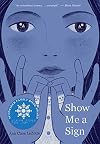
This is another book on the SLJ Best Books of the Year list, and unlike The Magnificent Monsters of Cedar Street, it really is! I could not put the book down. This book takes place in the early 1800s on Martha's Vineyard and is told by Mary Lambert, who is deaf. In fact, as many as 1 in 6 of the residents of her town is deaf, a phenomenon that occurs worldwide in small, isolated communities where genetic variations are passed down and passed on. As with all of those communities, they develop show more their own sign language - in this case MVSL or Martha's Vineyard Sign Language - which is "spoken" fluently by the deaf and hearing alike. Mary's description of life on her island is charming and idyllic, but her family is mourning the accidental death of Mary's brother George, and there are tensions and conflict between the English settlers and the native Wampanoag people over land ownership and religion. These serious and complex issues are handled with skill and sensitivity. A little heavier hand is used to show the prejudices and misunderstandings about the deaf off of the island. This is brought terrifyingly to life with the arrival of a young scientist to the island, who is determined to find out the source of the "infirmity" afflicting the island's deaf. He takes soil and water samples, grills the women about the tightness of their stays during pregnancy, and ultimately takes Mary as a "live specimen" and subjects her to cruel treatment and experiments. Mary must struggle to save herself while also contemplating for the first time the nature of a disability and whether it makes the disabled less than full people. Though the book is set over 200 years ago the issues are as relevant as they ever were. This book is terrific and fascinating. show less

In this novel in verse, Effie, who is Deaf, and her older sister Deja have been sent to live with their dad in a trailer. Deja misses living with Mom and Nick and going to school with her friend Cass, but Effie doesn't feel truly safe in either place: no one in her family speaks her first language, ASL, and only Deja usually bothers to communicate with her in writing. Miss Kathy, Effie's interpreter at school, builds a case to gain custody of Effie, at first temporarily and then permanently. show more Meanwhile, Effie makes friends at school with Cait, who has CP and uses a wheelchair; Cait understands Effie's concern for the deer population that is being displaced by new construction, and Effie helps Cait stand up for herself to an aide who won't give her any privacy.
Quotes
I'm repeating a grade
because of my reading
scores, but libraries
don't judge.
They reflect
the quietness
inside me. (26)
...No
one here speaks
my language. I feel
like a bird put back
in its cage, so it can't
sing anymore. (41)
I know [Cait is] also learning for me.
Why has my family never cared
about that? (92)
I have shut myself,
like a clam, a drawer,
a door, the fridge,
my eyes and fists
shut tight. (110)
It hurts a lot
to be broken apart
like puzzle pieces
in front of strangers
who will decide
the rest of our lives. (184)
I made that happen.
Speaking up
is important
in any language. (199) show less
Quotes
I'm repeating a grade
because of my reading
scores, but libraries
don't judge.
They reflect
the quietness
inside me. (26)
...No
one here speaks
my language. I feel
like a bird put back
in its cage, so it can't
sing anymore. (41)
I know [Cait is] also learning for me.
Why has my family never cared
about that? (92)
I have shut myself,
like a clam, a drawer,
a door, the fridge,
my eyes and fists
shut tight. (110)
It hurts a lot
to be broken apart
like puzzle pieces
in front of strangers
who will decide
the rest of our lives. (184)
I made that happen.
Speaking up
is important
in any language. (199) show less
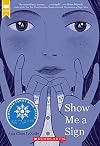
"A young girl living on Martha’s Vineyard in 1805 doesn’t think her community of Deaf and hearing signers is special until the day the hearing world violently intrudes.
In present-tense narrator Mary Lambert’s life, it is easy to forget who is Deaf and who is hearing. Everyone she knows uses sign language, and a quarter of her village is Deaf. Mary only learns how different her community is when a young scientist with disdain for the Deaf and no understanding of their culture arrives, show more seeking to discover the cause of their “infirmity”—using Mary as an experimental subject. LeZotte weaves threads of adventure, family tragedy, community, racism, and hearing people’s negative assumptions about Deaf people into a beautiful and complex whole. Mary overcomes her own ordeal with the support of her community, but in the process she discovers that there is no silver bullet for the problems and prejudices of the world. There is no hollow inspirational content to be found in this tale, even where another author may have fallen into the trap. Though Mary is White of English descent, LeZotte acknowledges the racial tensions among the English, Black, Irish, and Wampanoag residents of Martha’s Vineyard, creating a dynamic that Mary interacts within but cannot fix. Each element of the narrative comes together to create an all-too-rare thing: an excellent book about a Deaf person. A closing note provides further information on Martha’s Vineyard Sign Language and the history of both Martha’s Vineyard and Deaf education.
A vivid depiction of Deaf community along with an exciting plot and beautiful prose make this a must-read. (Historical fiction. 8-14)" A Kirkus Starred Review, www.kirkusreviews.com show less
In present-tense narrator Mary Lambert’s life, it is easy to forget who is Deaf and who is hearing. Everyone she knows uses sign language, and a quarter of her village is Deaf. Mary only learns how different her community is when a young scientist with disdain for the Deaf and no understanding of their culture arrives, show more seeking to discover the cause of their “infirmity”—using Mary as an experimental subject. LeZotte weaves threads of adventure, family tragedy, community, racism, and hearing people’s negative assumptions about Deaf people into a beautiful and complex whole. Mary overcomes her own ordeal with the support of her community, but in the process she discovers that there is no silver bullet for the problems and prejudices of the world. There is no hollow inspirational content to be found in this tale, even where another author may have fallen into the trap. Though Mary is White of English descent, LeZotte acknowledges the racial tensions among the English, Black, Irish, and Wampanoag residents of Martha’s Vineyard, creating a dynamic that Mary interacts within but cannot fix. Each element of the narrative comes together to create an all-too-rare thing: an excellent book about a Deaf person. A closing note provides further information on Martha’s Vineyard Sign Language and the history of both Martha’s Vineyard and Deaf education.
A vivid depiction of Deaf community along with an exciting plot and beautiful prose make this a must-read. (Historical fiction. 8-14)" A Kirkus Starred Review, www.kirkusreviews.com show less
Set in Martha's Vineyard and Boston in 1805-1806, SHOW ME A SIGN is narrated by eleven-year-old Mary, a Deaf girl in the town of Chilmark. Mary's father is also Deaf; her mother is hearing, but, like everyone else on the island, also signs. (Mary's older brother, George, died in an accident; he was hearing also.) For Mary, the fact that everyone communicates in sign is not extraordinary, but when Andrew Noble sails in, she realizes that elsewhere, deafness is considered a disability. Andrew show more has no respect for Deaf people, makes no effort to communicate with them - either in sign or writing - and part of his "research" into the question of why Deafness is so predominant on the island requires a "live specimen." Part II of the narrative follows Mary's kidnapping and her time in Boston; finally, after many weeks of being able to communicate with anyone, she is able to write a letter, which helps her escape. Mary's view of the world outside her island gives her more perspective - not just on the difference between Deaf and hearing people, but into all kinds of prejudice (white settlers vs. the Wampanoag people and formerly enslaved people, for example).
Quotes
"All beliefs are important to the believers." (Thomas to Mary, 127)
It's odd how an antagonist back home could be a welcome friend elsewhere. (176) show less
Quotes
"All beliefs are important to the believers." (Thomas to Mary, 127)
It's odd how an antagonist back home could be a welcome friend elsewhere. (176) show less
Lists
Awards


You May Also Like


Statistics
- Works
- 8
- Members
- 927
- Popularity
- #27,686
- Rating
- 3.7
- Reviews
- 69
- ISBNs
- 31
- Languages
- 1