
Karen Levine (1) (1955–)
Author of Hana's Suitcase
For other authors named Karen Levine, see the disambiguation page.
Works by Karen Levine
Tagged
Common Knowledge
- Birthdate
- 1955
- Gender
- female
- Occupations
- radio producer
- Organizations
- Canadian Broadcasting Corporation
- Awards and honors
- Peabody Award for Excellence in Broadcasting
Sydney Taylor Book Award
Norma Fleck Award for Canadian Children’s Non-Fiction - Relationships
- Enright, Micheal (partner)
- Nationality
- Canada
- Birthplace
- Ottawa, Ontario, Canada
- Places of residence
- Toronto, Ontario, Canada
- Associated Place (for map)
- Ontario, Canada
Members
Reviews
I don't think I have ever cried so hard reading something before. This story was written so beautifully, and it was very touching to see the photos and documents. Author Levine wrote this book in a really unique way, switching back and fourth from Fumiko's side of searching to learn more about Hana Brady, to putting the readers into Hana Brady's experience. It was transitioning back and fourth, and I thought it was done very well. As a reader, writing the book like so gives me a chance to show more follow along on Fumiko's journey, as well as Hana's journey, without separating them into two separate stories. It was not until the end that we as readers find out that Hana's brother George was the one retelling all of Hana's events, and that just made it that much more touching. show less
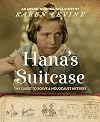
This book has really cool merging story lines in an almost perfectly alternating style. It begins in Tokyo in 2000 when Fumiko Ishioka, the director of a children's museum in Japan, sets on a journey to discover more about a little girl's name on a suitcase recovered from the Holocaust. She wants to use it as a student-based object of inquiry to help children in Tokyo learn about the tragedies which occurred during the Holocaust so they can avoid anything similar in the future. Hana Brady, a show more little girl in Europe, has blonde hair and blues eyes, but her family is (unorthodox) Jewish. She has an older brother, George, and they live with their parents who seem rich but are very kind souls and a friend to everyone. They take private lessons, but they also feed the hungry. They own a store but work hard to keep it running. Later, the war comes, but they don't leave. Meanwhile, Fumiko is writing museums across the world, trying to find out more about Hana's life. which is slowly revealed in the story as she finds more on Hana's personal life. She gets rejected time after time but becomes more determined because her students are becoming more invested in Hana as they discover more over time. Hana and George's parents get taken a few months apart before it was their turn to split. They go to an orphanage-like center where food is scarce and conditions aren't great. After a while, Hana and George finally reunite. Through this, Fumiko has been in correspondence with several museums and has had some success up to this point. She gets a chance to fly to London for a Holocaust seminar. From there, she flies and drives a few hours away to the Terezin Ghetto museum in then Czechoslovakia/ modern day Czech Republic, or Czechia, only to find the museum is closed for holiday. Tough luck. Unexpectedly, a stroke of luck occurs when Fumiko is caught roaming through the closed museum in search of answers. She finds Ludmila. They discover more about Hana and her family while working together. This review is getting lengthy, so I'm going to wrap it up. I think Karen Levine told the two interdependent stories in a really cool way as readers are often left on cliffhangers, leaving them captivated and craving more. Both of these stories are significant, and it certainly takes one to tell the other, and they're nearly one in the same. I loooooved this book! show less
Karen Levine begins the story in a Holocaust Museum in Tokyo, Japan in 2000. She describes a suitcase that is "very ordinary-looking", humanizing Hana and addressing she was really a normal person, just like any of us, who went through Hell on Earth at Auschwitz during the Holocaust. The story then moves back to the 1930's in Czechoslovakia, continuing to point out the humanity of the millions of victims who were affected by the Holocaust. The story continues this style of flipping back and show more forth between Fumiko Ishioka as she researches the suitcase in 2000 and Hana's life in Czechoslovakia in the 1930s. Karen Levine also added real photo's of Hana and her brother, George, once again adding a degree of humanity and the concept that this was a real person who lost her life, along with over six million others, in what was nothing more than a mad man's attempted genocide of an entire race. Karen Levine told the story focusing in on the mindsets of the children, Hana in particular, as they heard the adults talking about leaving before they no longer could and how no one seemed to want to leave, a sad truth for many Jewish people at the time, including my own family. The story continues the jump from Hana's world changing for the worse during World War II and Mrs. Fumiko in 2000 as she continues to research and learn more about the identity of Hana and the importance of her suitcase. I was completely sobbing when Hana's mother was arrested by the Gestapo and she tells her children before she leaves, "I will write...will you write back to me?" It was such a simple question, but it carried so much more weight than the mother ever could have imagined. Mrs. Fumiko's drive throughout the book to find out everything she could about Hana and the short life she lived just emphasized the importance of remembering that 6 million isn't just a number, it is 6 million sisters, fathers, PEOPLE who lost their lives in one of the most horrifying times of modern human history. Honestly, this book was really hard for me to read, but so was the case with books like, "Night", "Number the Stars", or "The Diary of Anne Frank". These are extremely difficult books to read, but their importance to remembering history and preventing such atrocities from occurring again have never been so important with all of the hate and fear that some people are trying to fill the world with.
I was fighting back tears coming into this book and I only made it to page 18 when they mentioned Kristallnacht, better known as "the Night of the Broken Glass", and I couldn't hold back the tears anymore. Hana's story followed a similar path to the one my grandmother and her parents narrowly avoided. My Bubbe (yiddish for Grandma) and her parents were the only members of my family who survived the Holocaust. Before she passed away, my Bubbe used to tell me about how she remembered writing letters back and forth to her family members, especially her cousin Joseph, who I was named after, who were unable or not willing to escape Poland when her family left because her parents saw what was happening in Germany. The letters, however, abruptly stopped coming one day and my Bubbe never heard from the rest of her family again. That was in 1939. My family spent nearly half a century working with Yad Vashem and other agencies trying to find any trace of our missing family members, which with the highly meticulous notes taken by the Nazis, should have been possible, but we were never able to find any answers, even in the form of death certificates. One of the last times spoke to my Bubbe, I asked her to tell me everything she could about my family in the Holocaust, she told me that she was told that they probably never even made it to the trains; how they were more than likely just part of a mass grave behind the small village they lived in in Poland. show less
I was fighting back tears coming into this book and I only made it to page 18 when they mentioned Kristallnacht, better known as "the Night of the Broken Glass", and I couldn't hold back the tears anymore. Hana's story followed a similar path to the one my grandmother and her parents narrowly avoided. My Bubbe (yiddish for Grandma) and her parents were the only members of my family who survived the Holocaust. Before she passed away, my Bubbe used to tell me about how she remembered writing letters back and forth to her family members, especially her cousin Joseph, who I was named after, who were unable or not willing to escape Poland when her family left because her parents saw what was happening in Germany. The letters, however, abruptly stopped coming one day and my Bubbe never heard from the rest of her family again. That was in 1939. My family spent nearly half a century working with Yad Vashem and other agencies trying to find any trace of our missing family members, which with the highly meticulous notes taken by the Nazis, should have been possible, but we were never able to find any answers, even in the form of death certificates. One of the last times spoke to my Bubbe, I asked her to tell me everything she could about my family in the Holocaust, she told me that she was told that they probably never even made it to the trains; how they were more than likely just part of a mass grave behind the small village they lived in in Poland. show less
From nearly no information at all, a determined museum director, Fumiko Ishioka, finds the identifying information behind a child's suitcase that tells an incredibly sad and important story. The suitcase, Fumiko finds out, belonged to a young Czech Jewish girl named Hana Brady, who during World War II was deported to a Jewish ghetto and then, ultimately, died in Auschwitz. The vivid re-telling of Hana and her family's life is very well-written, and moves quickly. Complemented by the show more intriguing tale of Fumiko's search and the group of youth who are invested in Fumiko's work, this book feels hopeful, even amidst the tragedy it recounts. I felt it was unfortunate that the book's introduction lists the Holocaust as the "worst example of genocide in human history", when it is arguable that the genocide of Indigenous people in Central and South America (an estimated 55 million people) and the genocide of enslaved Africans (an estimated 8 to 10 million people) were in fact worse. That is not to decrease the urgency of learning about the Holocaust -- in fact, I think those figures prove that learning about Genocide is incredibly important. But, I would like to see these atrocious mass killings of people of color also considered to be genocides and included in contexts that discuss the Holocaust. show less
Lists
Awards


You May Also Like


Associated Authors
Statistics
- Works
- 3
- Members
- 1,831
- Popularity
- #14,053
- Rating
- 4.5
- Reviews
- 371
- ISBNs
- 92
- Languages
- 13
- Favorited
- 1