

Mary Szybist
Author of Incarnadine: Poems
Works by Mary Szybist
Associated Works
Family Resemblance: An Anthology and Exploration of 8 Hybrid Literary Genres (2015) — Contributor — 27 copies
Tagged
Common Knowledge
- Birthdate
- 1970-09-20
- Gender
- female
- Education
- University of Virginia (BA|1992)
University of Virginia (MT|1994)
Iowa Writers' Workshop (MFA|1996) - Nationality
- USA
- Birthplace
- Williamsport, Pennsylvania, USA
- Places of residence
- Pennsylvania, USA
Portland, Oregon, USA - Associated Place (for map)
- Pennsylvania, USA
Members
Reviews
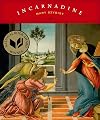
Disappointed to find that most of these National Book Award winning poems didn't register much with me. She changes form a good deal, using found text poetry, shape poetry, prose poetry, etc., which probably impresses judges but tends to distract me, and I dislike found poetry anyway (stop doing that, people!). And the personal poems here I found dull.
But! This collection is named for a series of poems around the Annunciation, and "Conversion Figure" and "Annunciation in Play" I really show more liked. The first is told by the angel Gabriel:
But! This collection is named for a series of poems around the Annunciation, and "Conversion Figure" and "Annunciation in Play" I really show more liked. The first is told by the angel Gabriel:
I spent a long time fallingThe shattering stars reflect the violently disruptive event that God taking on human form would be, and the clouds with no confetti foreshadow the humble birth, the dangerous life.
toward your slender, tremulous face -
a long time slipping through stars
as they shattered, through sticky clouds
with no confetti in them.
Girl on the lawn without sleeves, knees bare even of lotion,Bearing the son of God would surely trigger a massive crisis of self-image, radically changing how you view yourself and your role in the world. In "Annunciation in Play", Szybist suggests Mary would, in self-defense, try to delay this encounter that would necessitate such hard work:
time now to strip away everything
you try to think about yourself.
-into the 3rd second, the girlBut the girl knows she cannot put off this meeting with God's angel for long.
holds on, determined not to meet his gaze-
she swerves her blue sleeve,
closes down the space,
while his eyes are intent, unwilling
to relent and
late into the 5th second they are still
fighting on
but the delayIt's a touching poem of the hesitation, fear, reluctance we can imagine Mary would have felt, about to lose her current sense of self and idealized life, in the moments before she replied, "be it unto me according to thy word." show less
is what she has
before his expert touch
swings in, before
she loses her light, clean edges, before she
loses possession-
before they look at each other.
Welp, this was a set of poems that hit me right in my past as a medievalist who worked on Middle English mystics as well as someone who loves gorgeous language and experiments in form. I especially loved "Conversion Figure", "Hail", and "Update on Mary" though I think my favorite lines are in "Invitation" - "Angels of prostitution and rain/you of sheerness and sorrow/you who take nothing/breathe into me". I can think of at least one person I know who is also a poet who should read this show more immediately if she hasn't. show less
he poems in Mary Szybist’s Incarnadine* consider the collision of the ordinary and the otherworldly (as figured in the Annunciation) from a multitude of angles. With their varied forms and fierce fragility, the poems gracefully explore the relationship between the spirit and the body, motherhood and childlessness, discovery and loss, violence and desire, the sacred and the secular.
Incarnadine
What surprised me most about the collection was the striking range of forms that Ms. Szybist show more employs. Incarnadine includes a poem in terza rima, a concrete poem (lines densely radiating from a circular negative space, appearing like a sun), prose poems, a poem composed with pieces snipped from Natalie Angier’s Woman: An Intimate Geography and Henry James’s The Portrait of a Lady, a poem as a diagrammed sentence, an abecedarian, near-sonnets, hymn-like structures — all in seventy-two pages.
This formal variety enhances the collection’s fresh approach to the subject of the Annunciation; the scene is replayed in new contexts many times over. For example, in “Annunciation in Nabokov and Starr,” excerpts from Lolita and The Starr Report fill out an annunciation account from the angel’s point of view, while later, in “Annunciation: Eve to Ave,” Eve explains her bewilderment at the discovery that the man who brought her news was not a man at all. After this poem’s especially playful diction, the last lines rise to the surface in all their parenthetical heaviness: “(But I was quiet, quiet as / eagerness–that astonished, dutiful fall.).”
As the book goes on, and the annunciations stack up, they become more and more ensnared in violation, which, it appears, is the underside of this particular adumbration; spirit does not instantiate in flesh without violence.
Ms. Szybist’s verse is elegant, sometimes deceptively simple, and poised, balancing darkness and transcendence, incarnadine and cerulean. Highly recommended reading.
Incarnadine won the National Book Award for poetry in 2013
*My thanks to Graywolf Press for sending me a review copy of Incarnadine. show less
Incarnadine
What surprised me most about the collection was the striking range of forms that Ms. Szybist show more employs. Incarnadine includes a poem in terza rima, a concrete poem (lines densely radiating from a circular negative space, appearing like a sun), prose poems, a poem composed with pieces snipped from Natalie Angier’s Woman: An Intimate Geography and Henry James’s The Portrait of a Lady, a poem as a diagrammed sentence, an abecedarian, near-sonnets, hymn-like structures — all in seventy-two pages.
This formal variety enhances the collection’s fresh approach to the subject of the Annunciation; the scene is replayed in new contexts many times over. For example, in “Annunciation in Nabokov and Starr,” excerpts from Lolita and The Starr Report fill out an annunciation account from the angel’s point of view, while later, in “Annunciation: Eve to Ave,” Eve explains her bewilderment at the discovery that the man who brought her news was not a man at all. After this poem’s especially playful diction, the last lines rise to the surface in all their parenthetical heaviness: “(But I was quiet, quiet as / eagerness–that astonished, dutiful fall.).”
As the book goes on, and the annunciations stack up, they become more and more ensnared in violation, which, it appears, is the underside of this particular adumbration; spirit does not instantiate in flesh without violence.
Ms. Szybist’s verse is elegant, sometimes deceptively simple, and poised, balancing darkness and transcendence, incarnadine and cerulean. Highly recommended reading.
Incarnadine won the National Book Award for poetry in 2013
*My thanks to Graywolf Press for sending me a review copy of Incarnadine. show less
Incarnadine truly made me feel creeped out at the idea of the annunciation (thankfully). Szybist has a way of communicating experiences that I (the male reader) could never be privy to and gathers the threads of history, theology, identity, and womanhood and creates such powerful poems as she threads them together.
Lists
Awards


You May Also Like


Associated Authors
Statistics
- Works
- 3
- Also by
- 3
- Members
- 306
- Popularity
- #76,933
- Rating
- 3.7
- Reviews
- 10
- ISBNs
- 4
- Favorited
- 1