
John Leland (4) (1959–)
Author of Hip: The History
For other authors named John Leland, see the disambiguation page.
About the Author
John Leland is a reporter and author, born in 1959. He is a graduate of Columbia College. His career includes senior editor at Newsweek, editor in chief at Details, music critic at Newsday, and an original columnist at SPIN magazine. In 2000 he began working at the New York Times, covering a wide show more range of topics as a Metro reporter. He is the author of Hip: The History (2004), Why Kerouac Matters: The Lessons of 'On the Road' (2007), and Happiness Is a Choice You Make: Lessons from a Year among the Oldest Old (2018). (Bowker Author Biography) show less
Works by John Leland
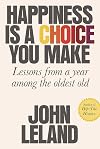
Happiness Is a Choice You Make: Lessons from a Year Among the Oldest Old (2018) 217 copies, 12 reviews
Why Kerouac Matters: The Lessons of On the Road (They're Not What You Think) (2007) 162 copies, 2 reviews
Associated Works
And It Don't Stop: The Best American Hip-Hop Journalism of the Last 25 Years (2004) — Contributor — 55 copies
Tagged
Common Knowledge
- Birthdate
- 1959
- Gender
- male
- Organizations
- New York Times
Members
Reviews
As I creep closer to this age group and have a mother who is turning 98 soon, I thought it would be interesting to read a study the journalist John Leland made of one of the fastest growing age groups in America, those between 85 and 94. What an intriguing study as Leland chose a cross mix of women/men, well-off/disadvantaged, religious/not so much and included a racial mix of black, Chinese, immigrants, etc. Of course with only 6 participants this is not a scientific study but it did probe show more many pertinent ideas on how the oldest of the old are viewed and how they view themselves. His year long visits to these six participants revealed that in spite of many pain causing infirmities, limited mobility, and lack of family support that the individuals always found what seemed to be simple things to make life worth living. He makes the point that none of us know what will sustain us when we get older and that those who point out the elderly don't have much quality of life make these assumptions from a younger person's point of view. Leland's own elderly mother was often mentioned and this portrayed how hard it is for family members to really listen to the wants and needs of their aged relatives as Leland readily admits. He also admits that having a purpose in life is probably one of the most important traits we can have but that purpose might be as simple as enjoying as much as we can where we find ourselves at any point in time. Great ideas but I sometimes wondered how I would have interpreted the participants views and statements. I didn't always agree that their viewpoints were interpreted correctly by Leland. Also this is not a book about those in excruciating pain such as with cancer which is another topic entirely. Even so I recommend this book to anyone interested in a view that yes we lose many things as we age but still as Jonas, one of the participants says, "Have you ever thought about how amazing, really amazing, life is?" show less
In 2015, reporter John Leland spent a year interviewing six seniors age 85 and older (the "oldest old") for a series of articles that appeared in the New York Times. Here, he expands on those articles and the lessons he, as a middle-aged man, hopes to take from each of them - including the greater contentment that comes with age.
The first half of the book is wide-ranging, dealing in broad strokes nad grand themes such as gratitude and love in old age. Leland includes quotes from "his" show more seniors as well as recent studies on the topics he's addressing. The second half is "Lessons from" Fred Jones, John Sorenson, Helen Moses, Ping Wong, Ruth Willig and Jonas Mekas. These seniors are a diverse group in background and ethnicity, and they had some insights on love of life and acceptance of death. The book didn't quite live up to my expectations. Perhaps it was the format - because of that division, I found it repetitive. But I think part of it was that Leland's original bias was to think of how much you lose in old age, leading to a revelation that in fact, despite loss, older people are still happy. I've had the privilege of knowing my maternal grandparents well into adulthood, and both reached their 80s (my grandmother has since passed away). So I never had the negative associations with old age that Leland did: I saw them losing some abilities, but overall being quite happy, having purpose and reason to get up in the morning. And, after my grandmother passed away, I've seen my grandfather stay motivated by playing cards at the senior center and seeing a lady friend on a regular basis. Maybe I was just expecting too much from the book. It may be of interest to people who enjoyed Tuesdays with Morrie or Being Mortal. And learning about Jonas Mekas alone was worth the read. show less
The first half of the book is wide-ranging, dealing in broad strokes nad grand themes such as gratitude and love in old age. Leland includes quotes from "his" show more seniors as well as recent studies on the topics he's addressing. The second half is "Lessons from" Fred Jones, John Sorenson, Helen Moses, Ping Wong, Ruth Willig and Jonas Mekas. These seniors are a diverse group in background and ethnicity, and they had some insights on love of life and acceptance of death. The book didn't quite live up to my expectations. Perhaps it was the format - because of that division, I found it repetitive. But I think part of it was that Leland's original bias was to think of how much you lose in old age, leading to a revelation that in fact, despite loss, older people are still happy. I've had the privilege of knowing my maternal grandparents well into adulthood, and both reached their 80s (my grandmother has since passed away). So I never had the negative associations with old age that Leland did: I saw them losing some abilities, but overall being quite happy, having purpose and reason to get up in the morning. And, after my grandmother passed away, I've seen my grandfather stay motivated by playing cards at the senior center and seeing a lady friend on a regular basis. Maybe I was just expecting too much from the book. It may be of interest to people who enjoyed Tuesdays with Morrie or Being Mortal. And learning about Jonas Mekas alone was worth the read. show less
John Leland wrote a well-received newspaper series about "the oldest old," people who are eight-five and up. "Happiness is a Choice You Make" originated from his year-long interaction with six individuals in their eighties and nineties. Some are ill, while others are relatively healthy, if you discount the aches and pains that afflict everyone sooner or later. Ninety-one year old John Sorenson has lived for forty-eight years on the Upper West Side of Manhattan, and still mourns his late show more partner, Walter. Eighty-seven year old Frederick Jones, who is diabetic and has a weak heart, lives alone in a walk-up (he has difficulty navigating stairs). Helen Moses, ninety, lives in a Bronx nursing home, and is thrilled that her fellow resident, Howie, whom she cares for deeply, is there for her. Ping Wong lives comfortably in a low-rent apartment in Gramercy Park and has a home attendant coming in to assist her. Ninety-one year old Ruth Willig is in an assisted living facility in Brooklyn, New York. Finally, Jonas Mekas, ninety-two, is a filmmaker and writer who is energetic enough to remain independent and active.
Although "Happiness is a Choice" is engrossing, timely, and even darkly humorous, the writing could have been sharper, more concise, and less meandering. Still, Leland's work of non-fiction is worth looking at, for several reasons. Since life expectancy has gone up markedly, we should think about what it would be like to be octogenarians and even nonagenarians. How would we ward off loneliness; pay our bills; run a household; keep track of our medications; deal with relatives; cope with our dwindling physical capabilities; and find joy? The author does not sugarcoat the negatives. Some of his interviewees candidly state that they have had it, and are ready to call it quits. However, there are an ample number of upbeat messages here: Live in the moment, but cherish your memories; learn to give and take graciously; and try to adapt to the changes that come with advanced age. To sum up: "We can focus on what we've lost or the life we have now."
"Happiness is a Choice You Make" is sometimes painful to read. It reminds us that if we are destined to live for many decades, we may be in for some challenging times, medically and psychologically. Still, it is enlightening to learn from people who have been around long enough to see the big picture. The most successful among the elders engage in pleasurable activities, maintain a certain amount of optimism, and stick with those relationships that are emotionally nurturing. An expert on aging warns that "social isolation kills," so staying involved with friends and loved ones is a key to boosting one's morale and remaining invested in the future. show less
Although "Happiness is a Choice" is engrossing, timely, and even darkly humorous, the writing could have been sharper, more concise, and less meandering. Still, Leland's work of non-fiction is worth looking at, for several reasons. Since life expectancy has gone up markedly, we should think about what it would be like to be octogenarians and even nonagenarians. How would we ward off loneliness; pay our bills; run a household; keep track of our medications; deal with relatives; cope with our dwindling physical capabilities; and find joy? The author does not sugarcoat the negatives. Some of his interviewees candidly state that they have had it, and are ready to call it quits. However, there are an ample number of upbeat messages here: Live in the moment, but cherish your memories; learn to give and take graciously; and try to adapt to the changes that come with advanced age. To sum up: "We can focus on what we've lost or the life we have now."
"Happiness is a Choice You Make" is sometimes painful to read. It reminds us that if we are destined to live for many decades, we may be in for some challenging times, medically and psychologically. Still, it is enlightening to learn from people who have been around long enough to see the big picture. The most successful among the elders engage in pleasurable activities, maintain a certain amount of optimism, and stick with those relationships that are emotionally nurturing. An expert on aging warns that "social isolation kills," so staying involved with friends and loved ones is a key to boosting one's morale and remaining invested in the future. show less
What a lovely book about being very old.
I recently read an article by John Leland and it was so well written I decided to see if he had written any books. I found this one, and it is lovely.
He spent a year with six very different, very old people, and wrote about what he learned from them. I learned a great deal from them in the process myself.
I am not very old yet, but I am old enough to see my life changing already, and this book tells me it’s not what I imagine.
A clear, candid, show more thoughtful book that was a pleasure to read. Recommended. show less
I recently read an article by John Leland and it was so well written I decided to see if he had written any books. I found this one, and it is lovely.
He spent a year with six very different, very old people, and wrote about what he learned from them. I learned a great deal from them in the process myself.
I am not very old yet, but I am old enough to see my life changing already, and this book tells me it’s not what I imagine.
A clear, candid, show more thoughtful book that was a pleasure to read. Recommended. show less
Lists
culture (1)
Awards

You May Also Like


Associated Authors
Statistics
- Works
- 3
- Also by
- 1
- Members
- 748
- Popularity
- #33,982
- Rating
- 3.6
- Reviews
- 15
- ISBNs
- 55
- Languages
- 2