
Tillie Olsen (1912–2007)
Author of Tell Me a Riddle
About the Author
Born in Omaha, Nebraska, Tillie Olsen received only a high school education. But because of her success as a writer, she has served as a visiting lecturer and writer-in-residence at a number of colleges, including Amherst College, Stanford University, and MIT. She has received numerous awards for show more her work, including an O. Henry Award for best American short story (1961) and a Guggenheim fellowship (1976-77). The widely anthologized "I Stand Here Ironing" (1961), in the circumstances of its publication and its voice and subject, embodies the concerns of Olsen's literary career. In this monologue of a woman reviewing her relationship to her 19-year-old daughter, Olsen suggests the themes of the blighted potential and wasted talent of working-class women that have preoccupied her throughout her career. As she irons, the woman mournfully meditates on how she may have prevented her daughter's full "flowering" - a flowering that she herself has never had. Most intensely recalled is how she had to leave her infant daughter to go to work after her husband abandoned them. A mother herself by age 19, Olsen did not publish her first work until she was in her forties (though she began to write in her teens) when the pressures of supporting herself and her four children lessened and she felt she had written something worthy of publication. At times considered unrelenting in the despair that she attributes to her characters, Olsen's style is marked by a rhythmic, hypnotic lyricism and an evocative use of language. Olsen later published an introductory essay to the reprint of Rebecca Harding Davis's nineteenth-century novel, Life in the Iron Mills. In Silences (1978), a collection of essays, she addresses directly the various cultural, political, and economic forces that silence women writers and writers from working-class or minority backgrounds. (Bowker Author Biography) show less
Works by Tillie Olsen
The Riddle of Life and Death: Tell Me a Riddle and The Death of Ivan Ilych (Two By Two) (2007) 18 copies, 1 review
Olsen, Tillie Archive 1 copy
No title 1 copy
Olsen Tillie 1 copy
Yonnonido From the Thirties 1 copy
Associated Works
Literature: An Introduction to Fiction, Poetry, and Drama (1995) — Contributor, some editions — 1,016 copies, 7 reviews
Points of View: An Anthology of Short Stories, Revised & Updated Edition (1995) — Contributor — 443 copies, 7 reviews
You've Got to Read This: Contemporary American Writers Introduce Stories that Held Them in Awe (1994) — Contributor — 414 copies, 3 reviews
Wise Women: Over Two Thousand Years of Spiritual Writing by Women (1996) — Contributor — 230 copies, 1 review
An American Album: One Hundred and Fifty Years of Harper's Magazine (2000) — Contributor — 145 copies, 1 review
Writing Women's Lives: An Anthology of Autobiographical Narratives by Twentieth-Century American Women Writers (1994) — Contributor — 128 copies, 3 reviews
The Woman Who Lost Her Names: Selected Writings of American Jewish Women (1980) — Contributor — 57 copies
The Haves and Have Nots: 30 Stories About Money and Class in America (1999) — Contributor — 37 copies
Fifty Years of the American Short Story from the O. Henry Awards 1919-1970 (1970) — Contributor — 17 copies, 1 review
West Coast Fiction: Modern Writing from California, Oregon, and Washington (1979) — Contributor — 8 copies, 1 review
Fifty Years of the American Short Story from the O. Henry Awards 1919-1970, Volume 2 (1970) — Contributor — 5 copies
Tagged
Common Knowledge
- Legal name
- Lerner, Tillie (born)
- Birthdate
- 1912-01-14
- Date of death
- 2007-01-01
- Gender
- female
- Education
- Lake School, Omaha, Nebraska, USA
Omaha High School, Omaha, Nebraska, USA - Occupations
- novelist
essayist
editor
political activist
feminist - Awards and honors
- Robert Kirsch Award(2001)
American Academy of Arts and Letters Academy Award(Literature ∙ 1975)
Western Literature Association's Distinguished Achievement Award(1996)
Guggenheim Fellowship - Agent
- Frances Goldin Literary Agency (estate)
- Short biography
- Tillie Lerner was born on a tenant farm in Nebraska to Russian-Jewish immigrants who fled their homeland after their involvement in the failed 1905 Russian revolution. She grew up in Omaha, where her father worked as a painter and paperhanger and served as state secretary of the Nebraska Socialist Party. Tillie was a voracious reader from a young age, and although she dropped out of Omaha High School after the 11th grade, she said, "public libraries were my sustenance and my college." In 1929, she embarked on what would be a lifetime of low-paying jobs, such as hotel maid, waitress, and factory worker. She joined the Young Communist League and became deeply involved in many labor, social, and political causes. She was briefly jailed for organizing packinghouse workers in Omaha and Kansas City. At age 19, while recovering from illness contracted as a result of factory work, Tillie wrote her first novel, later titled Yonnondio: From the Thirties, which would not be published for another 40 years. In 1932, her first child was born, and the next year she moved to San Francisco. In 1936 she met Jack Olsen, an organizer and a longshoreman. They married in 1944 and had 3 more children. At age 42, Tillie Olsen decided to try to return to writing. She applied for and received a Wallace Stegner Fellowship in Creative Writing at Stanford University and published her first short story "I Stand Here Ironing" in 1955. Over the next eight years, she produced the stories collected in her most famous volume, Tell Me a Riddle, the title story of which received the O'Henry Award in 1941 as the Best American short story of the year. Tillie Olsen drew attention in her work to lives of women and the poor and influenced American feminist fiction since the 1940s. She became a teacher and writer-in-residence at numerous colleges, such as Amherst College, Stanford University, MIT, and Kenyon College. She was the recipient of nine honorary degrees, National Endowment for the Arts fellowships, and a Guggenheim Fellowship.
- Nationality
- USA (birth)
- Birthplace
- Wahoo, Nebraska, USA
- Places of residence
- Omaha, Nebraska, USA
Berkeley, California, USA
San Francisco, California, USA
Oakland, California, USA - Place of death
- Oakland, California, USA
- Associated Place (for map)
- California, USA
Members
Reviews

Less stories than spiky stream of conscious dips into lives on the bare edge of survival with blows that can't be born but must, helpless to protect much less nurture their children, parents, spouses. Also, this includes gritty, unromantic accounts of strikes and arrests for labor actions, but retains hope that the fight for a better life for more than just themselves might bear fruit. As ugly as our times are, we have no monopoly on ugliness, and our anger feels like pale echos of theirs.
The Riddle of Life and Death: Tell Me a Riddle and The Death of Ivan Ilych (Two By Two) by Tillie Olsen
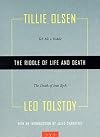
In the last few years, due to various circumstances, I've been forced to become more and more cognizant of my mortality. Not only mortality, but also the essentially linear nature of life itself. You're born, you live, you die. And as you live there are some things that happen only once, if at all, and if you miss an opportunity, it's gone, no "redo's" no second chances, it's just you, yourself, and the time you have left to do with what you will (or can, to nudge away the fatalist in show more me).
It's with this mindset I approached this collection. Now, I'd read The Death of Ivan Ilych years ago in a community college literature class. It hit me hard then as (I recall one reviewer putting it) one of the most realistic portrayals of death and dying ever put to the page, but reading it a second time, along with Tillie Olsen's Tell Me A Riddle, felt far more effective, even jaggedly transformative. Tolstoy's prose is at once grand yet unassuming, over the top (like Dostoyevsky) but somehow restrained enough to allow the reader to place his or herself with his or time in place of Tolstoy's. This is not to say that the story isn't an evocative piece of distinctly Russian taste, not at all, but very much like Joyce or Kafka, Tolstoy manages a fiction so well-crafted that it accomplishes the near impossible, the having of the best of both worlds. It's incredibly particular and acutely personal yet so much so it crosses the line into the generally applicable and even humanly universal. I think they call that great writing.
Tillie Olson's story was the true revelation for me in this collection, however. Like I said, I'd already had the pleasure of watching Ivan Ilych die (and writing a paper on it too!) but Ms. Olsen and I hadn't had the pleasure until just a little while ago. I have to admit I was a bit hesitant to read her story, especially after Ilych. I thought "How could anyone follow up Tolstoy's opening act?" But, really, I was wrong. While Olsen's story "Tell Me A Riddle" might lack the austere polish of Tolstoy's Ilych, it has something just as important, in spades, that his story lacked, that is, corporeality, uncleanliness, dirt, passion, heat, and well calculated (and well executed) imperfections in literary execution. Where Tolstoy's story was one you could practically read and set your watch to, Olsen's was a passionate evocation, a mournful primal howling at the moon, at God, at everything and nothing, that didn't and doesn't give a damn about the proprieties and strictures of orthodox storytelling. More than that (and I realize this is a personal affection of mine) it's an incredibly Jewish story, but going further it's a profoundly Secular Jewish story, mentioning beautifully, painfully, poetically, the failures and limitations of our dogma, our cultures, and our traditions, while meanwhile clinging to them as fanatically as we all do, in our own ways.
After the overrated and plastic Disney-esque schmaltz of Jonathan Foer and his wife Nicole Krauss, I'd forgotten what true Jewish writing was, and I'm glad to be reminded of its power and necessity. But, personal digression completed, I can say that this collection is an incredible and needed addition to any die-hard reader's library. If you'd like a pair of painful but reveletory looks at life and death, at the meaning capable of being gleaned from the meaninglessness of it all, then you owe it to yourself to take the plunge into these, the coldest of true waters. show less
It's with this mindset I approached this collection. Now, I'd read The Death of Ivan Ilych years ago in a community college literature class. It hit me hard then as (I recall one reviewer putting it) one of the most realistic portrayals of death and dying ever put to the page, but reading it a second time, along with Tillie Olsen's Tell Me A Riddle, felt far more effective, even jaggedly transformative. Tolstoy's prose is at once grand yet unassuming, over the top (like Dostoyevsky) but somehow restrained enough to allow the reader to place his or herself with his or time in place of Tolstoy's. This is not to say that the story isn't an evocative piece of distinctly Russian taste, not at all, but very much like Joyce or Kafka, Tolstoy manages a fiction so well-crafted that it accomplishes the near impossible, the having of the best of both worlds. It's incredibly particular and acutely personal yet so much so it crosses the line into the generally applicable and even humanly universal. I think they call that great writing.
Tillie Olson's story was the true revelation for me in this collection, however. Like I said, I'd already had the pleasure of watching Ivan Ilych die (and writing a paper on it too!) but Ms. Olsen and I hadn't had the pleasure until just a little while ago. I have to admit I was a bit hesitant to read her story, especially after Ilych. I thought "How could anyone follow up Tolstoy's opening act?" But, really, I was wrong. While Olsen's story "Tell Me A Riddle" might lack the austere polish of Tolstoy's Ilych, it has something just as important, in spades, that his story lacked, that is, corporeality, uncleanliness, dirt, passion, heat, and well calculated (and well executed) imperfections in literary execution. Where Tolstoy's story was one you could practically read and set your watch to, Olsen's was a passionate evocation, a mournful primal howling at the moon, at God, at everything and nothing, that didn't and doesn't give a damn about the proprieties and strictures of orthodox storytelling. More than that (and I realize this is a personal affection of mine) it's an incredibly Jewish story, but going further it's a profoundly Secular Jewish story, mentioning beautifully, painfully, poetically, the failures and limitations of our dogma, our cultures, and our traditions, while meanwhile clinging to them as fanatically as we all do, in our own ways.
After the overrated and plastic Disney-esque schmaltz of Jonathan Foer and his wife Nicole Krauss, I'd forgotten what true Jewish writing was, and I'm glad to be reminded of its power and necessity. But, personal digression completed, I can say that this collection is an incredible and needed addition to any die-hard reader's library. If you'd like a pair of painful but reveletory looks at life and death, at the meaning capable of being gleaned from the meaninglessness of it all, then you owe it to yourself to take the plunge into these, the coldest of true waters. show less
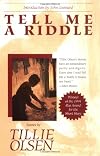
In my continuing attempt to read things with some Nebraska connection, and also (mostly) in honor of Olsen's passing at the beginning of the year, I thought I would read something from her. It turns out that this is really her only completed book of fiction, so I suppose it's not unusual that this is the one I would settle on. Having read the book, in any case, there is one thing I can say for sure: Holy hell, this woman could write. I'm not sure I've ever read a more powerful collection of show more stories. She has an incredibly tight grip on the human psyche, and from the very first page she takes you exactly where she wants you to go. Not to say that the writing is manipulative. It's just so evocative and compelling. If you don't cry while reading this book, you're not human. When I finished the last (and most gripping) story, I was physically unable to rise from the chair.
In case you hadn't guessed, this isn't a real light, cheery book. This may give you some sense: I found myself thinking, throughout the book, that Olsen is the writer Annie Proulx wishes she could be. There are several significant differences between the two (not least that Olsen is simply a better writer), but the one that stands out for me most now that I've finished the book is that Olsen's writing—while every bit as depressing as Proulx's—has more to it. After reading Annie Proulx, you get this feeling that someone has just drug you to the ground and kicked the hell out of you for no good reason. With Olsen, on the other hand, it's more like you've spent time with an angel, or even a god, who has managed to illuminate for you some of the inner workings of the world and the human mind. There is a sadness which suffuses the book, but that's not its goal.
I'm not sure why I'm spending so much time comparing these two authors, in any case. But there you go. show less
In case you hadn't guessed, this isn't a real light, cheery book. This may give you some sense: I found myself thinking, throughout the book, that Olsen is the writer Annie Proulx wishes she could be. There are several significant differences between the two (not least that Olsen is simply a better writer), but the one that stands out for me most now that I've finished the book is that Olsen's writing—while every bit as depressing as Proulx's—has more to it. After reading Annie Proulx, you get this feeling that someone has just drug you to the ground and kicked the hell out of you for no good reason. With Olsen, on the other hand, it's more like you've spent time with an angel, or even a god, who has managed to illuminate for you some of the inner workings of the world and the human mind. There is a sadness which suffuses the book, but that's not its goal.
I'm not sure why I'm spending so much time comparing these two authors, in any case. But there you go. show less
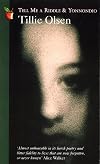
Two volumes of incredibly powerful, searing writing, the theme throughout being the tragedy of What Life Does ...to the beautiful baby, the open-minded child, the determined young family... Olsen came from immigrant stock herself, worked menial jobs and was a union activist in early 20th century USA.
"Tell me a Riddle" features four short stories: in one, a mother laments unspecified problems in her teenage daughter's life, but recalls how Life (poor, absent, working mother, a spell in the show more 'care' system etc) propelled the lovely child into suffering. A drunken sailor visits family while on shore leave; a couple of adolescent female pals- one white, one black - find their friendship crumbles as they enter Junior High and its prejudices; and an elderly immigrant woman faces terminal illness...
"Yonnondio" is unfinished (but that in no way detracts- the narrative suffices). It called to mind "Grapes of Wrath" (Steinbeck), "The Dollmaker" (Arnow) and "The Jungle" (Sinclair.) Written in a stream of consciousness manner, the account follows a poor working family from a mining village - where death is a regular occurence - to the idyll to farm life. Life is good - but unprofitable, and they find themselves driven back to the city and the stinking hell of the meat packing industry...
Utterly brilliant writing.which deserves to be much better known. show less
"Tell me a Riddle" features four short stories: in one, a mother laments unspecified problems in her teenage daughter's life, but recalls how Life (poor, absent, working mother, a spell in the show more 'care' system etc) propelled the lovely child into suffering. A drunken sailor visits family while on shore leave; a couple of adolescent female pals- one white, one black - find their friendship crumbles as they enter Junior High and its prejudices; and an elderly immigrant woman faces terminal illness...
"Yonnondio" is unfinished (but that in no way detracts- the narrative suffices). It called to mind "Grapes of Wrath" (Steinbeck), "The Dollmaker" (Arnow) and "The Jungle" (Sinclair.) Written in a stream of consciousness manner, the account follows a poor working family from a mining village - where death is a regular occurence - to the idyll to farm life. Life is good - but unprofitable, and they find themselves driven back to the city and the stinking hell of the meat packing industry...
Utterly brilliant writing.which deserves to be much better known. show less
Lists
Awards


You May Also Like


Associated Authors
Statistics
- Works
- 20
- Also by
- 31
- Members
- 1,912
- Popularity
- #13,458
- Rating
- 3.9
- Reviews
- 38
- ISBNs
- 75
- Languages
- 7
- Favorited
- 13
