
She Lao (1899–1966)
Author of Rickshaw Boy
About the Author
Lao She (1899-1966) is a master novelist and playwright famous for his revisioning of China
Disambiguation Notice:
(swe) Lao She är pseudonym för Shu Qingchun.
Image credit: Portrait photo of the writer Lao She (Author unknown)
Works by She Lao
The Yellow Storm 8 copies
Sacrificarsi 3 copies
Patru generatii sub acelasi acoperis 3 copies
La maison de thé - édition bilingue: Édition bilingue : chinois, pinyin, français & notes (2017) 2 copies
Cat Country | 猫城记 1 copy
Konec slavného kopiníka 1 copy
Heavensent 1 copy
Le Tireur de pousse 1 copy
En ricksha i Peking 1 copy
Rickshaw Wala 1 copy
la città dei gatti 1 copy
老舍小品集 1 copy
Bo set Collection Museum: Selected Works of Lao children's literature ( prose volumes )(Chinese Edition) (2013) 1 copy
老舍小說经典 / 舒济选编., Lao She xiao shuo jing dian / Shu Ji xuan bian, 第二版, li hun, mao cheng ji deng 1 copy
老舍小說经典 / 舒济选编., Lao She xiao shuo jing dian / Shu Ji xuan bian, 第一版, lao zhang de zhe xue, er ma 1 copy
Lao niu po che : Essai autocritique sur le roman et l'humour (Bulletin de la Maison franco-japonaise) (1974) 1 copy
Collected Childrens Literary Works of Lao She / Required Reading Materials for Teenagers (Chinese Edition) (2013) 1 copy
Lao She: Rikschakuli 1 copy
Città dei gatti 1 copy
De laatste trein 1 copy
Associated Works
The Plum in the Golden Vase Volume 2 (of 5): The Rivals (1985) — Contributor, some editions — 145 copies, 1 review
Tagged
Common Knowledge
- Legal name
- Shu Sheyou
Shu Qingchun (born) - Other names
- Lao She
- Birthdate
- 1899-02-03
- Date of death
- 1966-08-24
- Gender
- male
- Occupations
- teacher
professor
novelist
playwright - Nationality
- China
- Birthplace
- Beijing, China
- Places of residence
- Beijing, China (birth)
London, England, UK
Singapore - Place of death
- Beijing, China
- Map Location
- China
- Disambiguation notice
- Lao She är pseudonym för Shu Qingchun.
Members
Reviews
https://nwhyte.livejournal.com/3256057.html
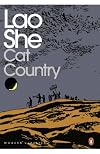
My old friend Rana Mitter recommended this to me as an early example of the Chinese science fiction tradition which we're now seeing in the works of Cixin Liu and Hao Jingfang (and others, but those are the recent Hugo winners). It's a short read, a very very direct satire on China of the 1930s, portrayed as a country on the planet Mars inhabited by cat people. The narrator is an earthling who arrives in a crashed spaceship just before the story show more begins and gets away slightly murkily as it ends. I thought it was really interesting to note that the trope of people going to Mars and encountering talking non-humans was already well enough established for a Chinese writer writing in Chinese in 1930s China to just pick it up and run with it. The works of Jules Verne and H.G. Wells were circulating in translation, but neither of them has humans landing on Mars.
The satire is so direct that I wondered if Pierre Boulle might have been partly inspired by this for Monkey Planet/Planet of the Apes. The dates however don't seem to check out - according to ISFDB, Cat Country seems to have been translated into English only in 1970, and to French only in 1981, too late for Boulle's book which was published in 1963. Our unnamed protagonist comes to terms with a fragmented Cat Country, full of weak patriarchal local warlords who are exploited by rich and cynical foreigners, and undermined by subversive students who follow the philosophy taught by Uncle Karl which led to the overthrow of the emperor in the neighbouring country. As satire goes, it's not all that subtle. But it's effectively written, and I found William A. Lyell's translation lucid. show less
My old friend Rana Mitter recommended this to me as an early example of the Chinese science fiction tradition which we're now seeing in the works of Cixin Liu and Hao Jingfang (and others, but those are the recent Hugo winners). It's a short read, a very very direct satire on China of the 1930s, portrayed as a country on the planet Mars inhabited by cat people. The narrator is an earthling who arrives in a crashed spaceship just before the story show more begins and gets away slightly murkily as it ends. I thought it was really interesting to note that the trope of people going to Mars and encountering talking non-humans was already well enough established for a Chinese writer writing in Chinese in 1930s China to just pick it up and run with it. The works of Jules Verne and H.G. Wells were circulating in translation, but neither of them has humans landing on Mars.
The satire is so direct that I wondered if Pierre Boulle might have been partly inspired by this for Monkey Planet/Planet of the Apes. The dates however don't seem to check out - according to ISFDB, Cat Country seems to have been translated into English only in 1970, and to French only in 1981, too late for Boulle's book which was published in 1963. Our unnamed protagonist comes to terms with a fragmented Cat Country, full of weak patriarchal local warlords who are exploited by rich and cynical foreigners, and undermined by subversive students who follow the philosophy taught by Uncle Karl which led to the overthrow of the emperor in the neighbouring country. As satire goes, it's not all that subtle. But it's effectively written, and I found William A. Lyell's translation lucid. show less

Rickshaw Boy appears to be widely considered to be a classic of modern Chinese literature. (I note that a list of the “’100 greatest Chinese novels of the 20th century’ selected by 14 Chinese critics from different Chinese speaking regions” listed Rickshaw Boy third and Lao She is fourth among “60 Greatest Chinese Writers of the Century.”) This novel, first published in 1937, follows the arrival in the capital of Xiangzi, a poor peasant from the countryside. Xiangzi is illiterate show more and hard-working, blessed with youth, strength, determination, and integrity. He becomes the perfect protagonist for the author’s purpose, to illustrate the power and brutality of the environment and the inevitable futility of the individual’s struggle to escape the unending cycle of poverty, hunger, and violence. For a Western reader, Lao She also sheds a fascinating light on Chinese philosophy and religious beliefs. The social fabric is woven in such a way that without great luck—which is constantly just beyond his grasp—Xiangzi’s life is guaranteed to amount to nothing. As we follow his fortunes—up, down, then up again and finally down again—he seeks nothing more than to own his own rickshaw and be content. (For reasons explained in detail in the introduction, this translation, by Howard Goldblatt, is clearly the one to get.) My greatest disappointment? That the author’s other works are so hard to find in English. show less
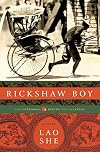
This deceptively simple book Rickshaw Boy by Lao She (1899-1966) is a classic of Chinese literature. According to the helpful introduction by translator Howard Goldblatt, Lao She was a prolific writers of plays, short stories and novels, and his status as one of the most widely read and best beloved Chinese authors is all the more remarkable given his humble beginnings. His father was a lowly palace guard for the emperor when he was killed during the Boxer rebellion in 1900, plunging the show more family into dire poverty, which influenced Lao She for the rest of his life.
Despite disruption to his education due to financial difficulties, he was able to graduate from Beijing Normal University and, became a teacher, eventually making his way to the University of London where he taught Chinese from 1924-1929. He read voraciously and became a great admirer of Dickens, whose devotion to the urban downtrodden and use of ironic humour Lao She found particularly affecting; they would inform much of his own work, particularly the early novels and stories. He wrote his first three novels in London, and continued writing when he returned to China, mostly writing stories which critiqued the malaise which inhibited development in China and made it vulnerable to foreign incursions. During what became a turbulent period in Chinese history, his belief in the Confucian ideal of individual moral integrity, shifted as he began to doubt that individual heroism could be of any use in a generally corrupt society. Yes, hard on the heels of Barnard Eldershaw's Tomorrow and Tomorrow and Tomorrow which posited the hopelessness of individual effort to achieve social mobility or even to keep one's head above water, I read Rickshaw Boy which has the same political and moral message: that individualism is bankrupt in the face of a corrupting and dehumanising social system.
But where the Barnard Eldershaw novel expounded the message in 400+ pages of sledgehammer polemics, the simplicity and elegance of Rickshaw Boy is a different reading experience altogether. Its central character is an orphaned rural labourer who comes to Beijing (called Beiping in the novel) determined to better himself. Despite his poverty Xiangzi is the embodiment of the Confucian man of virtue: he beggars himself to dress neatly and to rent the smartest of rickshaws; he offers superior service; he is as classy as a rickshaw boy can be to get the work he wants so that he can buy his own rickshaw and be financially independent. Never at any time are the disasters which befall him his fault.
If you aren't already feeling uneasy about the cover image on this book, the descriptions of Xiangzi pulling his rickshaw through all kinds of terrible weather and at the mercy of his customers, will make you realise how degrading this form of human exploitation is. In the beginning Xiangzi pities the older men, never imagining that he will be old before his time too:
Summer is equally perilous, on days when the torrid heat means no one should be doing hard physical labour of this kind.
To read the rest of my review please visit https://anzlitlovers.com/2019/11/23/rickshaw-boy-by-lao-she-translated-by-howard... show less
Despite disruption to his education due to financial difficulties, he was able to graduate from Beijing Normal University and, became a teacher, eventually making his way to the University of London where he taught Chinese from 1924-1929. He read voraciously and became a great admirer of Dickens, whose devotion to the urban downtrodden and use of ironic humour Lao She found particularly affecting; they would inform much of his own work, particularly the early novels and stories. He wrote his first three novels in London, and continued writing when he returned to China, mostly writing stories which critiqued the malaise which inhibited development in China and made it vulnerable to foreign incursions. During what became a turbulent period in Chinese history, his belief in the Confucian ideal of individual moral integrity, shifted as he began to doubt that individual heroism could be of any use in a generally corrupt society. Yes, hard on the heels of Barnard Eldershaw's Tomorrow and Tomorrow and Tomorrow which posited the hopelessness of individual effort to achieve social mobility or even to keep one's head above water, I read Rickshaw Boy which has the same political and moral message: that individualism is bankrupt in the face of a corrupting and dehumanising social system.
But where the Barnard Eldershaw novel expounded the message in 400+ pages of sledgehammer polemics, the simplicity and elegance of Rickshaw Boy is a different reading experience altogether. Its central character is an orphaned rural labourer who comes to Beijing (called Beiping in the novel) determined to better himself. Despite his poverty Xiangzi is the embodiment of the Confucian man of virtue: he beggars himself to dress neatly and to rent the smartest of rickshaws; he offers superior service; he is as classy as a rickshaw boy can be to get the work he wants so that he can buy his own rickshaw and be financially independent. Never at any time are the disasters which befall him his fault.
If you aren't already feeling uneasy about the cover image on this book, the descriptions of Xiangzi pulling his rickshaw through all kinds of terrible weather and at the mercy of his customers, will make you realise how degrading this form of human exploitation is. In the beginning Xiangzi pities the older men, never imagining that he will be old before his time too:
Xiangzi was not heedless of the wretched condition of the old, frail rickshaw men whose clothes were so tattered, a light wind blew through them and a strong one tore them to shreds. Their feet were wrapped in rags. They waited, shivering in the cold, at rickshaw stands, wanting to be first to shout "Rickshaw!" when a prospective fare approached. Running warmed them up and soaked their tattered clothes in sweat, which froze as soon as they stopped. Strong winds nearly stopped them in their tracks. When the wind came from above, they ducked their heads down into their chests; wind gusting up from below nearly knocked them off their feet. They dared not raise their heads in a headwind, to keep from turning into kites, and when the wind was at their backs, they lost control of both their rickshaws and themselves. They tried every trick they knew, used every ounce of energy they possessed, to pull their rickshaws to their destination, nearly killing themselves for a few coins. After each trip, their faces were coated with dust mixed with sweat, through which poked three frozen red circles—two eyes and mouth. Few people were out on the streets during the short, cold days of winter, and a day of running might not bring in enough for one good meal. And yet the older men had wives and children at home, while the younger ones had parents and siblings. For these men, winters were sheer torture... (p.95)
Summer is equally perilous, on days when the torrid heat means no one should be doing hard physical labour of this kind.
To read the rest of my review please visit https://anzlitlovers.com/2019/11/23/rickshaw-boy-by-lao-she-translated-by-howard... show less

Bravo, Lao She! I'm only sorry that your idealism and integrity caused you to be tortured, and pushed you to take your own life.
Once I knew that this was a satire in Chinese life in the 30s, I couldn't help to see each situation as making fun of Chinese and the beginning of communism and the whole madness of Mao Zedong.
My fave quotes:
--"This was a good example of Cat Country logic: the ableist people ought to receive the lowest Rewards" (p.54).
--"the cat people were not accustomed to show more helping in anything that might be beneficial to someone else, even if that help only cost them a few words" (p.61).
--"anyway, I thought to myself, the cat people seem to consider Mutual plunder an entirely reasonable form of behavior, so why should I interfere?"(p.66).
--"You see, the victims of all this drum playing we're not exactly Angels themselves. None of those who were hindmost were willing to stay at the back, and would push, kick, crowd and even bite you in order to make their way in the world and become foremost. Those who were already foremost, on the other hand, kicked back with their heels, poked back with their elbows and leaned back hard in order to keep the hindmost in their proper place" (p.75).
--"Consequently, those who ought to have been killed were not; and those who ought to have been spared, on the contrary, lost their lives. The ones who were to have been killed but weren't, wormed their way into the Everybody SharesSchyism brawl and started corrupting it with Wiley schemes from within" (p.162). show less
Once I knew that this was a satire in Chinese life in the 30s, I couldn't help to see each situation as making fun of Chinese and the beginning of communism and the whole madness of Mao Zedong.
My fave quotes:
--"This was a good example of Cat Country logic: the ableist people ought to receive the lowest Rewards" (p.54).
--"the cat people were not accustomed to show more helping in anything that might be beneficial to someone else, even if that help only cost them a few words" (p.61).
--"anyway, I thought to myself, the cat people seem to consider Mutual plunder an entirely reasonable form of behavior, so why should I interfere?"(p.66).
--"You see, the victims of all this drum playing we're not exactly Angels themselves. None of those who were hindmost were willing to stay at the back, and would push, kick, crowd and even bite you in order to make their way in the world and become foremost. Those who were already foremost, on the other hand, kicked back with their heels, poked back with their elbows and leaned back hard in order to keep the hindmost in their proper place" (p.75).
--"Consequently, those who ought to have been killed were not; and those who ought to have been spared, on the contrary, lost their lives. The ones who were to have been killed but weren't, wormed their way into the Everybody SharesSchyism brawl and started corrupting it with Wiley schemes from within" (p.162). show less
Lists
Awards


You May Also Like


Associated Authors
Statistics
- Works
- 110
- Also by
- 3
- Members
- 1,345
- Popularity
- #19,139
- Rating
- 3.8
- Reviews
- 21
- ISBNs
- 210
- Languages
- 15
- Favorited
- 5