
Jessica Amanda Salmonson
Author of Amazons!
About the Author
Image credit: Jessica Amanda Salmonson [credit: Pacific Warriors]
Series
Works by Jessica Amanda Salmonson
What Did Miss Darrington See? An Anthology of Feminist Supernatural Fiction (1989) — Editor — 126 copies
The Encyclopedia of Amazons: Women Warriors from Antiquity to the Modern Era (1999) 123 copies, 1 review
The Eleventh Jaguarundi and Other Mysterious Persons (The Wordcraft Speculative Writers Series) (1995) 9 copies
Fantasy and Terror # 7 3 copies
Bohemians of Sesqua Valley 3 copies
Fantasy and Terror # 4 2 copies
Fantasy and Terror # 5 2 copies
Fantasy Macabre #13 (1990) 2 copies
Fantasy and Terror # 6 2 copies
Fantasy Macabre #8 2 copies
Lincoy's Journey [short fiction] 2 copies
The Ugly Unicorn 2 copies
The Swordswoman 1 copy
Fantasy Macabre #6 (1985) 1 copy
Fantasy & Terror #8 (1986) 1 copy
The Oval Dragon 1 copy
Fantasy & Terror #2 (1984) 1 copy
Fantasy Macabre #16 (1994) 1 copy
Fantasy & Terror #1 (1984) 1 copy
Fantasy Macabre #5 (1985) 1 copy
Fantasy Macabre #15 (1992) 1 copy
Fantasy & Terror #11 (1989) 1 copy
Fantasy & Terror #13 (1992) 1 copy
Fantasy & Terror #10 (1987) 1 copy
Fantasy Macabre #11 (1988) 1 copy
Ogopogo 1 copy
The Forest in the Lake 1 copy
Fantasies in Black and White 1 copy
Slide Show 1 copy
Tomoe Gozen 1 1 copy
Fantasy Macabre #9 (1987) 1 copy
Islands 1 copy
Mirabeau 1 copy
Woodsman And Water Nymph 1 copy
The Ghastly Pond 1 copy
The Lingering Minstrel 1 copy
Innocent of Evil 1 copy
Carmanda 1 copy
The Final Fête of Abba Adi 1 copy
Nights in the City 1 copy
The House That Knew No Hate 1 copy
Jeremiah 1 copy
Mamishka And The Sorcerer 1 copy
The Queen Mum 1 copy
Naginata #7 1 copy
Underneath an Arkham Moon 1 copy
Sarah, the Ghost of Castle 1 copy
The Hounds of the Hearth 1 copy
Associated Works
Love in Vein: Twenty Original Tales of Vampiric Erotica (1994) — Contributor — 822 copies, 7 reviews
Devils & Demons: A Treasury of Fiendish Tales Old & New (1991) — Contributor — 290 copies, 2 reviews
The Year's Best Fantasy and Horror: Sixth Annual Collection (1993) — Contributor — 219 copies, 1 review
Isaac Asimov's Magical Worlds of Fantasy, Volume 12: Faeries (1991) — Contributor — 216 copies, 4 reviews
Masterpieces of Terror and the Unknown: A Treasury of Bizarre Tales Old and New (1993) — Contributor — 213 copies, 2 reviews
Lovers & Other Monsters: A Collection of Amorous Tales of Fantasy, Old and New (1993) — Contributor — 64 copies, 1 review
Bruce Coville's Book of Ghosts II: More Tales to Haunt You (1997) — Contributor — 52 copies, 1 review
Women of Other Worlds: Excursions Through Science Fiction and Feminism (1999) — Contributor — 42 copies
Spaceships and Spells: A Collection of New Fantasy and Science-fiction Stories (1987) — Contributor — 24 copies
The Supernatural Tales of Fitz-James O'Brien: Dream Stories and Fantasies (1988) — Editor, some editions — 21 copies
The Supernatural Tales of Fitz-James O'Brien: Volume One: Macabre Tales (1988) — Editor, some editions — 17 copies
Quantum : Science Fiction and Fantasy Review, No.41 (Winter/Spring [1991/]1992) — Contributor — 1 copy
Tagged
Common Knowledge
- Legal name
- Salmonson, Jessica Amanda
- Other names
- Salmonson, Amos
- Birthdate
- 1950-01-06
- Gender
- female
- Occupations
- fantasy writer
editor
critic
publisher
bookseller (Violet Books) - Relationships
- Rhonda Boothe (partner)
- Nationality
- USA
- Birthplace
- Seattle, Washington, USA
- Places of residence
- Seattle, Washington, USA
Puget Sound, Washington, USA - Associated Place (for map)
- Washington, USA
Members
Reviews

I was deeply disappointed by the way that this book seems to have stripped out pretty much all the queerness of the first book. If you were to pick up this book without having read the first, there would be no indication that Tomoe is attracted to women at all. The beautiful ninja who seemed set to become the main love interest doesn't appear and in fact is never even mentioned. Tomoe's tendency to note the beauty of almost every single woman she interacts with is gone; one character who got show more this treatment in book 1 is described a few times as "beautiful" but it comes off as an objective description that comes directly from the narrator, rather than as something that relates Tomoe's point of view. The nature of Tomoe's past relationship with Lady Shigeno is never mentioned either; it's possible that someone who had not read the first book might be able to infer that her decision to cut Tomoe off entirely after Tomoe marries (out of familial duty/filial piety) is in part driven by jealousy and hurt, but the subtext is extremely subtle. The book essentially shoves Tomoe into the closet and shuts the door, which is a jarring change from how explicit and unapologetic the first book is about her sexuality. (There aren't even any mentions of queer relationships/attraction between other women; there are a few brief mentions of such between men, mostly characters who are secondary at best, but that's it.) I don't really have much grounds to speculate, but the only way this makes sense to me is if the original publisher leaned on the author to tone it down--so I don't really blame her, but still, it's a letdown. show less

This book is what happens when someone does research into Japanese history and mythology, and then decides that it would be so much more awesome if there was no difference between them (which I have to admit, is kind of true). Enter Tomoe Gozen, the titular character and alternate reality version of the real life lady-samurai from the Heiki Monogatari. In this first volume of the series, she fights her way out of hell, becomes enslaved by a sorceror from the mainland, and fights show more super-powered ninja-priests. All in the first third of the book.
Needless to say, Tomoe is a completely kick-ass heroine, and this book is a great read for people looking for a cool alternative history of Japan. I'm sure that it would be a good read even to someone with no background in Japanese history or culture, but I must say that I had as much fun spotting the references as I did following the story.
Sadly, this trilogy is now out of print, so if you are cruising through your local used book shop, I strongly recommend you keep an eye out for this series. show less
Needless to say, Tomoe is a completely kick-ass heroine, and this book is a great read for people looking for a cool alternative history of Japan. I'm sure that it would be a good read even to someone with no background in Japanese history or culture, but I must say that I had as much fun spotting the references as I did following the story.
Sadly, this trilogy is now out of print, so if you are cruising through your local used book shop, I strongly recommend you keep an eye out for this series. show less
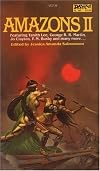
The first Amazons! collection of fantasy stories centered on female heroes was groundbreaking when it was published in 1979. I loved it when I discovered it in my teens--pre-Buffy, there were few stories of adventure with strong female heroines. I disagree that this second collection of a dozen stories is weaker--I actually prefer it to the first; I think it's stronger both on average and with more outstanding stories and no real clunkers. It's a bit more gender balanced on the contents show more page--the first book had only one "token male" author as Salmonson pointed out--and this second book even had stronger, more appealing and complex male characters. It also had the advantage of having more authors I'd consider favorites on the content page. Tanith Lee, a great favorite is the one author with a repeat appearance and also features F.M. Busby, Phylis Ann Karr, and G.R.R. Martin. Not only are all these the authors in the contents page I consider favorites, but all in all I'd say the stories they provided were my favorites in the collection.
Busby's "For a Daughter" has fantasy trappings but could actually be seen as science-fiction set in a post-apocalyptic future--there's no magic involved, and the adversary here is arguably the most complex in the book. Tanith Lee's "Southern Lights" features her Jaisel, who appeared in the first anthology and I think this story stronger--less polemical. Phyllis Ann Karr's "The Robber Girl" not only has a lovely fairy-tale feel, but her central character is more an anti-heroine--an appealing rogue. And I thought George R. R. Martin (yes, that Martin, Game of Thrones Martin) offered the strongest story of the lot in "In the Lost Lands." A great closer. show less
Busby's "For a Daughter" has fantasy trappings but could actually be seen as science-fiction set in a post-apocalyptic future--there's no magic involved, and the adversary here is arguably the most complex in the book. Tanith Lee's "Southern Lights" features her Jaisel, who appeared in the first anthology and I think this story stronger--less polemical. Phyllis Ann Karr's "The Robber Girl" not only has a lovely fairy-tale feel, but her central character is more an anti-heroine--an appealing rogue. And I thought George R. R. Martin (yes, that Martin, Game of Thrones Martin) offered the strongest story of the lot in "In the Lost Lands." A great closer. show less
Tomoe Gozen is the first novel of the Tomoe Gozen Saga. Naipon is an island-empire in a world very much like our own, and Naipon is the Japan of that world, except all the legends are real. Tomoe Gozen and a couple other samurai serve Lord Shigeno and his daughter, Lady Toshima. However, Tomoe is struck by lightning in a battle with an evil sorceror's forces; and one of her companions brings her to the sorceror so she can be brought back to life. He brings her back, but she has to serve him, show more along with her companion. She is brought back however, during a battle in which she slays Lord Shigeno. She traverses the country as a ronin, meeting along the way a boy-samurai who is looking for his sister, a bakemono, and a Buddhist nun. The bakemono improson's the little samurai's sister, and Tsuki, the nun, is killed by Oni serving him and Tomoe is scarred for life. She decides to go with Lady Toshima, who serves the exiled Mikado, into exile. However, their ship crashes, and they are marooned on an island. Tomoe is trapped in a stone city by an old mad woman, and she constantly gets drunk. In the end, Tomoe helps a magician-ninja fight an evil priest who was responsible to what happened to Tomoe. Tomoe and Lady Toshima return to Naipon, and Tomoe duels and kills the Shogun's champion, Ugo Mohri.
This book was quite fun for me to read, as I'm a great fan of Medieval -Japan era. However, there were some things that I didn't like. For example, I didn't how the book would jump into the future every once in a while. The samurai duels were very well described, and seemed very realistic. However, I didn't like how Tomoe was always the best samurai, except once. I also thought that Tomoe would travel into the world of real Japan. I hope I will see that in the next book. show less
This book was quite fun for me to read, as I'm a great fan of Medieval -Japan era. However, there were some things that I didn't like. For example, I didn't how the book would jump into the future every once in a while. The samurai duels were very well described, and seemed very realistic. However, I didn't like how Tomoe was always the best samurai, except once. I also thought that Tomoe would travel into the world of real Japan. I hope I will see that in the next book. show less
Lists
Awards


You May Also Like


Associated Authors
Statistics
- Works
- 99
- Also by
- 80
- Members
- 2,362
- Popularity
- #10,866
- Rating
- 3.6
- Reviews
- 20
- ISBNs
- 51
- Languages
- 3
- Favorited
- 2