
Saburo Sakai (1916–2000)
Author of Samurai!
About the Author
Image credit: nationalmuseum.af.mil
Works by Saburo Sakai
Associated Works
Zero: Combat and Development History of Japan's Legendary Mitsubishi A6M Zero Fighter (Motorbooks International Warbird History) (1994) — Foreword — 38 copies, 1 review
Tagged
Common Knowledge
- Canonical name
- Sakai, Saburo
- Legal name
- Sakai, Saburō
- Birthdate
- 1916-08-25
- Date of death
- 2000-09-22
- Gender
- male
- Occupations
- fighter pilot
Buddhist acolyte
motivational speaker - Organizations
- Imperial Japanese Navy
- Nationality
- Japan
- Places of residence
- Saga, Japan (birthplace)
- Place of death
- Atsugi, Kanagawa, Japan
- Burial location
- Sagami Memorial Park, Kanagawa, Kanagawa Prefecture Japan
- Associated Place (for map)
- Japan
Members
Reviews

Sakai was one of the Imperial Japanese Navy's top aces, with over 60 confirmed kills in air to air combat. He also had a charmed life which somehow saw him through the war despite the tremendous losses the IJN took. This memoir focuses mostly on the dogfights, with just enough life on the ground to provide context.
Sakai was born in an impoverished family of samurai origin, and wound up in the IJN in the 30s. He was one of 75 enlisted men selected for flight training, and one of 25 in that show more class to actually graduate, making him a true elite in the air. Superior individual training and superior aircraft let Sakai rack up the scores in fighting over China, and then in five glorious months posted to Lae dueling P-39s and P-40s over New Guinea. But while this was still the period of Japan's easy victories, there were cracks. The B-17 was a true flying fortress, fast and difficult to shoot down. And no matter how many planes Sakai and his squadron shot down, the Americans and Australians were always back up in the air the next day, bombing Lae and opening new bases.
Sakai avoided an assignment to the doomed Midway fleet, and was transferred to Rabaul for the Battle of Guadalcanal. His first encounter with American Navy pilots in F4F Wildcats was of a different order, and Sakai's Zero was shot full of holes, and he was heavily wounded. Somehow, he nursed his crippled plane back to Rabaul, and was sent home to Japan for surgery. He lost sight in one eye, a major disadvantage for a fighter pilot, and as the war turned against the Japanese, he returned to combat. He was posted to Iwo Jima months before the invasion, where his squadron of 80 Zeroes was decimated by the superior F6F Hellcat. He was ordered on a kamikaze mission, but failed to find the American fleet. Somewhat shockingly, Iwo Jima was barely defended at this point. If the Americans had invaded in May 1944 instead of fulfilling McArthur's promise to return the Philippines, they could have taken the island with minimal resistance.
He and the remaining Japanese aces were withdrawn to form interception squadrons, piloting Raiden and Shinden fighters against B-29 raids. These last-generation planes were heavily armed bomber destroyers, but they were vulnerable to escorting P-51s. And ultimately, sheer numbers and a switch to night bombing rendered Sakai and his comrades impotent.
Samurai! puts a human voice to an enemy that was dehumanized during the war, and the doomed heroism of Japan's defenders at the end of the war. show less
Sakai was born in an impoverished family of samurai origin, and wound up in the IJN in the 30s. He was one of 75 enlisted men selected for flight training, and one of 25 in that show more class to actually graduate, making him a true elite in the air. Superior individual training and superior aircraft let Sakai rack up the scores in fighting over China, and then in five glorious months posted to Lae dueling P-39s and P-40s over New Guinea. But while this was still the period of Japan's easy victories, there were cracks. The B-17 was a true flying fortress, fast and difficult to shoot down. And no matter how many planes Sakai and his squadron shot down, the Americans and Australians were always back up in the air the next day, bombing Lae and opening new bases.
Sakai avoided an assignment to the doomed Midway fleet, and was transferred to Rabaul for the Battle of Guadalcanal. His first encounter with American Navy pilots in F4F Wildcats was of a different order, and Sakai's Zero was shot full of holes, and he was heavily wounded. Somehow, he nursed his crippled plane back to Rabaul, and was sent home to Japan for surgery. He lost sight in one eye, a major disadvantage for a fighter pilot, and as the war turned against the Japanese, he returned to combat. He was posted to Iwo Jima months before the invasion, where his squadron of 80 Zeroes was decimated by the superior F6F Hellcat. He was ordered on a kamikaze mission, but failed to find the American fleet. Somewhat shockingly, Iwo Jima was barely defended at this point. If the Americans had invaded in May 1944 instead of fulfilling McArthur's promise to return the Philippines, they could have taken the island with minimal resistance.
He and the remaining Japanese aces were withdrawn to form interception squadrons, piloting Raiden and Shinden fighters against B-29 raids. These last-generation planes were heavily armed bomber destroyers, but they were vulnerable to escorting P-51s. And ultimately, sheer numbers and a switch to night bombing rendered Sakai and his comrades impotent.
Samurai! puts a human voice to an enemy that was dehumanized during the war, and the doomed heroism of Japan's defenders at the end of the war. show less
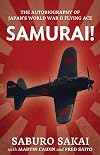
This originally appeared at The Irresponsible Reader.
---
In the Imperial Japanese Navy I learned only one trade—how to man a fighter plane and how to kill enemies of my country. This I did for nearly five years, in China and across the Pacific. I knew no other life; I was a warrior of the air.
WHAT'S SAMURAI! ABOUT?
The inside page of my edition puts it this way, and I can't do much better (although I might tone down the language a bit, but it's not bad for the late 70's)
The Outcast Who show more Became Emperor of the Skies
He was a school dropout, juvenile delinquent, and family disgrace—until he first stepped into an airplane. From that moment he soared into legend as Japan’s deadliest ace, and the most feared pilot of World War I.
SAMURAI! is the unforgettable saga of Saburo Sakai—a story of explosive action, violent victory, and personal agony that is absolutely true and vividly real . . . from the roaring of winged cannons in aerial combat, to the anguish of a defeated nation.
THE FOREWORD ALONE
The foreword to the book gives an abbreviated biography of Sakai and is the only point that Caidan and Saito are mentioned, to emphasize the "autobiographical" nature of the book*. It also describes some of the research that went into the book.
Honestly, you don't have to read the whole book to get the idea that Sakai is an impressive figure. Just read the foreword. His post-ward activities alone are pretty impressive—possibly more so than the feats during the war, given the context.
If you're at all curious about the book, read the foreword. If you're still curious—dive in. If you decide, "I'm good," at that point, you probably are. (Although you might want to take a glance at chapters 2 and 3 to see what his military training was like. If you're similar to me, you'll think that Full Metal Jacket's Gny. Sgt. Hartman wasn't so bad after all.)
* There might be one or two mentions of Saito's research in footnotes, but I'm pretty sure Caidin isn't mentioned again. Like a good ghostwriter, he disappears.
INCREDIBLY TRUE
The back cover of my edition claims that this is "an incredibly true, powerfully moving story of glory, defeat, and ultimate victory—told by the man who lived it."
Maybe it's just me, but anytime you put a qualifier on "true," my skepticism kicks in a little. I'd prefer something "credibly true" any day. Yes, this is an incredible story. And yes, I think it's based on truth. Probably truth that's grown a little in the telling.
Is this just fallible memory? Is it the story of someone whose accomplishments get embellished by himself/others a little over time to the extent they don't remember the actual details? Is this the case of a ghostwriter goosing the facts to make for a better, more exciting read in the States? Possibly all of the above—I lean toward a combination of the latter two (my instinct to favor the third option is helped by the fact that this book wasn't published in Japan).
It should be stated that the foreword claims that in addition to the hours and hours of interviews with Sakai that Fred Saito, an Associated Press correspondent, researched military archives (from multiple nations) and interviewed associates to authenticate this. How much of that ended up in the final product is beyond my ability to state.
The text points out some places where there are discrepancies between official records and witnesses and what the text states happened. So, it's not like Caidin and Saito are unaware of some discrepancies.
ON THE OTHER HAND...
In April of 1944...With the secret reports available to me as an officer, I had been able to maintain a true appraisal of the war. The secret documents were a far cry from the drivel shouted over the radios to the unsuspecting populace. Everywhere in the Pacific our units were being forced back. Incredibly powerful American task forces, fleet units the size of which staggered the imagination, roamed the Pacific almost at will.
... We were still hanging on at Rabaul, but no longer did that once-mighty bastion threaten Moresby and the enemy’s other bases. Rabaul suffered in more ways than one. The Americans were using it for bombing practice, to break in their new replacements.
From the war in China, the reports internal to the Japanese military, what the civilians heard, and what American military/news reported, one thing that Sakai is clear about for almost the entire book—everyone was lying, exaggerating, hiding, and spinning facts.
So it's no wonder at all that it's hard to document or "prove" all of what he says. Probably everything we read about the War in the Pacific should have an asterisk following it, not just this book.
SAKAI'S MISTAKES AND INJURIES
No longer was I myself inviolate. It had been the enemy’s turn then, and no less than a miracle had brought me here on this train as it swayed along the tracks leading to Sasebo. A man sees the war differently after the doctors have scraped away rotten flesh from his skull, have dug jagged steel splinters from his body, and comforted him with the staggering living-death sentence, “It is not so bad, Sakai, you will be only half blind.” Only half blind!
Sakai is pretty upfront with mistakes, blunders, and times that his ego led him and others into trouble (although he was rarely alone in letting ego get the best of him). His first arial combat was just...ugly, and he got chewed out for it—as he should've, from what I can tell.
He sustained his share of injuries throughout the conflicts he was in—obviously, the worst was the injury that cost him most of the sight from his right eye. I'm not going to go into details about that incident—you really want to read about it yourself, even more than the hint you get in the Foreword.
But when you read about the medical care he received, you have to wonder a little bit what 2025 doctors would do differently. It's not quite as bad as reading about Civil War surgeons dealing with injuries—but it's not unlike it, either.
Still, that he came back from that at all to take to the air again says a lot about him. It probably also says a lot about how Japan was doing in the War at that time, and how much they needed pilots.
SO, WHAT DID I THINK ABOUT SAMURAI!
But to fly is just like swimming. You do not forget easily. I have been on the ground for more than ten years. If I close my eyes, however, I can again feel the stick in my right hand, the throttle in my left, the rudder bar beneath my feet. I can sense the freedom and the cleanliness and all the things which a pilot knows.
It's easy to think of this—in part, anyway—as Sakai telling stories that make him look good (with a few exceptions for the sake of true or perceived humility). But he's quick—and consistent—to praise others. He makes some of these other pilots sound really amazing, and I appreciated Sakai singing their praises and lamenting their deaths (as appropriate).
Like any good narrative about war*, Sakai does wonder about the costs to both sides.
...that night, for the first time, I thought of the enemy pilots I had shot down as other human beings like myself, instead of unknown entities in their planes. It was a strange and depressing feeling, but, as with every other facet of war, it was kill or be killed.
He doesn't forget that—but in kill or be killed, survival comes to the forefront.
More than once, I realized that when I was pleased to hear about a close escape, or a great victory for him, that I was cheering against the U.S. in the War. And that feels more than a little strange, I have to say. It's one thing in a work of fiction to get invested enough to cheer for an enemy or opponent. But in non-fiction?
I didn't even get into the strange but sweet love story about Sakai's first wife, and wish I knew more about what happened to her after the War, although it's clear it's not a happy story for anyone.
From his horrific days in training; through the combat in China; through hearing about how Dec. 7, 1941 could have had more infamy to live in; through his injuries and triumphs; through the end of the war—this was a riveting read. Yes, I have many questions about some of the details—but as a reader, not a professional historian, I can let those go and appreciate what we have.
I recommend this book, with some obvious caveats. But as someone rapidly approaching the time in life when I'm legally obligated to read WWII histories and watch hours of documentaries about it a week, this is a decent place to start. Fellow Gen Xers approaching the same deadlines would do well to give this a glance.
People who just love an exciting first-person account should do that, too.
* Maybe that's my personal preference shining through. show less
---
In the Imperial Japanese Navy I learned only one trade—how to man a fighter plane and how to kill enemies of my country. This I did for nearly five years, in China and across the Pacific. I knew no other life; I was a warrior of the air.
WHAT'S SAMURAI! ABOUT?
The inside page of my edition puts it this way, and I can't do much better (although I might tone down the language a bit, but it's not bad for the late 70's)
The Outcast Who show more Became Emperor of the Skies
He was a school dropout, juvenile delinquent, and family disgrace—until he first stepped into an airplane. From that moment he soared into legend as Japan’s deadliest ace, and the most feared pilot of World War I.
SAMURAI! is the unforgettable saga of Saburo Sakai—a story of explosive action, violent victory, and personal agony that is absolutely true and vividly real . . . from the roaring of winged cannons in aerial combat, to the anguish of a defeated nation.
THE FOREWORD ALONE
The foreword to the book gives an abbreviated biography of Sakai and is the only point that Caidan and Saito are mentioned, to emphasize the "autobiographical" nature of the book*. It also describes some of the research that went into the book.
Honestly, you don't have to read the whole book to get the idea that Sakai is an impressive figure. Just read the foreword. His post-ward activities alone are pretty impressive—possibly more so than the feats during the war, given the context.
If you're at all curious about the book, read the foreword. If you're still curious—dive in. If you decide, "I'm good," at that point, you probably are. (Although you might want to take a glance at chapters 2 and 3 to see what his military training was like. If you're similar to me, you'll think that Full Metal Jacket's Gny. Sgt. Hartman wasn't so bad after all.)
* There might be one or two mentions of Saito's research in footnotes, but I'm pretty sure Caidin isn't mentioned again. Like a good ghostwriter, he disappears.
INCREDIBLY TRUE
The back cover of my edition claims that this is "an incredibly true, powerfully moving story of glory, defeat, and ultimate victory—told by the man who lived it."
Maybe it's just me, but anytime you put a qualifier on "true," my skepticism kicks in a little. I'd prefer something "credibly true" any day. Yes, this is an incredible story. And yes, I think it's based on truth. Probably truth that's grown a little in the telling.
Is this just fallible memory? Is it the story of someone whose accomplishments get embellished by himself/others a little over time to the extent they don't remember the actual details? Is this the case of a ghostwriter goosing the facts to make for a better, more exciting read in the States? Possibly all of the above—I lean toward a combination of the latter two (my instinct to favor the third option is helped by the fact that this book wasn't published in Japan).
It should be stated that the foreword claims that in addition to the hours and hours of interviews with Sakai that Fred Saito, an Associated Press correspondent, researched military archives (from multiple nations) and interviewed associates to authenticate this. How much of that ended up in the final product is beyond my ability to state.
The text points out some places where there are discrepancies between official records and witnesses and what the text states happened. So, it's not like Caidin and Saito are unaware of some discrepancies.
ON THE OTHER HAND...
In April of 1944...With the secret reports available to me as an officer, I had been able to maintain a true appraisal of the war. The secret documents were a far cry from the drivel shouted over the radios to the unsuspecting populace. Everywhere in the Pacific our units were being forced back. Incredibly powerful American task forces, fleet units the size of which staggered the imagination, roamed the Pacific almost at will.
... We were still hanging on at Rabaul, but no longer did that once-mighty bastion threaten Moresby and the enemy’s other bases. Rabaul suffered in more ways than one. The Americans were using it for bombing practice, to break in their new replacements.
From the war in China, the reports internal to the Japanese military, what the civilians heard, and what American military/news reported, one thing that Sakai is clear about for almost the entire book—everyone was lying, exaggerating, hiding, and spinning facts.
So it's no wonder at all that it's hard to document or "prove" all of what he says. Probably everything we read about the War in the Pacific should have an asterisk following it, not just this book.
SAKAI'S MISTAKES AND INJURIES
No longer was I myself inviolate. It had been the enemy’s turn then, and no less than a miracle had brought me here on this train as it swayed along the tracks leading to Sasebo. A man sees the war differently after the doctors have scraped away rotten flesh from his skull, have dug jagged steel splinters from his body, and comforted him with the staggering living-death sentence, “It is not so bad, Sakai, you will be only half blind.” Only half blind!
Sakai is pretty upfront with mistakes, blunders, and times that his ego led him and others into trouble (although he was rarely alone in letting ego get the best of him). His first arial combat was just...ugly, and he got chewed out for it—as he should've, from what I can tell.
He sustained his share of injuries throughout the conflicts he was in—obviously, the worst was the injury that cost him most of the sight from his right eye. I'm not going to go into details about that incident—you really want to read about it yourself, even more than the hint you get in the Foreword.
But when you read about the medical care he received, you have to wonder a little bit what 2025 doctors would do differently. It's not quite as bad as reading about Civil War surgeons dealing with injuries—but it's not unlike it, either.
Still, that he came back from that at all to take to the air again says a lot about him. It probably also says a lot about how Japan was doing in the War at that time, and how much they needed pilots.
SO, WHAT DID I THINK ABOUT SAMURAI!
But to fly is just like swimming. You do not forget easily. I have been on the ground for more than ten years. If I close my eyes, however, I can again feel the stick in my right hand, the throttle in my left, the rudder bar beneath my feet. I can sense the freedom and the cleanliness and all the things which a pilot knows.
It's easy to think of this—in part, anyway—as Sakai telling stories that make him look good (with a few exceptions for the sake of true or perceived humility). But he's quick—and consistent—to praise others. He makes some of these other pilots sound really amazing, and I appreciated Sakai singing their praises and lamenting their deaths (as appropriate).
Like any good narrative about war*, Sakai does wonder about the costs to both sides.
...that night, for the first time, I thought of the enemy pilots I had shot down as other human beings like myself, instead of unknown entities in their planes. It was a strange and depressing feeling, but, as with every other facet of war, it was kill or be killed.
He doesn't forget that—but in kill or be killed, survival comes to the forefront.
More than once, I realized that when I was pleased to hear about a close escape, or a great victory for him, that I was cheering against the U.S. in the War. And that feels more than a little strange, I have to say. It's one thing in a work of fiction to get invested enough to cheer for an enemy or opponent. But in non-fiction?
I didn't even get into the strange but sweet love story about Sakai's first wife, and wish I knew more about what happened to her after the War, although it's clear it's not a happy story for anyone.
From his horrific days in training; through the combat in China; through hearing about how Dec. 7, 1941 could have had more infamy to live in; through his injuries and triumphs; through the end of the war—this was a riveting read. Yes, I have many questions about some of the details—but as a reader, not a professional historian, I can let those go and appreciate what we have.
I recommend this book, with some obvious caveats. But as someone rapidly approaching the time in life when I'm legally obligated to read WWII histories and watch hours of documentaries about it a week, this is a decent place to start. Fellow Gen Xers approaching the same deadlines would do well to give this a glance.
People who just love an exciting first-person account should do that, too.
* Maybe that's my personal preference shining through. show less

I've seen so little about the war from the Japanese viewpoint that this book is invaluable to me. It really sheets home how much the Japanese military culture differed from that in the west. Sakai comes across as a quite likeable guy he has many of the same hopes and fears as his equivalents on the Allied side, but his unthinking adherence to the Japanese military code, his absolute willingness to die for his Emperor and his indifference to the suffering his country has wrought on the world show more with its aggressive militarism is chillingly apparent. I understand the Japanese military mentality much more after reading this book, but I am no closer to understanding how apparently ordinary men could carry out the atrocities which the Japanese inflicted during WWII. That aside its a great read for war buffs and aviation junkies. show less

I couldn't put this book down. What a revelation to read the Japanese side of the aerial war in the Pacific. The story is written in the first person by the Japanese Ace, Saburo Sakai. He relates in detail dog fights against American pilots. I read these 'at the edge of your seat' stories with mixed feelings as the Japanese Ace tells how he often out maneuvered my fellow country men and shot them down. He tells of the courage, daring and fearlessness the Americans showed even though they show more were out numbered and out flown. However, he relates sadly, by 1944, the war had gone full circle and it was the Japanese turn to be out numbered and out gunned. While his culture is different from our's, Saburo Sakai's feelings, goals, thoughts were the same as ours. I highly recommend this book for anyone who is interested in aerial combat, WW2, human nature and the war as the Japanese experienced it.
Another reader's review: Reads like a novel more than an autobiography. Author appears to be honest in his self evaluations, but seems to progressively suffer from self delusions, and idolizing the few in their minute and superior clique. Most of their Glory Days (early in the war) kills were on our pieces-of-crap P-39's, P-40's, Buffaloes, and Wildcats. When the Hellcats entered the war, things turned around - fast. A few left-handed compliments were given to the American pilots, but mostly credited the Hellcat aircraft itself and by sheer superiority of numbers. One wonders if American pilots were really that mediocre to downright incompetent. Methinks this just doesn't Jive w/ other historical evidence available. show less
Another reader's review: Reads like a novel more than an autobiography. Author appears to be honest in his self evaluations, but seems to progressively suffer from self delusions, and idolizing the few in their minute and superior clique. Most of their Glory Days (early in the war) kills were on our pieces-of-crap P-39's, P-40's, Buffaloes, and Wildcats. When the Hellcats entered the war, things turned around - fast. A few left-handed compliments were given to the American pilots, but mostly credited the Hellcat aircraft itself and by sheer superiority of numbers. One wonders if American pilots were really that mediocre to downright incompetent. Methinks this just doesn't Jive w/ other historical evidence available. show less
You May Also Like


Associated Authors
Statistics
- Works
- 5
- Also by
- 2
- Members
- 468
- Popularity
- #52,558
- Rating
- 4.1
- Reviews
- 13
- ISBNs
- 36
- Languages
- 7
