
Publius
Author of The Federalist Papers
About the Author
Image credit: Alexander Hamilton (author of the majority of articles published under the name "Publius")
Works by Publius
Tagged
Common Knowledge
There is no Common Knowledge data for this author yet. You can help.
Members
Reviews
As you might have heard in a certain musical, The Federalist Papers represented a series of essays published in New York newspapers in 1788 by “Publius” as an attempt to defend the structure and substance of the Constitution proposed for the creation of the government of the United States as we now know it. “Publius” was a consortium of John Jay, Alexander Hamilton, and James Madison; Jay only wrote two or three, Madison a few, especially about the legislature, and most of it comes show more from Hamilton.
The Federalist Papers has become part of the American hagiography, seen by far too many as the Wisdom from the Founders from On High, as if their understanding should thus inform how we interpret the Constitution to this day.
In reading The Federalist Papers two striking themes kept re-appearing and came to mind.
The first involves some of the effective basis of that hagiography: in many respects we today take for granted a lot of the ways in which the government of the United States is organized and run which were laid out in the Constitution and defended in The Federalist Papers, and we do not imagine how it could be otherwise. But many of these principles needed defending. There were alternate ways of imagining how the United States might organize itself, and many of those views were enshrined in the Articles of Confederarion and were being strongly supported by other factions. It would have been disastrous if the military functions or the ability to make treaties had devolved onto the states individually or in regional blocs. We don’t think twice about how we have become fifty states, but do we think how much power the original thirteen was willing to give up in order for that to become a reality?
The second theme, however, involves a recognition of the thin gruel which represented the bases on which the authors were setting forth their propositions. I have never heard more references to various Greek leagues of city-states than I have in The Federalist Papers, and I was a Classics major. It is a reminder of just how radical the idea of democratic-republican governance with a separation of powers within the federal government and between the federal and state governments really was. Sometimes appeals were made to British common law, but most appeals, if there were any basis in historical experience, would involve those Greek city-state leagues, the Roman Republic, or previous experience under the Articles of Confederation or the kinds of governments already in place in the various states.
Hamilton’s final points about the imperfections of the Constitution and the striving to form a more perfect union remain as apt as ever: the Constitution, and The Federalist Papers which defend it, are important historical documents. They well navigated and negotiated a lot of difficulties. The United States also enjoyed a lot of benefits, some natural, some policy related, and some by chance or good fortune. Yet even its authors recognized the importance of allowing the government to adapt based upon learned experience and socio-cultural changes. The Bill of Rights was good. The later amendments enshrining civil rights and the end of chattel slavery as previously practiced were good. Suffrage for women and non-propertied persons was good.
No doubt many of the changes which have been wrought in the past two hundred plus years would horrify Hamilton, Madison, et al, for even though they did not want to build a European-style aristocracy, they still maintained a lot of aristocratic airs. But I do have to wonder how they would feel in looking at the contrast between the changes and developments in Europe versus the stagnation in governance now prevalent in the United States of America. Yet it seems fairly certain none of them would have been interested in the level of hagiography which currently exists in relation to the forms of government they encouraged. They were the Founders, not the Finishers, of our system of governance.
(Technical concerns about the particular edition of The Federalist Papers linked above: a lot of OCR scanning errors; year numbers left as unknown characters; and especially in the Madison section, too many spacing issues. It’s $1 for a reason. A cleaner version would enhance reading.) show less
The Federalist Papers has become part of the American hagiography, seen by far too many as the Wisdom from the Founders from On High, as if their understanding should thus inform how we interpret the Constitution to this day.
In reading The Federalist Papers two striking themes kept re-appearing and came to mind.
The first involves some of the effective basis of that hagiography: in many respects we today take for granted a lot of the ways in which the government of the United States is organized and run which were laid out in the Constitution and defended in The Federalist Papers, and we do not imagine how it could be otherwise. But many of these principles needed defending. There were alternate ways of imagining how the United States might organize itself, and many of those views were enshrined in the Articles of Confederarion and were being strongly supported by other factions. It would have been disastrous if the military functions or the ability to make treaties had devolved onto the states individually or in regional blocs. We don’t think twice about how we have become fifty states, but do we think how much power the original thirteen was willing to give up in order for that to become a reality?
The second theme, however, involves a recognition of the thin gruel which represented the bases on which the authors were setting forth their propositions. I have never heard more references to various Greek leagues of city-states than I have in The Federalist Papers, and I was a Classics major. It is a reminder of just how radical the idea of democratic-republican governance with a separation of powers within the federal government and between the federal and state governments really was. Sometimes appeals were made to British common law, but most appeals, if there were any basis in historical experience, would involve those Greek city-state leagues, the Roman Republic, or previous experience under the Articles of Confederation or the kinds of governments already in place in the various states.
Hamilton’s final points about the imperfections of the Constitution and the striving to form a more perfect union remain as apt as ever: the Constitution, and The Federalist Papers which defend it, are important historical documents. They well navigated and negotiated a lot of difficulties. The United States also enjoyed a lot of benefits, some natural, some policy related, and some by chance or good fortune. Yet even its authors recognized the importance of allowing the government to adapt based upon learned experience and socio-cultural changes. The Bill of Rights was good. The later amendments enshrining civil rights and the end of chattel slavery as previously practiced were good. Suffrage for women and non-propertied persons was good.
No doubt many of the changes which have been wrought in the past two hundred plus years would horrify Hamilton, Madison, et al, for even though they did not want to build a European-style aristocracy, they still maintained a lot of aristocratic airs. But I do have to wonder how they would feel in looking at the contrast between the changes and developments in Europe versus the stagnation in governance now prevalent in the United States of America. Yet it seems fairly certain none of them would have been interested in the level of hagiography which currently exists in relation to the forms of government they encouraged. They were the Founders, not the Finishers, of our system of governance.
(Technical concerns about the particular edition of The Federalist Papers linked above: a lot of OCR scanning errors; year numbers left as unknown characters; and especially in the Madison section, too many spacing issues. It’s $1 for a reason. A cleaner version would enhance reading.) show less

While borrowing heavily from the French physiocrats and philosophes, including Montesquieu ("Esprit de Lois") who first divided government functions into three branches and a Fourth Estate (Free Press) as a means of balancing power, the authors of the collected essays in The Federalist Papers transform the politics of meanness and faction into equilibrium and responsible action.
The main problem is how to avoid the paralysis of chaos and the injustice of tyranny. Without resorting to mere show more tirade, Hamilton, Jay and Madison gently essay the experience of history into a rationale for the draft Constitution which was being debated State by State. By cutting away the pretty pretentions which so many authors were forced to present in countries ruled by aristocrats, and by addressing the expressed concerns of people, the authors drew a compelling argument for checks and balances in government by c'est moi.
Comparing these essays to any collection of work by the Founders of any other Government -- from the Lycurgus Code, the empire of Marcus Aurelius, the pretentions of the Niceneans, the decrees of tyrants, the betrayals of Marx-Engels, the Soviet Supremes, the Little Red Book, to the chickens in every Pol Pot coming home to roost -- the Federalist Papers simply stand without equal to this day.
The only concern which seems slightly dated is the recurrent effort to be certain that "titles" and nobility in general were not given purchase or opportunity in the United States. The only concern which seems to be missing is the failure to recognize that Slavery was inconsistent with civic responsibility, by definition and as practiced.
The Papers are, by the way, unfamiliar to the "Tea Party". The whole point, the entire argument, is to place a STRONG CENTRAL GOVERNMENT into being. The authors are shouting out AGAINST the plutocrats and feudal lords who decried the slightest concession against their own absolute powers in their respective fiefdoms -- bleeding muddy ignorant and shackled. The Founders proof against the tyranny of "government" is that THIS entity is OURS. WE OWN this one. show less
The main problem is how to avoid the paralysis of chaos and the injustice of tyranny. Without resorting to mere show more tirade, Hamilton, Jay and Madison gently essay the experience of history into a rationale for the draft Constitution which was being debated State by State. By cutting away the pretty pretentions which so many authors were forced to present in countries ruled by aristocrats, and by addressing the expressed concerns of people, the authors drew a compelling argument for checks and balances in government by c'est moi.
Comparing these essays to any collection of work by the Founders of any other Government -- from the Lycurgus Code, the empire of Marcus Aurelius, the pretentions of the Niceneans, the decrees of tyrants, the betrayals of Marx-Engels, the Soviet Supremes, the Little Red Book, to the chickens in every Pol Pot coming home to roost -- the Federalist Papers simply stand without equal to this day.
The only concern which seems slightly dated is the recurrent effort to be certain that "titles" and nobility in general were not given purchase or opportunity in the United States. The only concern which seems to be missing is the failure to recognize that Slavery was inconsistent with civic responsibility, by definition and as practiced.
The Papers are, by the way, unfamiliar to the "Tea Party". The whole point, the entire argument, is to place a STRONG CENTRAL GOVERNMENT into being. The authors are shouting out AGAINST the plutocrats and feudal lords who decried the slightest concession against their own absolute powers in their respective fiefdoms -- bleeding muddy ignorant and shackled. The Founders proof against the tyranny of "government" is that THIS entity is OURS. WE OWN this one. show less
I just finished this book after a long hiatus. It took me awhile to figure out a strategy for reading it, which for me turned out to be reading one chapter a day. Once I approached it that way, I found it to be fascinating, inspiring and eye-opening. Reading it now in the midst of so many debates about the proper role of each of the branches of government as they address domestic and international issues has been very interesting. The thoroughness of the analysis is very impressive. Madison, show more Jay and Hamilton had such a wealth of historical knowledge that they brought into their discussions, not just about the forms of various governments (ancient and contemporary), but how those forms played out in particular circumstances. One curious aspect of it though is a strange sort of naivete about the honesty and integrity of individuals who would be filling positions in government. Each of the authors goes to great lengths to describe the checks on less than admirable behavior, but at the same time argues that anyone called to any of these positions would have a certain nobility of character that would ensure acting in the best interests of all the people. Time has shown us over and over again that this is not the case. Even with that small contradictory element, I can't recommend this work more highly--I wish I had read it long ago, and would be interested in a reread of it with other folks. show less
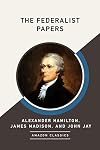
I'm reading an earlier vital text on American democracy "The Federalist Papers" at a relaxed pace and I find I am drawn again and again to the ideals of the early US founders and this preposterous joke of a President supported by the Trumptards, breaking all the protocols. It’s quite a sad read, all these impassioned arguments and the basis for checks and balances in the face of a system that has been 25% violated by Donnie The Chump and his Republican enablers. Tocqueville's “Democracy show more in America” makes much of the wisdom and social equality of the Pilgrims and of the vast uncultivated wilderness being the founding conditions for the democratic success of the US (incidentally, I'm not quite satisfied with Tocqueville's distinction between the uncultivated northern part of the continent and the cultivated southern part upon the arrival of Europeans as an explanation for the different courses of freedom and tyranny in the two hemispheres; it's one of the rare cases where he doesn't really buttress an assertion.) Would you agree that these founding conditions nurtured certain expansive traits in the American character which fed democracy for 200 years but are now depleting it?
Tocqueville cites “The Federalist Papers” extensively in “Democracy in America”. The rationality and foresight that exudes from the quotes is deeply refreshing. In my analysis of what Tocqueville says about the laws of the US, I can't see that Trump has been able to exploit any weakness. The federal constitution, with its amendments, seems to be doing its job admirably well. Arguably the 2/3 majority requirement in the Senate for impeachment might be seen as an error, but that provision was presumably intended (perhaps others can confirm this?) as a bulwark against populist sways of opinion. As ever, the Founding Fathers could provide against many contingencies, but not against the Senate being filled with fruitcakes who can't tell a conspiracy from a fact, or a principle from a bucket of pigswill.
The reality, it seems to me, is almost diametrically opposite to this: the Constitutional balance of power between the legislative, executive, and judicial branches of the federal government, balanced in the course of each checking power accumulators in the other two, and each two, in the other one, depends absolutely on actual people doing the checking-and-balancing.
McConnell and Barr (and Roberts), for example, would have to provide checks against Trump cronies ignoring lawful subpoenas. (I use their names both literally and representatively (of their party, the Republicans).)
I'm not saying that Kremlin Don is exploiting the natural "weakness" of laws, a nation of laws, ultimately depending on people to attach those laws to real circumstances, real behavior. (He couldn't exploit three four-of-a-kinds in a row at a poker table; his living as though he were a 'winner' has nothing to do with even talents for public relations or crime, and everything to do with appearing at the right time to appeal to a catastrophically susceptible not-minority-enough — and, of course, to having had a successfully crooked father go senile and to having pretended to operate a laughably transparent money Laundromat for Russian gangsters.)
The weakness, in my view, is ineradicable among human societies and cultures: no political-economic, legal, and social geodesic has such great "tensegrity" as to survive corruption in—especially—it’s most load-bearing human components. (At the moment, the best illustration of that is McConnell—but there are many other instances.)
I don't think Trump has the skilz or, in fact, the spine, to take over; to me, a greater worry is someone capable of spotting a ruling vacuum and getting, eventually, a REAL majority behind him. show less
Tocqueville cites “The Federalist Papers” extensively in “Democracy in America”. The rationality and foresight that exudes from the quotes is deeply refreshing. In my analysis of what Tocqueville says about the laws of the US, I can't see that Trump has been able to exploit any weakness. The federal constitution, with its amendments, seems to be doing its job admirably well. Arguably the 2/3 majority requirement in the Senate for impeachment might be seen as an error, but that provision was presumably intended (perhaps others can confirm this?) as a bulwark against populist sways of opinion. As ever, the Founding Fathers could provide against many contingencies, but not against the Senate being filled with fruitcakes who can't tell a conspiracy from a fact, or a principle from a bucket of pigswill.
The reality, it seems to me, is almost diametrically opposite to this: the Constitutional balance of power between the legislative, executive, and judicial branches of the federal government, balanced in the course of each checking power accumulators in the other two, and each two, in the other one, depends absolutely on actual people doing the checking-and-balancing.
McConnell and Barr (and Roberts), for example, would have to provide checks against Trump cronies ignoring lawful subpoenas. (I use their names both literally and representatively (of their party, the Republicans).)
I'm not saying that Kremlin Don is exploiting the natural "weakness" of laws, a nation of laws, ultimately depending on people to attach those laws to real circumstances, real behavior. (He couldn't exploit three four-of-a-kinds in a row at a poker table; his living as though he were a 'winner' has nothing to do with even talents for public relations or crime, and everything to do with appearing at the right time to appeal to a catastrophically susceptible not-minority-enough — and, of course, to having had a successfully crooked father go senile and to having pretended to operate a laughably transparent money Laundromat for Russian gangsters.)
The weakness, in my view, is ineradicable among human societies and cultures: no political-economic, legal, and social geodesic has such great "tensegrity" as to survive corruption in—especially—it’s most load-bearing human components. (At the moment, the best illustration of that is McConnell—but there are many other instances.)
I don't think Trump has the skilz or, in fact, the spine, to take over; to me, a greater worry is someone capable of spotting a ruling vacuum and getting, eventually, a REAL majority behind him. show less
Lists
Awards


You May Also Like
Associated Authors
Statistics
- Works
- 17
- Members
- 11,982
- Popularity
- #1,956
- Rating
- 4.1
- Reviews
- 77
- ISBNs
- 325
- Languages
- 10