

David G. Myers
Author of Psychology
About the Author
David G. Myers is John Dirk Werkman Professor of Psychology at Hope College. (Bowker Author Biography)
Image credit: Courtesy of David G. Myers.
Works by David G. Myers
The Pursuit of Happiness: Discovering the Pathway to Fulfillment, Well-Being, and Enduring Personal Joy (1992) 120 copies, 1 review
A Friendly Letter to Skeptics and Atheists: Musings on Why God Is Good and Faith Isn't Evil (2008) — Author — 40 copies, 1 review
The human puzzle: Psychological research and Christian belief (Christian perspectives on counseling and the behavioral sciences) (1978) 12 copies
The Human Puzzle 6 copies
Printed Test Banks I and II to Accompany David G. Myers' Exploring Psychology [6th Ed.] (2004) 2 copies
Image Not Available Psychology 106: Introductory Pyschology II (Brookdale Community College) 8th Edition (2009) 2 copies
Introdução à psicologia geral 2 copies
Psychology, 13th Edition 1 copy
livro psicologia 1 copy
Associated Works
This Will Make You Smarter: New Scientific Concepts to Improve Your Thinking (Edge Question Series) (2012) — Contributor — 902 copies, 17 reviews
What Is Your Dangerous Idea? Today's Leading Thinkers on the Unthinkable (2007) — Contributor — 668 copies, 8 reviews
Homosexuality and Christian Faith: Questions of Conscience for the Churches (1999) — Contributor — 252 copies, 2 reviews
Tagged
Common Knowledge
- Legal name
- Myers, David Guy
- Other names
- 萬爾斯
- Birthdate
- 1942-09-20
- Gender
- male
- Short biography
- This is a short biography of David G. Myers the psychologist: David G. Myers is a social psychologist at Hope College in Holland, Michigan, and a communicator of psychological science to college students and the general public.
His scientific writings, supported by National Science Foundation fellowships and grants and recognized by the Gordon Allport Prize, have appeared in three dozen academic periodicals, including Science, American Scientist, and Psychological Science.
He has also written for four dozen magazines, from Scientific American to Christian Century. His books include include texts for introductory and social psychology, works that relate psychological science to faith, and general audience books on happiness, intuition, sexual orientation, and hearing loss.
Myers is a Seattle native, an all-weather bicyclist, and a national advocate of hearing-aid-compatible assistive listening (see Hearingloop.org). David and Carol Myers are the parents of three adult children. [adapted slightly from A Friendly Letter to Skeptics and Atheists (2008)]
His agent if Susan Arellano.
Members
Reviews
The Pursuit of Happiness: Discovering the Pathway to Fulfillment, Well-Being, and Enduring Personal Joy by David G. Myers
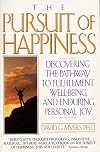
This book asks and answers the important questions about the nature and value of happiness. Is happiness rare? Can money buy happiness? Does age affect happiness? Are men happier than women? This is my favorite quote I found in the book. The essence of happiness is pausing to savor the gift of our present moments.
In a world of multi-tasking happiness may be eluding us more and more. We need to take time over our coffee, tea or soda. We need to focus on eating when eating and realize we are show more nourishing our bodies. We need to see the beauty in a fresh fallen snow and let the worries about traffic keep for when you have to deal with the traffic. We need to treasure the times that our pets cuddle with us, when a friend takes time to say hello, when a neighbor needs help, when our child takes time to need us. show less
In a world of multi-tasking happiness may be eluding us more and more. We need to take time over our coffee, tea or soda. We need to focus on eating when eating and realize we are show more nourishing our bodies. We need to see the beauty in a fresh fallen snow and let the worries about traffic keep for when you have to deal with the traffic. We need to treasure the times that our pets cuddle with us, when a friend takes time to say hello, when a neighbor needs help, when our child takes time to need us. show less
A Friendly Letter to Skeptics and Atheists: Musings on Why God Is Good and Faith Isn't Evil by David G. Myers
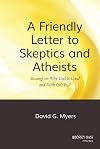
An elegantly written and argued book, focusing on finding common ground between skeptics and believers. It argues convincingly that some belief in God is not disproved by science, and that there is room for belief in the modern world.
Myers' relgious views are hard for even a skeptic to find very offensive, for they are mild and life-affirming But to make this argument, he cedes a lot of ground (rightfully I think) to the skeptics, dismissing religious views that deny evolution and the like show more as admittedly beyond the pale of reasonable discourse. But this dismissal is undercut by his own admission that 43 percent of Americans believe the world is only about 10,000 years old.
.He then argues eloquently that people who hold
religious views of this sort (himsefl included) are generally happier and enjoy a mroe fully realized life. So then why shouldn't we just agree to disagree on these points?
Myers' book is a good start towards a rational discussion on religion and whether it makes sense. I would think in the end he might well lose this argument, but at least he sets out reasonable ground rules and provides a good first round of arguments for consideration by agnostics and skeptics of a more reasoned approach to whetehr or not there is a God. It's a discussion, not a rant. show less
Myers' relgious views are hard for even a skeptic to find very offensive, for they are mild and life-affirming But to make this argument, he cedes a lot of ground (rightfully I think) to the skeptics, dismissing religious views that deny evolution and the like show more as admittedly beyond the pale of reasonable discourse. But this dismissal is undercut by his own admission that 43 percent of Americans believe the world is only about 10,000 years old.
.He then argues eloquently that people who hold
religious views of this sort (himsefl included) are generally happier and enjoy a mroe fully realized life. So then why shouldn't we just agree to disagree on these points?
Myers' book is a good start towards a rational discussion on religion and whether it makes sense. I would think in the end he might well lose this argument, but at least he sets out reasonable ground rules and provides a good first round of arguments for consideration by agnostics and skeptics of a more reasoned approach to whetehr or not there is a God. It's a discussion, not a rant. show less

Terribly biased and written based on outdated data. Myers apparently has no knowledge of biopharmacology or of the studies done on St. Johnswort. He presents statements alluding all intense religious experiences with fantasy prone personalities, a point of view prohibited by NIMH. This was also very culturally insensitive and downright offensive in places. One star for at least making concepts accessible.
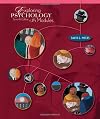
Not my favorite psychology book on the market, but it was certainly readable. Compared to other similar texts that I have read, this one did not flow the best but the information was still easy enough to understand.
Lists
You May Also Like


Associated Authors
Statistics
- Works
- 75
- Also by
- 3
- Members
- 3,180
- Popularity
- #8,034
- Rating
- 3.6
- Reviews
- 12
- ISBNs
- 404
- Languages
- 10
- Favorited
- 1