
Erika Mann (1905–1969)
Author of School for Barbarians: Education Under the Nazis
About the Author
Disambiguation Notice:
(yid) VIAF:46777706
(mao) VIAF:PND:118747436
(fre) SUDOC:028579437
(swe) SELIBR:302010
Image credit: World Telegram staff photo (Library of Congress Prints and Photographs Division, LC-USZ62-119199)
Works by Erika Mann
Klaus 2 copies
Thomas Mann : Briefe 2 copies
Thomas Mann - Eine Auslese 1 copy
Muck, der Zauberonkel 1 copy
The Lights Go Down 1 copy
Viaggio intorno al mondo 1 copy
El último año 1 copy
Associated Works
* De Provence Lege Artis: Verhalen uit het land van Van Gogh — Contributor — 1 copy
Tagged
Common Knowledge
- Canonical name
- Mann, Erika
- Legal name
- Mann, Erika Julia Hedwig
- Birthdate
- 1905-11-09
- Date of death
- 1969-08-27
- Gender
- female
- Education
- Luisengymnasium, Munich, Germany
Höhere Mädchenschule am St. Annaplatz, Bogenhausen, Germany - Occupations
- actor
children's book author
journalist - Relationships
- Mann, Thomas (father)
Mann, Klaus (brother)
Mann, Golo (brother)
Mann, Monika (sister)
Auden, W.H. (husband)
Mann, Katia (mother) (show all 8)
Mann Borgese, Elisabeth (sister)
Mann, Heinrich (uncle) - Short biography
- Erika Mann was the firstborn daughter of Thomas Mann, Nobel Prize-winning author, and his wife, Katharina Pringsheim. She was particularly close to her brother Klaus, and attended private school along with him. After gymnasium (high school), she began taking acting classes in Berlin. She had a role in the premier of Klaus Mann's 1925 play Anja und Esther. The following year, she married Gustaf Gründgens, an actor, but the couple divorced in 1929. In 1927, she and Klaus took a trip around the world, which they documented in a book, Rundherum; Das Abenteuer einer Weltreise. Erika became active in journalism and in politics, and in 1932, published the first of many children's books. In 1933, she, Klaus, and Therese Giehse founded a cabaret in Munich called Die Pfeffermühle, for which Erika wrote most of the material. She was forced to flee the Nazi regime in Germany, and helped save many of Thomas Mann's papers from their Munich home when she escaped to Zurich. In 1936, Die Pfeffermühle opened again in Zurich and became a rallying point for German exiles. In 1935, she married her friend W.H. Auden to obtain British citizenship. She travelled to New York City, where Die Pfeffermühle opened again as "The Pepper Mill," and Erika joined a large group of German artists in exile that included Kurt Weill. In 1938, she and Klaus reported on the Spanish Civil War, and she published School for Barbarians, a book about Nazi Germany's educational system. During World War II, she worked as a journalist in England, and later was one of the only women to report on the Nuremberg Trials. In 1952, she moved to Switzerland to help her father with his writing.
- Cause of death
- Cancer du cerveau
- Nationality
- Germany
- Birthplace
- Munich, Germany
- Places of residence
- Switzerland
Bogenhausen, Munich, Germany - Place of death
- Zurich, Switzerland
- Burial location
- Cimetière de Kilchberg, Près de Zurich, Suisse
- Disambiguation notice
- SUDOC:028579437
- Associated Place (for map)
- Munich, Germany
Members
Discussions
Baldrico Lectures de 2015 in Lectures des francophones (July 2016)
Reviews
School for Barbarians: Education Under the Nazis (Dover Books on History, Political and Social Science) by Erika Mann
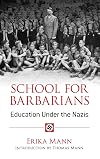
Extremely disturbing exposition of the massive amount of brainwashing and indoctrination German children were exposed to. There are lessons for today when totalitarian groups and ideologies gain control of the apparatus of education.

Anyone looking for reasons why German children were so dedicated to the Nazi ideology should read this book. It gives
you a detail look on how the Nazis perverted the education system
from kindergarten right through university. It was written in 1938 by Thomas Mann's daughter Erika, and it is still capable of
sending a chill up the spine.
you a detail look on how the Nazis perverted the education system
from kindergarten right through university. It was written in 1938 by Thomas Mann's daughter Erika, and it is still capable of
sending a chill up the spine.
Iedereen van naam die op een onzachte manier te maken kreeg met het nazisme komt hier aan bod.
Awards

You May Also Like


Associated Authors
Statistics
- Works
- 29
- Also by
- 4
- Members
- 345
- Popularity
- #69,184
- Rating
- 3.8
- Reviews
- 8
- ISBNs
- 67
- Languages
- 9
