
Arthur Rosenberg (1) (1889–1943)
Author of Imperial Germany: The Birth of the German Republic, 1871-1918 (Beacon Paperback No. 177)
For other authors named Arthur Rosenberg, see the disambiguation page.
Works by Arthur Rosenberg
Imperial Germany: The Birth of the German Republic, 1871-1918 (Beacon Paperback No. 177) (1928) 75 copies, 3 reviews
Tagged
Common Knowledge
- Canonical name
- Rosenberg, Arthur
- Birthdate
- 1889-12-19
- Date of death
- 1943-02-07
- Gender
- male
- Occupations
- historian
politcian - Nationality
- Germany
- Birthplace
- Berlin, Germany
- Place of death
- New York, New York, USA
- Associated Place (for map)
- Germany
Members
Reviews

Trying to get to the real historic facts about World War I is quite a challenge. Does anyone really know the full story? Sources could be littered with biased accounts and false information. And since World War II was basically a continuation of WWI, it is an intriguing and quite extended topic… especially considering that history does have a way of repeating itself.
Arthur Rosenberg offers his interpretation as to how and why WW I was lost by Germany. Rosenberg was a reporter commissioned show more by the Reichstag to investigate the causes of the German collapse. First published in Germany in 1928, the first English translation was printed under the title "The Birth of the German Republic 1871-1918".
Rosenberg refutes the “stab in the back” theory that Socialist and Marxist-instigated strikes and revolts in the final months of the war were a major factor in the collapse. The back cover talks of “empty political claptrap, illusions, and improvisations” that played a part in later political development. What the book content fails to mention is that Rosenberg was a member of the Germany Socialist party- the U.S.D.P. (the same party that supposedly started the revolutionary mutiny). He later joined the Communist party. He advocated a revolutionary offensive against the Weimar State. Therefore, might his interpretation be biased? Certainly it seems unavoidable.
Nonetheless, "Imperial Germany" is a worthy read. The book explains the political climate in Germany, Austria, and Hungary from the final days of Otto von Bismarck to the end of WW I. There was a lot of dissension amongst the general population… Socialist against conservative, rich against poor, Catholic against Protestant. Fear of losing internal national political power to radical Marxists and concern of foreign invasion by more powerful nations was pervasive. Contrary to what one might believe, the military, the peasants, farmers and lower middle class were all on the side of the ruling class. The Socialists were the academia and industrialists.
Rosenberg offers considerable detail regarding the internal political struggle within the Prussian government, thus schooling the reader on political science as well as German history. He presents many facts and then gives his analysis about their significance. Some are indisputable. Of course Germany could not continue the war in that last week of November 1918. They had to surrender. It was too late to win after the United States started sending massive numbers of troops to help England and France. Germany made some bad strategic decisions and put too much focus on stopping Russian interference on the Eastern Front.
"Imperial Germany" doesn’t provide all the answers but it does clarify facts about strikes, revolts, and mutiny which interfered with Germany’s ability to win the war. The outcome may have been a little more favorable in the terms of the Treaty of Versailles if internal Socialist mutiny hadn’t occurred. And if the terms had been more favorable toward Germany… who knows? Perhaps there may not have been a World War II. show less
Arthur Rosenberg offers his interpretation as to how and why WW I was lost by Germany. Rosenberg was a reporter commissioned show more by the Reichstag to investigate the causes of the German collapse. First published in Germany in 1928, the first English translation was printed under the title "The Birth of the German Republic 1871-1918".
Rosenberg refutes the “stab in the back” theory that Socialist and Marxist-instigated strikes and revolts in the final months of the war were a major factor in the collapse. The back cover talks of “empty political claptrap, illusions, and improvisations” that played a part in later political development. What the book content fails to mention is that Rosenberg was a member of the Germany Socialist party- the U.S.D.P. (the same party that supposedly started the revolutionary mutiny). He later joined the Communist party. He advocated a revolutionary offensive against the Weimar State. Therefore, might his interpretation be biased? Certainly it seems unavoidable.
Nonetheless, "Imperial Germany" is a worthy read. The book explains the political climate in Germany, Austria, and Hungary from the final days of Otto von Bismarck to the end of WW I. There was a lot of dissension amongst the general population… Socialist against conservative, rich against poor, Catholic against Protestant. Fear of losing internal national political power to radical Marxists and concern of foreign invasion by more powerful nations was pervasive. Contrary to what one might believe, the military, the peasants, farmers and lower middle class were all on the side of the ruling class. The Socialists were the academia and industrialists.
Rosenberg offers considerable detail regarding the internal political struggle within the Prussian government, thus schooling the reader on political science as well as German history. He presents many facts and then gives his analysis about their significance. Some are indisputable. Of course Germany could not continue the war in that last week of November 1918. They had to surrender. It was too late to win after the United States started sending massive numbers of troops to help England and France. Germany made some bad strategic decisions and put too much focus on stopping Russian interference on the Eastern Front.
"Imperial Germany" doesn’t provide all the answers but it does clarify facts about strikes, revolts, and mutiny which interfered with Germany’s ability to win the war. The outcome may have been a little more favorable in the terms of the Treaty of Versailles if internal Socialist mutiny hadn’t occurred. And if the terms had been more favorable toward Germany… who knows? Perhaps there may not have been a World War II. show less
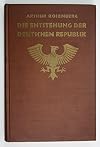
The complexities of German politics after 1890 are analyzed with masterly clarity in this work; in particular the author brings out the insoluble dilemma in which Social Democracy was placed by its status as a minority movement in a country where the government could always rely on an elected majority to block progress towards full democracy. [1961]

Nel 1935 Arthur Rosenberg pubblicava questa Geschichte der deutschen Republik, facendo seguito alla Entstehung der deutschen Republik ( in questa collana: Origini della Repubblica di Weimar), che nel 1928 segnava il suo passaggio agli studi della storia contemporanea dopo la parentesi politica e parlamentare. "Uscito nel 1927 dalla KPD, il problema di Rosenberg è inizialmente (1928) quello di ripristinare una analisi derlla rivoluzione di novembre che renda ragione dell'esito politico di un show more processo apertosi nel movimento operaio sotto l'insegna della rivoluzione mondiale, poi (1934), ma su di una linea di interiore continuità, di evidenziare i tratti salienti dio una dinamica politica che ha imposto al movimento operaio una completa paralisi politica determinandone in ultima istanza la distruzione fisica. Nasce di qui quel singolare intreccio tra l'esposizione e l'analisi dei movimenti e la serrata discussione critica dei più remoti fondamenti teorici della strategia del movimento operaio, che costituisce il carattere peculiare di questa indagine storica, così come si viene definendo non attraverso un largo reperimento di fonti inedite, ma nella ricerca di una verifica e di un approfondimento continuo di alcune ipotesi interpretative, tutte ruotanti attorno al rapporto democrazia-socialismo". show less
May 23, 2014 (Edited)Italian

Nel 1928 Arthur Rosenberg pubblicava questa Entstehung der deutschen Republik 1871-1918, cui avrebbe fatto seguito nel 1935 la Geschichte der deutschen Republik (in questa collana: Storia della Repubblica di Weimar), come primo risultato del suo nuovo interesse per gli studi di storia contemporanea dopo la parentesi politica e parlamentare (nel 1928 era scaduto il suo mandato al Reichstag come rappresentante della KPD, nel 1927 aveva abbandonato il movimento comunista esprimendo show more pubblicamente il suo dissenso sulla politica del Comintern). Dal 1925 al 1928 aveva fatto parte della Commissione di inchiesta del Reichstag sulle cause della sconfitta tedesca ed era stato relatore sulla questione della cosiddetta " pugnalata alla schiena". E' chiaro, quindi, che l'indagine storica in questo caso non era che il prolungamento della sua attività di politico militante: "ripristinare una analisi della rivoluzione di novembre che rendesse ragione dell'esito politico di un processo apertosi nel movimento operaio sotto l'insegna della rivoluzione mondiale" (dalla Introduzione di Leonardo Paggi al presente volume). In questa analisi si propose di evitare ogni giudizio che potesse apparire viziato di parzialità. "Ho scritto questo libro- così dichiara Rosenberg il suo intento nella prefazione - senza alcun riguardo a orientamenti politici e senza voler salvaguardare il prestigio di alcun partito e non credo che la mia attività politica nell'ultimo decennio mi abbia indotto a formulare giudizi parziali. Nella stesura dell'opera ho sempre tenuto presente il pericolo di rimanere prigioniero della "leggenda storica, indipendentemente dal fatto che provenisse da destra o da sinistra. show less
You May Also Like


Associated Authors
Statistics
- Works
- 9
- Members
- 172
- Popularity
- #124,307
- Rating
- 3.8
- Reviews
- 4
- ISBNs
- 24
- Languages
- 6
- Favorited
- 2