
David Guterson
Author of Snow Falling on Cedars
About the Author
David Guterson was born in Seattle and later graduated from the University of Washington. Before becoming a full-time writer, Guterson was a high school English teacher and a contributing editor for Harper's Magazine. Guterson has published The Country Ahead of Us, The Country Behind, a collection show more of short stories, and Family Matters: Why Home Schooling Makes Sense, a nonfiction book. Snow Falling on Cedars is Guterson's most famous work; it has won the Pen/Faulkner Award and was an American Booksellers Book of the Year Nominee. (Bowker Author Biography) show less
Image credit: David Guterson at The Times Cheltenham Literature Festival on October 11, 2008 in Cheltenham, England
Works by David Guterson
Odyssean Journeys Collection: Cold Mountain, Snow Falling on Cedars, and East of the Mountains (2001) — Contributor — 3 copies
1999 1 copy
Associated Works
Tagged
Common Knowledge
- Legal name
- Guterson, David
- Birthdate
- 1956-05-04
- Gender
- male
- Education
- University of Washington
- Occupations
- author
- Organizations
- Field's End
Granta's Best Of Young American Novelists (1996) - Awards and honors
- Granta's Best Of Young American Novelists (1996)
- Relationships
- Guterson, Mary (sister)
- Nationality
- USA
- Birthplace
- Seattle, Washington, USA
- Places of residence
- Seattle, Washington, USA
Bainbridge Island, Washington, USA - Associated Place (for map)
- Washington, USA
Members
Reviews

This is a multi-faceted novel that addresses issues of guilt, evil, justice, and family, all through the description of a courtroom drama. Told in the first person, the narrator is an author who has decided to take a break from writing fiction, so he is available to help his aged father take on his final defense case. It is quickly apparent that the defendants are guilty of a horrific crime, the abuse and torture of the girl they have adopted from Ethiopia. The couple believes show more unquestioningly in the power of physical punishment to teach their children to submit to their authority in all things, and in the guise of morality they inflict increasing torture on their victim who refuses to submit. Even knowing their guilt, their lawyer believes in their right to a proper defense and the need for the trial to play out. At times, this novel is extremely uncomfortable to read, yet compelling for the moral and ethical questions raised, and the contemporary dilemmas posed by people convinced of their own moral rectitude turned evil by most standards. show less
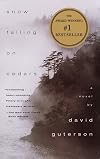
Snow Falling on Cedars is set after World War II and centers on a trial of a Japanese American fisherman accused of murder, but it’s about much more than just the courtroom. Through flashbacks, the novel slowly reveals the complicated lives and histories of the people involved, showing how World War II, Pearl Harbor, and the incarceration of Japanese Americans changed their island community. The racism isn’t always explicit but it’s there, woven into everyday life, and it plays a big show more role in the story. The novel explores how prejudice lingers, even in places that once seemed close-knit or welcoming show less
This was so close to being an incredible, essential book, but some fatal flaws halfway ruined it for me.
First the good: it's a powerful story, primarily about the atrocity that was the US's WW2 internment of Japanese-Americans, and with some important secondary themes like how the war itself damaged people and how men can hurt ourselves by internalising all our problems. Guterson's also a very talented writer, switching easily between a precise clinical style that fits the courtroom elements show more of the story, and a lyrical style that captures the feel of Puget Sound in winter beautifully.
But there were three flaws that by the end of the book really took a lot away in my eyes:
1. The two Japanese families who have major parts in the story feel like instances of a culture, not sets of living breathing characters. Even the two individuals from those families who are at the centre of the story felt more like roles than people. By halfway through I found myself really wanting to read a Nisei author's telling of the same story. And it's odd because this isn't about trading in nasty stereotypes--the author is clearly very much on their side, but still can't quite get past essentialising their culture.
2. Guterson has a strange obsession with penises, the size thereof, and writing very mechanical sex scenes in which the insertion of peg A into slot B is jarringly unsexy but kicks off massive emotional repercussions. Those scenes felt like they were written by a teenage boy feeling pressure to lose his virginity, and it's all the stranger because he's so good at writing other types of scene.
3. I'm going to hide this one. It's not exactly a suspense spoiler, but I don't want my impression of it to colour other peoples' reactions if you're reading this book with fresh eyes.I hated how at the end the book suddenly becomes Ishmael's redemption story. That character was interesting--I liked him a lot at the start of the book and progressively less as the story unfolded--but ultimately worthwhile for how disturbingly relatable his faults were. But suddenly at the end Guterson made the story not about Kabuo, Hisao or Carl at all, and all about the emotionally-still-a-teenager white boy saving the day by getting over his baggage. I wish I could rewrite it to either not require him to be the one who announces the new evidence, or having his mum coerce or shame him into revealing it. show less
First the good: it's a powerful story, primarily about the atrocity that was the US's WW2 internment of Japanese-Americans, and with some important secondary themes like how the war itself damaged people and how men can hurt ourselves by internalising all our problems. Guterson's also a very talented writer, switching easily between a precise clinical style that fits the courtroom elements show more of the story, and a lyrical style that captures the feel of Puget Sound in winter beautifully.
But there were three flaws that by the end of the book really took a lot away in my eyes:
1. The two Japanese families who have major parts in the story feel like instances of a culture, not sets of living breathing characters. Even the two individuals from those families who are at the centre of the story felt more like roles than people. By halfway through I found myself really wanting to read a Nisei author's telling of the same story. And it's odd because this isn't about trading in nasty stereotypes--the author is clearly very much on their side, but still can't quite get past essentialising their culture.
2. Guterson has a strange obsession with penises, the size thereof, and writing very mechanical sex scenes in which the insertion of peg A into slot B is jarringly unsexy but kicks off massive emotional repercussions. Those scenes felt like they were written by a teenage boy feeling pressure to lose his virginity, and it's all the stranger because he's so good at writing other types of scene.
3. I'm going to hide this one. It's not exactly a suspense spoiler, but I don't want my impression of it to colour other peoples' reactions if you're reading this book with fresh eyes.
Snow Falling on Cedars
By David Guterson
1995, Vintage
Paperback, 460pp
"...accident ruled every corner of the universe except the chambers of the human heart."
Every once in a while a novel finds you and perfectly satisfies your present literary needs. Character depth, plot complexity, controlled pacing, deft perspective- and time-shifting, taut sentences crafted to please anyone sensitive to language—it's all here. Sometimes you just want a conventional, well-executed, American novel, on the show more order of, say, Philip Roth or Donna Tartt. This was it for me, and I can press on knowing that my rendez-vous will not soon pass from memory. show less
By David Guterson
1995, Vintage
Paperback, 460pp
"...accident ruled every corner of the universe except the chambers of the human heart."
Every once in a while a novel finds you and perfectly satisfies your present literary needs. Character depth, plot complexity, controlled pacing, deft perspective- and time-shifting, taut sentences crafted to please anyone sensitive to language—it's all here. Sometimes you just want a conventional, well-executed, American novel, on the show more order of, say, Philip Roth or Donna Tartt. This was it for me, and I can press on knowing that my rendez-vous will not soon pass from memory. show less
Lists
Murder Mysteries (1)
Sense of place (1)
Unread books (1)
Page Turners (1)
First Novels (1)
Florida (1)
AP Lit (1)
Legal Stories (1)
Winter Books (1)
USA Road Trip (1)
1990s (1)
Awards


You May Also Like


Associated Authors
Statistics
- Works
- 24
- Also by
- 7
- Members
- 20,507
- Popularity
- #1,058
- Rating
- 3.7
- Reviews
- 356
- ISBNs
- 318
- Languages
- 18
- Favorited
- 16


