
Jennifer Senior
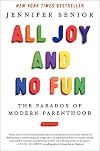
Author of All Joy and No Fun: The Paradox of Modern Parenthood
About the Author
Jennifer Senior is a contributing editor at New York magazine. All Joy and No Fun: The Paradox of Modern Parenthood is her first book. (Bowker Author Biography)
Image credit: Jennifer Senior
Works by Jennifer Senior
Associated Works
Tagged
Common Knowledge
- Gender
- female
- Education
- Princeton University
- Occupations
- staff writer
book critic - Organizations
- New York Magazine
The New York Times
Members
Reviews
this is really interesting and so much of it resonated with me. also gave me some insight into some of the challenges that will be ahead in the later parenting years, although i suspect it's like parenting in general - impossible to know or prepare for, or really even understand until you're in the midst of it. it's nice to have some validation about how unhappy being a parent can make someone, since society at large really doesn't talk about that. (and it was interesting, and logical, that show more this is especially true for people who had to go out of their way to have a child - adoption, in vitro, surrogacy, etc - as we are more likely to attach more of an expectation of happiness or fulfillment around something that took so much intention.) i do feel like, even though this isn't a parenting book in the traditional sense or even her intention, that there are take away ideas in here about how to be a happier, more present parent, that will be good for me to try to implement.
(one thing bears saying: there was a word she used early on, i didn't mark it so can't be sure but i think it was "gypped," that i can't believe made it past the editors. gave me serious pause at the time.)
one of the many interesting statistics:
"...the wage gap between mothers and childless women who are otherwise equally qualified is now greater than the gap between women and men generally." show less
(one thing bears saying: there was a word she used early on, i didn't mark it so can't be sure but i think it was "gypped," that i can't believe made it past the editors. gave me serious pause at the time.)
one of the many interesting statistics:
"...the wage gap between mothers and childless women who are otherwise equally qualified is now greater than the gap between women and men generally." show less
I’m working on a book right now about how those of us without children can relate to our friends with kids. I don’t have kids and I won’t be having kids, so most of what I know about kids comes from watching my friends raising their own.
But I live in the world, and I see so much out there about the best ways to parent. It seems overwhelming, but it also seems to almost always be focused on what the parents do and how that impacts the children. Other than the occasional “are parents show more happier than non-parents?” studies, nothing (until now) has focused on what parenting does to the parents.
This book is a fascinating treasure trove for those of us without kids. Ms. Senior (a parent herself) spent time with parents, read loads of studies, and consulted with the experts before putting together this long but extremely quick read. She covers autonomy, marriage, the joys and challenges of raising small children, the (new?) trend of scheduling and planning all of a child’s free time, and the special hell that is adolescence.
One thing I appreciated from this book is that (with one tiny, and likely unintentional exception) Ms. Senior doesn’t spend time comparing parents to non-parents in any way that suggests one life choice is better than the other. I also liked that Ms. Senior was also very straightforward about the limitations of this book – it does not address very poor or very rich families; it is focused on studying middle class families.
Another great component of this book is Ms. Senior’s way of weaving the history of parenthood into the narrative. So many things that seem ‘common sense’ or ‘parental intuition’ are pretty new to parenthood! But the best parts are the families she interviews and how she includes their stories. She does this seamlessly without interrupting the flow of the book.
Obviously as someone without kids I can’t speak to whether parents themselves will enjoy this book. They might find it hits way too close to home, they might angrily disagree, or they might find relief in knowing their experiences are not unique. But I’d love to hear a parent’s perspective on this one! show less
But I live in the world, and I see so much out there about the best ways to parent. It seems overwhelming, but it also seems to almost always be focused on what the parents do and how that impacts the children. Other than the occasional “are parents show more happier than non-parents?” studies, nothing (until now) has focused on what parenting does to the parents.
This book is a fascinating treasure trove for those of us without kids. Ms. Senior (a parent herself) spent time with parents, read loads of studies, and consulted with the experts before putting together this long but extremely quick read. She covers autonomy, marriage, the joys and challenges of raising small children, the (new?) trend of scheduling and planning all of a child’s free time, and the special hell that is adolescence.
One thing I appreciated from this book is that (with one tiny, and likely unintentional exception) Ms. Senior doesn’t spend time comparing parents to non-parents in any way that suggests one life choice is better than the other. I also liked that Ms. Senior was also very straightforward about the limitations of this book – it does not address very poor or very rich families; it is focused on studying middle class families.
Another great component of this book is Ms. Senior’s way of weaving the history of parenthood into the narrative. So many things that seem ‘common sense’ or ‘parental intuition’ are pretty new to parenthood! But the best parts are the families she interviews and how she includes their stories. She does this seamlessly without interrupting the flow of the book.
Obviously as someone without kids I can’t speak to whether parents themselves will enjoy this book. They might find it hits way too close to home, they might angrily disagree, or they might find relief in knowing their experiences are not unique. But I’d love to hear a parent’s perspective on this one! show less
I don't know who the audience of "All Joy and No Fun" is supposed to be, but it's certainly not me. I kept stopping the book, re-reading passages aloud to my partner, and then we'd both giggle and say, "Who are these people?"
Here is what I learned:
A. Being a parent means that you are not the protagonist in your own story anymore, and if you're not ok with that, then parenting is going to be rough on you. (Technically I didn't really "learn" that, since we'd already thought it through and show more discussed it ad nauseum before we decided to become parents.)
B. If there are cracks in your relationship about communication and/or division of labor, then babies will make it worse. So get your act together before procreating. Also, having one parent stay at home seems to exacerbate the situation. Unless you are independently wealthy, one stay-at-home parent is a recipe for divorce. Get thee back to work.
C. Lots of middle class white families need to chill the f out already.
I felt so super smug after reading this book. It's good to feel smug. show less
Here is what I learned:
A. Being a parent means that you are not the protagonist in your own story anymore, and if you're not ok with that, then parenting is going to be rough on you. (Technically I didn't really "learn" that, since we'd already thought it through and show more discussed it ad nauseum before we decided to become parents.)
B. If there are cracks in your relationship about communication and/or division of labor, then babies will make it worse. So get your act together before procreating. Also, having one parent stay at home seems to exacerbate the situation. Unless you are independently wealthy, one stay-at-home parent is a recipe for divorce. Get thee back to work.
C. Lots of middle class white families need to chill the f out already.
I felt so super smug after reading this book. It's good to feel smug. show less
This book is about the experience of being a parent. It takes a look at the various ways children throw your life a completely new realm. There's the bad -- they decrease your autonomy, strain your marriage, require a lot of work, bring a whole new host of social pressures (and all that gets worse with adolescence) -- and then there's the good. The good is harder to describe concisely. The best the author could do is the statement that gave her the title of the book -- that children are all show more joy and no fun. The book tries to capture some essence of that joy: the way children help you escape from your day-to-day self, the way they help you see the world with new eyes, and the sometimes heartbreaking joy of loving someone so much.
While this book did a great job of capturing the feelings of parenthood, of putting into words feelings that are familiar to me even after less than a year of being a parent, in the end, it was more a memoir of the experience of being a parent than an analysis of modern parenthood (a well researched memoir, to be fair). For many people, that probably hits just the point that they are looking for, but my preference in general is for books to dive a little more deeply into the whys and therefores than this one did. show less
While this book did a great job of capturing the feelings of parenthood, of putting into words feelings that are familiar to me even after less than a year of being a parent, in the end, it was more a memoir of the experience of being a parent than an analysis of modern parenthood (a well researched memoir, to be fair). For many people, that probably hits just the point that they are looking for, but my preference in general is for books to dive a little more deeply into the whys and therefores than this one did. show less
Lists
Awards


You May Also Like


Associated Authors
Statistics
- Works
- 4
- Also by
- 4
- Members
- 499
- Popularity
- #49,588
- Rating
- 3.8
- Reviews
- 25
- ISBNs
- 16
- Languages
- 2