
About the Author
Madeline Levine, Phd, is a psychologist, consultant, speaker, and educator as well as the author of the New York Times bestsellers Teach Your Children Well and The Price of Privilege. She is a cofounder of Challenge Success, a project of the Stanford School of Education that addresses education show more reform, student well-being, and parent education. She is also a consultant and advisor to founder- and family-led companies. She lives in San Francisco with her husband and is the proud mother of three grown sons and their remarkable expanding families. show less
Image credit: via author's website
Works by Madeline Levine
The Price of Privilege: How Parental Pressure and Material Advantage Are Creating a Generation of Disconnected and Unhappy Kids (2006) 472 copies, 3 reviews
Teach Your Children Well: Why Values and Coping Skills Matter More Than Grades, Trophies, or "Fat Envelopes" (2012) 138 copies, 4 reviews
Ready or Not: Preparing Our Kids to Thrive in an Uncertain and Rapidly Changing World (2020) 40 copies, 2 reviews
Associated Works
Tagged
Common Knowledge
- Gender
- female
Members
Reviews
The Price of Privilege: How Parental Pressure and Material Advantage Are Creating a Generation of Disconnected and Unhappy Kids by Madeline Levine
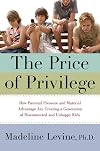
I'm not a huge fan of the title. But I do support the idea that feeling loved, a sense of autonomy, and allowed to follow things that interest you are important needs. It's also true that children need so much more than things. Another idea that she never really pointed out was the (modeled here) tragedy that here are hundreds, if not a couple thousand, of teenagers that replace their parents with her---their therapist. The final chapters, aimed specifically at mothers, were worthwhile and show more sad, at the same time.
It was interesting that she didn't really seem to address how poverty can exacerbate these issues(compounded with the stress of worrying about basic shelter, food, and other needs). For example, if nothing changes, we will make 25000 this year. Our ability to choose is severely limited by that---as is our ability to have fun hobbies. It can be draining. Stress over money can mute the love and attention that parents are able to show to each other and their children. I'm not complaining, just saying that it's not just a problem that the "privileged" have. I just want more information on that hypothetically ideal middle ground.
We should be acutely aware of the children in our society, no matter where or how they live. If they(or their parents) can afford the AP courses, the Ivy League schools, and the private tutors, we should still care for their mental and physical health. If they (or their parents) can't afford clothing, food, shelter, extracurricular activities, a bus pass, or gas for their cars, we should still care for their mental and physical health. They are, as Levine rightly says, the future.And, as she chillingly points out, permissive parents who hire lawyers to defend their children and state that "boys will be boys" after abusing disabled children are creating an incredibly dangerous world. Brock Turner anyone? show less
It was interesting that she didn't really seem to address how poverty can exacerbate these issues(compounded with the stress of worrying about basic shelter, food, and other needs). For example, if nothing changes, we will make 25000 this year. Our ability to choose is severely limited by that---as is our ability to have fun hobbies. It can be draining. Stress over money can mute the love and attention that parents are able to show to each other and their children. I'm not complaining, just saying that it's not just a problem that the "privileged" have. I just want more information on that hypothetically ideal middle ground.
We should be acutely aware of the children in our society, no matter where or how they live. If they(or their parents) can afford the AP courses, the Ivy League schools, and the private tutors, we should still care for their mental and physical health. If they (or their parents) can't afford clothing, food, shelter, extracurricular activities, a bus pass, or gas for their cars, we should still care for their mental and physical health. They are, as Levine rightly says, the future.

As author Madeline Levine asserts right from the start, Teach Your Children Well aspires to be the level-headed middle ground between the extreme parenting styles du jour the media is fawning over lately (i.e. "tiger moms versus coddling moms"). Micro-managing is not the answer, but neither is being a child's best friend over being a parent. To this end, she persuades us of a moderation and comes out ahead.
The core of the book moves sequentially from childhood through high school with Levine show more offering up plenty of practical advice and real-life examples. I was the most impressed by two areas she emphasized that made the whole book worth checking out. One is for the parent to listen every step of the way. Genuine, thoughtful listening. As a practicing psychologist as well as author, listening is no doubt a part of Levine's life, but nevertheless, she encourages the same standard for all parents. And two, how she addresses the sexual growth of teenagers in an honest and realistic way. This is a sensitive subject for many, and for Levine to speak unabashedly on sex gives her case a lot of weight.
The final chapter, the one titled "Editing the Script," really showcases Levine's enthusiasm for parenting as a beautiful work in progress. Her passion is the most evident here, but this section is also the most indulgent. Tightening it down to half its size or more would have made for a stronger sendoff. show less
The core of the book moves sequentially from childhood through high school with Levine show more offering up plenty of practical advice and real-life examples. I was the most impressed by two areas she emphasized that made the whole book worth checking out. One is for the parent to listen every step of the way. Genuine, thoughtful listening. As a practicing psychologist as well as author, listening is no doubt a part of Levine's life, but nevertheless, she encourages the same standard for all parents. And two, how she addresses the sexual growth of teenagers in an honest and realistic way. This is a sensitive subject for many, and for Levine to speak unabashedly on sex gives her case a lot of weight.
The final chapter, the one titled "Editing the Script," really showcases Levine's enthusiasm for parenting as a beautiful work in progress. Her passion is the most evident here, but this section is also the most indulgent. Tightening it down to half its size or more would have made for a stronger sendoff. show less
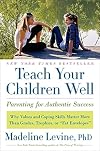
Focusing on views of success and child rearing, a renowned psychologist combines cutting-edge research with thirty years of clinical experience to explain how to shift focus to a parenting style that promotes academic success, a sense of purpose, and meaning in life.
As author Madeline Levine asserts right from the start, Teach Your Children Well aspires to be the level-headed middle ground between the extreme parenting styles du jour the media is fawning over lately (i.e. "tiger moms versus show more coddling moms"). Micro-managing is not the answer, but neither is being a child's best friend over being a parent. To this end, she persuades us of a moderation and comes out ahead.
The core of the book moves sequentially from childhood through high school with Levine offering up plenty of practical advice and real-life examples. I was the most impressed by two areas she emphasized that made the whole book worth checking out. One is for the parent to listen every step of the way. Genuine, thoughtful listening. As a practicing psychologist as well as author, listening is no doubt a part of Levine's life, but nevertheless, she encourages the same standard for all parents. And two, how she addresses the sexual growth of teenagers in an honest and realistic way. This is a sensitive subject for many, and for Levine to speak unabashedly on sex gives her case a lot of weight.
The final chapter, the one titled "Editing the Script," really showcases Levine's enthusiasm for parenting as a beautiful work in progress. Her passion is the most evident here, but this section is also the most indulgent. Tightening it down to half its size or more would have made for a stronger sendoff. ( ) show less
As author Madeline Levine asserts right from the start, Teach Your Children Well aspires to be the level-headed middle ground between the extreme parenting styles du jour the media is fawning over lately (i.e. "tiger moms versus show more coddling moms"). Micro-managing is not the answer, but neither is being a child's best friend over being a parent. To this end, she persuades us of a moderation and comes out ahead.
The core of the book moves sequentially from childhood through high school with Levine offering up plenty of practical advice and real-life examples. I was the most impressed by two areas she emphasized that made the whole book worth checking out. One is for the parent to listen every step of the way. Genuine, thoughtful listening. As a practicing psychologist as well as author, listening is no doubt a part of Levine's life, but nevertheless, she encourages the same standard for all parents. And two, how she addresses the sexual growth of teenagers in an honest and realistic way. This is a sensitive subject for many, and for Levine to speak unabashedly on sex gives her case a lot of weight.
The final chapter, the one titled "Editing the Script," really showcases Levine's enthusiasm for parenting as a beautiful work in progress. Her passion is the most evident here, but this section is also the most indulgent. Tightening it down to half its size or more would have made for a stronger sendoff. ( ) show less
Ready or Not: Preparing Our Kids to Thrive in an Uncertain and Rapidly Changing World by Madeline Levine
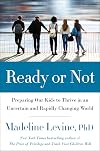
I found lots of good tidbits of new information in between pockets of studies and advice I'd found in other sources. Which is totally not their fault. Nor was it impossible to sift out her political leanings--- something which, depending on the person and the time, might detract from the message.
I really thought she had some unique points in the second-to-last chapter, though I didn't quite see the connection to the overall topic.
The most surprising thing in the book was her position on show more teen advocacy which, because it is more recent than most of the books I've read, included the response to the Parkland shooting. Her stance shocked me because the whole book had been about how we need to not push/drag our children into adulthood. However, what I think she meant, was that when it inevitably happens(as it does in times like these) this is a better and more empowering response? I would have appreciated a bit more clarification on that. show less
I really thought she had some unique points in the second-to-last chapter, though I didn't quite see the connection to the overall topic.
The most surprising thing in the book was her position on show more teen advocacy which, because it is more recent than most of the books I've read, included the response to the Parkland shooting. Her stance shocked me because the whole book had been about how we need to not push/drag our children into adulthood. However, what I think she meant, was that when it inevitably happens(as it does in times like these) this is a better and more empowering response? I would have appreciated a bit more clarification on that. show less
You May Also Like


Statistics
- Works
- 6
- Also by
- 1
- Members
- 666
- Popularity
- #37,862
- Rating
- 3.8
- Reviews
- 9
- ISBNs
- 25
- Languages
- 1