
Julie Lythcott-Haims
Author of How to Raise an Adult: Break Free of the Overparenting Trap and Prepare Your Kid for Success
About the Author
Julie Lythcott-Haims served as dean of freshmen and undergraduate advising at Stanford University, where she received the Dinkelspiel Award for her contributions to the undergraduate experience. She holds a BA from Stanford University, a JD from Harvard Law School, and an MFA in writing from show more California College of the Arts. She is a member of the San Francisco Writers' Grotto, and resides in the Bay Area with her husband, their two teenagers, and her mother. show less
Works by Julie Lythcott-Haims
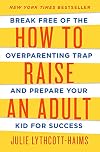
How to Raise an Adult: Break Free of the Overparenting Trap and Prepare Your Kid for Success (2015) 558 copies, 20 reviews
Tagged
Common Knowledge
Members
Reviews
How to Raise an Adult: Break Free of the Overparenting Trap and Prepare Your Kid for Success by Julie Lythcott-Haims
As the mother of a tween in an upper middle/upper class suburb, I have often wondered about the change in parenting expectations that I have seen between the parents of my generation versus how my friends and I were parented. The norm these days seems to be that we are supposed to be heavily involved in the homework load and school projects, setting up play dates, extracurricular activities, educational camps, etc. I grew up in a working class community, where the parents were not expected show more to micromanage their children's lives to this extent. I have been wondering for a few years now whether this is simply a difference in having moved up the socioeconomic ladder, or whether parenting has changed across the board.
The book How to Raise an Adult tackles this issue, specifically how many parents in middle/upper class communities are over-parenting their children in order to help them secure the best opportunities in life. The author says that we often do this in the hope that our children will get into one of the most competitive universities, but our well-meaning intent can lead to producing helpless young adults. Do we want our children to be high academic achievers but be uncomfortable making simple decisions for themselves and performing simple household tasks? Or should we take a step back, let our children take over more of the control and the decision making process for their own lives, even though it will be uncomfortable to watch them fail?
The author clearly laid out the benefits to going against the current culture of over-parenting, as well as discussing why the goal of pushing our children toward a top college might not lead to the happiest/most successful career path after all. She also laid out some practical ideas/examples to stop over-parenting in our day to day interactions with our children. I found this to be a very timely and thought-provoking read, and would certainly recommend it to friends. show less
The book How to Raise an Adult tackles this issue, specifically how many parents in middle/upper class communities are over-parenting their children in order to help them secure the best opportunities in life. The author says that we often do this in the hope that our children will get into one of the most competitive universities, but our well-meaning intent can lead to producing helpless young adults. Do we want our children to be high academic achievers but be uncomfortable making simple decisions for themselves and performing simple household tasks? Or should we take a step back, let our children take over more of the control and the decision making process for their own lives, even though it will be uncomfortable to watch them fail?
The author clearly laid out the benefits to going against the current culture of over-parenting, as well as discussing why the goal of pushing our children toward a top college might not lead to the happiest/most successful career path after all. She also laid out some practical ideas/examples to stop over-parenting in our day to day interactions with our children. I found this to be a very timely and thought-provoking read, and would certainly recommend it to friends. show less
 This review was written for LibraryThing Early Reviewers.
How to raise an adult : break free of the overparenting trap and prepare your kid for success by Julie Lythcott-Haims
Free LibraryThing Early Reviewer book. Wealthy parents, especially mothers, are spending way too much time and energy trying to make sure their children are perfect and go to Stanford, Yale, or Harvard. They do homework for their kids; they get their kids ADHD diagnoses; they intervene in personal disputes to smooth the way. This strategy paradoxically backfires and leaves the children stressed, possibly abusing drugs, ungrounded and uninterested in learning, and unable to accomplish show more ordinary life tasks for themselves. I was struck when reading the book how much the practices described synced up with the anti-vaccination movement: they both come from a place of mistrust. Mistrust of other people to treat your child right; mistrust of institutions like schools, universities, even the military. And mistrust of any outreach to others that isn’t paid coaching, as if relations outside the family can only be monetary exchanges. This turning inward is an effect and a cause of growing inequality. It’s a very sad picture. And I’m certainly vulnerable to these pressures; I too would like my kids to go to a top college and avoid severe suffering. When people a few miles away got child welfare called on them for letting their kids walk a mile alone, it’s hard to relax about letting your kids be independent. The advice to individual parents is sensible enough, given the problem: get your own life, let your kid make mistakes, let them find the path that’s right for them even though that path probably does not lead to Stanford, Yale, or Harvard. show less
This review was written for LibraryThing Early Reviewers.How to Raise an Adult: Break Free of the Overparenting Trap and Prepare Your Kid for Success by Julie Lythcott-Haims
Brilliant and interesting, this book discusses the recent trend of "helicopter parenting" and the effects it is having on children and society. Julie Lythcott-Haims bases her book on interviews with teenagers, parents, teachers, high school principals and guidance counselors, and college admissions professionals, as well as on her own experience as a parent and a freshman dean at Stanford. In addition to writing about the unintended consequences of overparenting (depression, drug abuse, show more stress, and young adults who are not capable of independence), she provides practical advice for how parents can overcome the trend in their own home and neighborhoods.
I particularly like the discussion about college admissions. She stresses that finding the right college is about fit more than about prestige. Ivy league and similar colleges are not the only choice, and often are not even the right choice for a particular kid.
This book does have a definite perspective that may not feel relatable to all parents - Lythcott-Haims is an upper middle class, well-educated, professional mother - but parents from other walks of life can certainly take the bits and pieces that apply to them. show less
I particularly like the discussion about college admissions. She stresses that finding the right college is about fit more than about prestige. Ivy league and similar colleges are not the only choice, and often are not even the right choice for a particular kid.
This book does have a definite perspective that may not feel relatable to all parents - Lythcott-Haims is an upper middle class, well-educated, professional mother - but parents from other walks of life can certainly take the bits and pieces that apply to them. show less
This review was written for LibraryThing Early Reviewers.How to raise an adult : break free of the overparenting trap and prepare your kid for success by Julie Lythcott-Haims
This book came to my attention having been recommended by my daughter's middle school. It was eye-opening and a bit of a wake-up call for me, as I could see some of the same dynamics playing out in our household. Lythcott-Haims' essential premise is that kids need responsibilities and challenges to feel confident and grow a sense of independence, and by denying them (doing everything for them and not allowing them to experience failure or navigate conflict) we are not setting them up for show more success. I took photos (my version of highlighting) of many passages and ideas to refer back to later on. Definitely a must-read for parents today. show less
Lists
Awards

You May Also Like


Associated Authors
Statistics
- Works
- 4
- Members
- 793
- Popularity
- #32,131
- Rating
- 4.1
- Reviews
- 31
- ISBNs
- 23
