
Jonathan Tweet
Author of Player's Handbook: Core Rulebook I (3.5)
About the Author
Works by Jonathan Tweet
Dungeon Master's Guide: Core Rulebook II (3.5) (2003) — Author, some editions — 1,086 copies, 3 reviews
Dungeons & Dragons Core Rulebook Set (Dungeons & Dragons d20 3.5 Fantasy Roleplaying, Three Book Slipcased Set) (2003) 83 copies
Ars Magica - Die Kunst der Magie. Die Kunst der Magie / Ars Magica - Die Kunst der Magie (1997) 3 copies
Over the Edge 3rd ed 2 copies
Dungeon master's guide 2 copies
Fighter Wizard Elf 1 copy
Associated Works
Monster Manual: Core Rulebook III (3.5) (2003) — Author, some editions; Author, some editions — 1,031 copies, 3 reviews
Second Person: Role-Playing and Story in Games and Playable Media (2007) — Contributor — 113 copies, 1 review
Player's Guide - Rulebook IV (Dungeons & Dragons: Kingdoms of Kalamar) (2002) — Contributor — 46 copies, 1 review
Tagged
Common Knowledge
- Birthdate
- 1965-09-29
- Gender
- male
- Organizations
- Wizards of the Coast
- Nationality
- USA
- Birthplace
- Rock Island, Illinois, USA
- Places of residence
- Seattle, Washington, USA
Rock Island, Illinois, USA - Map Location
- Illinois, USA
Members
Reviews
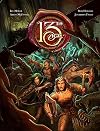
When most gamers sit down and decide to write 'D&D but better', we call it a fantasy heartbreaker. When Rob Heinsoo and Johnathan Tweet (lead designers of D&D 4e and D&D 3rd respectively) decide to do that, the result is an elegant and exciting roleplaying game that combines the best features of many D&D versions.
At the core of 13th Age are the Icons, 13 powerful mortal archetypes who shake the world and whom the player characters have a relationship. The Icons are a mechanical realization show more of the big NPCs in many settings, but in 13th Age they're divided against each other in tangled alliances and enmities, stretched to the limits of their abilities, and poised on the edge of catastrophe. The whole setting feels like Europe circa 1914, in a good way. The game is structured for thing to fall apart and the players to decide how the rubble will land.
Character classes are another highlight of 13th Age. Classes have been compressed into 10 levels, and are made nicely distinct from each other. For example, Fighters can pick what power they use after they attack, Bards sing songs where the final verse has an escalating effect, and Sorcerers charge their spells before attacking. Within classes there's plenty of room for diversity by picking Talents and attacks individually from a list, and enhancing them with Feats. Characters will only master three skills by the end of the game, which makes for satisfying but reasonable choices.
Combat is no longer tied to the grid as it was in 4e, with a more flexible system of engaged/disengaged replacing detailed movement rules. Much of the built in complexity of 3rd is removed, such as rules for Grapples, Trips, and Disarms. Hitpoints as the sole measure of combat endurance along with a Helaing Surge style mechanism (resurgance) are welcome 4e carryovers. Spells and weapons remain competitive through the level, with a 10th level warrior doing 10d8+3*Str damage with their longsword and 10th level wizard unleashing similar spell damage damage. Save-or-suck only works on creature with low hitpoints, so powerful enemies have to be whittled down first.
The GMing section provides a basic stock of monsters and magic items, and some useful guidelines on how to create your own, although as a single source book, there's definitely room for expansion. The default setting is some of the most gameable generic fantasy I've seen, but there are plenty of blank spots on the map and it's easy enough to swap out one to all of the Icons to change up the setting.
That said, there are some weak spots. The full page illustrations are gorgeous, the monster art less so. I'm not sure how well rolling firstful of dice will work in combat, and some groups may rebel at the entire idea of having to have relationships with the Icons. That said, these are minor gripes, and 13th Age is my next go-to game. show less
At the core of 13th Age are the Icons, 13 powerful mortal archetypes who shake the world and whom the player characters have a relationship. The Icons are a mechanical realization show more of the big NPCs in many settings, but in 13th Age they're divided against each other in tangled alliances and enmities, stretched to the limits of their abilities, and poised on the edge of catastrophe. The whole setting feels like Europe circa 1914, in a good way. The game is structured for thing to fall apart and the players to decide how the rubble will land.
Character classes are another highlight of 13th Age. Classes have been compressed into 10 levels, and are made nicely distinct from each other. For example, Fighters can pick what power they use after they attack, Bards sing songs where the final verse has an escalating effect, and Sorcerers charge their spells before attacking. Within classes there's plenty of room for diversity by picking Talents and attacks individually from a list, and enhancing them with Feats. Characters will only master three skills by the end of the game, which makes for satisfying but reasonable choices.
Combat is no longer tied to the grid as it was in 4e, with a more flexible system of engaged/disengaged replacing detailed movement rules. Much of the built in complexity of 3rd is removed, such as rules for Grapples, Trips, and Disarms. Hitpoints as the sole measure of combat endurance along with a Helaing Surge style mechanism (resurgance) are welcome 4e carryovers. Spells and weapons remain competitive through the level, with a 10th level warrior doing 10d8+3*Str damage with their longsword and 10th level wizard unleashing similar spell damage damage. Save-or-suck only works on creature with low hitpoints, so powerful enemies have to be whittled down first.
The GMing section provides a basic stock of monsters and magic items, and some useful guidelines on how to create your own, although as a single source book, there's definitely room for expansion. The default setting is some of the most gameable generic fantasy I've seen, but there are plenty of blank spots on the map and it's easy enough to swap out one to all of the Icons to change up the setting.
That said, there are some weak spots. The full page illustrations are gorgeous, the monster art less so. I'm not sure how well rolling firstful of dice will work in combat, and some groups may rebel at the entire idea of having to have relationships with the Icons. That said, these are minor gripes, and 13th Age is my next go-to game. show less
The system is fascinating in every way, but the arrangement of information needs massive reordering. Once all the pieces are in place in the reader's mind, the rules appear simple, but on first reading the system looks horrifically complicated because the information is not properly organized.

Brilliantly written and illustrated. The guides at the end are especially helpful. G and J and I had wonderful and insightful conversations while reading. The author presents evolution in a clear and concise manner that is easily relatable for children, but still factual and not at all "dumbed down."
I love D20, but it shouldn't really be called Dungeons and Dragons. The differences between 2e and 3e are huge, it's a completely different game. I'd much prefer they just call it D20 instead of mooching off the D&D name.
That said, it offers far more flexibility than earlier editions; no Fred the Fighter here! Not as good as some of the 3rd party refinements, but a good game for about 8 levels or so before the system starts to break down a little.
That said, it offers far more flexibility than earlier editions; no Fred the Fighter here! Not as good as some of the 3rd party refinements, but a good game for about 8 levels or so before the system starts to break down a little.
Lists
Awards


You May Also Like


Associated Authors
Statistics
- Works
- 44
- Also by
- 8
- Members
- 6,487
- Popularity
- #3,788
- Rating
- 4.0
- Reviews
- 28
- ISBNs
- 67
- Languages
- 7
- Favorited
- 1