
Edgar Parin d'Aulaire (1898–1986)
Author of D'Aulaire's Book of Greek Myths
About the Author
Disambiguation Notice:
Please do NOT combine this page with that of Ingrid D'Aulaire, nor with any of the author pages that include both their names, nor any author page using only the surname. See "Who Should/Shouldn't Get combined" on the Author wiki page. Thank you.
Image credit: Edgar Parin D'Aulaire
Works by Edgar Parin d'Aulaire
Associated Works
Sidsel Longskirt and Solve Suntrap: Two Children of Norway (1935) — Illustrator — 14 copies, 1 review
Kari: A Story of Kari Supper from Lindeland — Illustrator, some editions — 2 copies
Tagged
Common Knowledge
- Canonical name
- d'Aulaire, Edgar Parin
- Other names
- Parin, Edgar (birth name)
- Birthdate
- 1898-09-30
- Date of death
- 1986-05-01
- Gender
- male
- Occupations
- children's book author
children's book illustrator
artist - Awards and honors
- Catholic Library Association Regina Medal (1970)
Caldecott Medal (1940) - Relationships
- D'Aulaire, Ingri (wife)
Matisse, Henri (teacher)
Mortenson, Dagny (sister-in-law) - Short biography
- Edgar Parin d'Aulaire (1898-1986) was an American children's artist and illustrator, who worked in collaboration with his wife and fellow artist, Ingri d'Aulaire. Born Edgar Parin in Munich Germany, d'Aulaire was the son of Italian painter Gino Parin and American artist and musician Ella Auler. He took his mother's maiden name as his own when she changed it from Auler to d'Aulaire. After studying architecture in Munich, art at the School of Arts and Crafts, and fresco in Florence, he embarked on a book-illustrating career in Germany. He met Ingri Mortenson when she was a student in Munich, and they married in 1925, immigrating to the USA shortly thereafter and settling in Brooklyn. After pursuing separate careers initially, the couple turned to illustrating children's books together, releasing their first collaborative effort, The Magic Rug, in 1931. They settled in Wilton, Connecticut in 1941, and lived there until their deaths in the 1980s. Awarded the 1940 Caldecott Medal for their picture-book biography of Abraham Lincoln, the d'Aulaires published a number of other children's biographies, as well as some notable works on Greek and Norse mythology. (source: Wikipedia)
- Nationality
- USA (naturalized)
Germany (birth) - Birthplace
- Munich, Germany
- Places of residence
- Munich, Germany
Paris, France
Brooklyn, New York, USA
Wilton, Connecticut, USA - Map Location
- USA
- Disambiguation notice
- Please do NOT combine this page with that of Ingrid D'Aulaire, nor with any of the author pages that include both their names, nor any author page using only the surname. See "Who Should/Shouldn't Get combined" on the Author wiki page. Thank you.
Members
Reviews

Originally published in 1972, and reprinted in 2006 by the New York Review Children's Collection, this charming introduction to the world of Norwegian trolls is not as extensive as the D'Aulaires' Book of Greek Myths, nor D'Aulaires' Book of Norse Myths (also known as D'Aulaires' Norse Gods and Giants), but it is still a delightful exploration of the legends surrounding these mythological creatures. It happens also to be a book I remember with great fondness from my own childhood, and I have show more happy memories of poring over the illustrations, and reading and rereading the tales of the many-headed mountain trolls, beautiful hulder-maidens, and hard-working gnomes contained within.
Like the authors' other mythological works, this is less one continuous narrative, than it is a series of expository passages, together with a number of different tales. Here is the story of the brave young man who defeats a twelve-headed mountain troll, rescuing the twelve daughters of the king held captive by him; and here too is the tale of the very first trolls, known as frost giants. The reader quickly gets a sense, from the diversity of tales and trolls, of the importance of these creatures in the Norwegian folk tradition.
Rereading this as an adult, I was particularly fascinated by the tales concerning the hulder-maidens, and what they might reveal about old Norse ideas of exogamy. (I imagine that stories in which Irish men marry fairies could be examined from a similar perspective). It's instructive to note that in those cases in which marriage with a hulder-maiden resulted in the man being absorbed by his wife's people, the outcome was seen as negative: he is lost to his people, goes to live underground, and eventually loses his soul. By contrast, when the hulder-maiden is absorbed by the human community, the outcome is seen as positive: the maiden's cow-tail falls off, following the marriage ceremony, she gains a soul through her husband (Hans Christian Andersen's The Little Mermaid springs to mind here), and the couple experience good fortune, provided the husband treats his wife well.
Of course, those readers less interested in the anthropological interpretation of folklore - like children - can still appreciate this collection of tales, but it was a great pleasure to reread D'Aulaires' Trolls as a more mature reader! I'm not sure why the New York Review Children's Collection reprinted it as D'Aulaires' Book of Trolls (perhaps they wanted the title to read like their more famous work on Greek myths?), but I am certainly glad that this wonderful book is available to readers again. Highly recommended to any D'Aulaire fan who has not yet had the pleasure of reading it, as well as anyone interested in Norwegian folklore and Norse mythology. show less
Like the authors' other mythological works, this is less one continuous narrative, than it is a series of expository passages, together with a number of different tales. Here is the story of the brave young man who defeats a twelve-headed mountain troll, rescuing the twelve daughters of the king held captive by him; and here too is the tale of the very first trolls, known as frost giants. The reader quickly gets a sense, from the diversity of tales and trolls, of the importance of these creatures in the Norwegian folk tradition.
Rereading this as an adult, I was particularly fascinated by the tales concerning the hulder-maidens, and what they might reveal about old Norse ideas of exogamy. (I imagine that stories in which Irish men marry fairies could be examined from a similar perspective). It's instructive to note that in those cases in which marriage with a hulder-maiden resulted in the man being absorbed by his wife's people, the outcome was seen as negative: he is lost to his people, goes to live underground, and eventually loses his soul. By contrast, when the hulder-maiden is absorbed by the human community, the outcome is seen as positive: the maiden's cow-tail falls off, following the marriage ceremony, she gains a soul through her husband (Hans Christian Andersen's The Little Mermaid springs to mind here), and the couple experience good fortune, provided the husband treats his wife well.
Of course, those readers less interested in the anthropological interpretation of folklore - like children - can still appreciate this collection of tales, but it was a great pleasure to reread D'Aulaires' Trolls as a more mature reader! I'm not sure why the New York Review Children's Collection reprinted it as D'Aulaires' Book of Trolls (perhaps they wanted the title to read like their more famous work on Greek myths?), but I am certainly glad that this wonderful book is available to readers again. Highly recommended to any D'Aulaire fan who has not yet had the pleasure of reading it, as well as anyone interested in Norwegian folklore and Norse mythology. show less
Well-loved books from my past
Rating: 4* of five
Ingri and Edgar Parin d'Aulaire were a married couple of Euro-origin, he Swiss and she Norwegian, who came to the US in the 1920s to pursue fame and fortune. Edgar was an illustrator for books, magazines, and the like, while Ingri painted rich guys' portraits. Came the Depression, oh dearie me...everything got harder...so the two collaborated on writing and illustrating kids' books together. For forty-plus years, the couple turned out beautiful, show more beautiful books.
This book, published in 1967, was a gift from my dad to me. I haven't got a lot of fond memories of my parents, and oddly most of them center around books in one shape or another. This is no exception. Dad read the book to me, even though by 1967 I was reading on my own, and we both loved the experience. He's a hambone and a half, my dad, funny and quick and full of wordplay. This book launched him on trajectories of mythmashing that, had I known then what I know now, I'd've written down or memorized or tape-recorded or something. He was abso-bloody-lutely riotous doing Odin as a doddering old fuffertut and Thor as a lisping faggot (my sides are already hurting remembering the way that made me laugh...still does...) and the Valkyries as whining misery-guts.
P.C. he was, and is, not.
The last time we spoke on the phone, before deafness and vascular dementia made it pointless to speak at all, I reminded Dad of this book. He laughed like he had when he was 40. He lit up as he did the voices again. It was a good last conversation to have with him, and it's all down to being a great big kid as he always was, and appreciating his kidliness left me feeling a lot less angry for his adult failings.
So this book holds my special and dear gratitude for being a bridge to a man I never loved, but always felt impatient with and annoyed by and hurt by. Books are magic, and myths are real, and don't ever, ever, ever forget that. show less
Rating: 4* of five
Ingri and Edgar Parin d'Aulaire were a married couple of Euro-origin, he Swiss and she Norwegian, who came to the US in the 1920s to pursue fame and fortune. Edgar was an illustrator for books, magazines, and the like, while Ingri painted rich guys' portraits. Came the Depression, oh dearie me...everything got harder...so the two collaborated on writing and illustrating kids' books together. For forty-plus years, the couple turned out beautiful, show more beautiful books.
This book, published in 1967, was a gift from my dad to me. I haven't got a lot of fond memories of my parents, and oddly most of them center around books in one shape or another. This is no exception. Dad read the book to me, even though by 1967 I was reading on my own, and we both loved the experience. He's a hambone and a half, my dad, funny and quick and full of wordplay. This book launched him on trajectories of mythmashing that, had I known then what I know now, I'd've written down or memorized or tape-recorded or something. He was abso-bloody-lutely riotous doing Odin as a doddering old fuffertut and Thor as a lisping faggot (my sides are already hurting remembering the way that made me laugh...still does...) and the Valkyries as whining misery-guts.
P.C. he was, and is, not.
The last time we spoke on the phone, before deafness and vascular dementia made it pointless to speak at all, I reminded Dad of this book. He laughed like he had when he was 40. He lit up as he did the voices again. It was a good last conversation to have with him, and it's all down to being a great big kid as he always was, and appreciating his kidliness left me feeling a lot less angry for his adult failings.
So this book holds my special and dear gratitude for being a bridge to a man I never loved, but always felt impatient with and annoyed by and hurt by. Books are magic, and myths are real, and don't ever, ever, ever forget that. show less
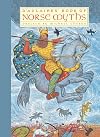
I am a huge fan of the d'Aulaire mythology collections. My kids and I love their collection of Greek myths, and have read through them more than once. The Norse myths are by nature a little harsher and a little colder, but I think they inspired more questions and discussion between my daughters and myself than the Greek myths did--always a good thing!
The d'Aulaire retelling of the Norse myths is clear, kid-friendly and just the right length to keep their attention, but it does all of this show more without losing the underlying feeling and meaning behind these often harsh and bloody histories. The illustrations are wonderful, and complement the stories perfectly. They myths can be read individually, or in order like a novel, to tell the story of the Norse pantheon from its inception to its demise at Ragnarokk.
There is so much reference to Norse myth in our culture and our literature, it really gives kids (and let's be honest, adults as well) a head start to have some familiarity with the stories and the history. This book has sparked plenty of interesting discussion, and I know we'll end up reading and enjoying it again and again over the years. show less
The d'Aulaire retelling of the Norse myths is clear, kid-friendly and just the right length to keep their attention, but it does all of this show more without losing the underlying feeling and meaning behind these often harsh and bloody histories. The illustrations are wonderful, and complement the stories perfectly. They myths can be read individually, or in order like a novel, to tell the story of the Norse pantheon from its inception to its demise at Ragnarokk.
There is so much reference to Norse myth in our culture and our literature, it really gives kids (and let's be honest, adults as well) a head start to have some familiarity with the stories and the history. This book has sparked plenty of interesting discussion, and I know we'll end up reading and enjoying it again and again over the years. show less

This was one of my favorite books growing up. The spine is completely broken, and it's been taped and repaired to the point where in 50 years, if it was the last copy in existence, you might get 50 cents for it ($1 if you include inflation). It's got fabulous illustrations, and the myths aren't prettied up for kids. It tells about how Zeus was a philanderer and Hera was trying to kill Heracles (ahem, Disney crap! Cough! Cough! Excuse me, I think I've got a frog in my throat...). Plus it gets show more all the Greek names right, and then tells you the Roman names. It's fantastic. A really good starter book for kids. show less
Lists
Precious People (1)
Unread books (1)
Ambleside Y2 (1)
Awards


You May Also Like


Associated Authors
Statistics
- Works
- 22
- Also by
- 10
- Members
- 22,114
- Popularity
- #967
- Rating
- 4.3
- Reviews
- 228
- ISBNs
- 114
- Languages
- 4
- Favorited
- 1
