
Silvia Ferrara
Author of The Greatest Invention: A History of the World in Nine Mysterious Scripts
About the Author
Image credit: via Macmillan Publishers
Works by Silvia Ferrara
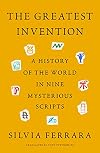
The Greatest Invention: A History of the World in Nine Mysterious Scripts (2019) 233 copies, 9 reviews
Associated Works
Tagged
Common Knowledge
Members
Reviews
The difficult process of decoding ancient or unknown scripts
I enjoyed this well written exploration of the process of deciphering unknown scripts. The author has a romantic and colorful style, casual in spots, more scholarly in other spots. Her Italian home and culture add a piquant taste to the writing, and, she is not afraid of stating her opinions about people and cultures, and revealing how she thinks and makes lists.
She starts on Easter Island, with the undeciphered rongorongo script, show more discusses her special interest in Creatan Hieroglyphics and Linear A. She considers the Phaistos Disk uncovered in Crete, the Voynich Manuscript, named for the bookseller who bought it from an antiquities dealer. The Inca used knotted, colored strings known as quipu, but how they are read is uncertain. The turtle shells and ox scapulae that bear the earliest Chinese inscriptions were first heated until they cracked, and the shamans studied the crack patterns for divination. Sequoyah, a Cherokee chief, notes that the white men consult paper with jots and lines that seem to give them power and single-handedly invents a script for the Cherokee language. The chapters are episodic, and do not form a textbook, but are chatty and witty. Altogether recommended. show less
I enjoyed this well written exploration of the process of deciphering unknown scripts. The author has a romantic and colorful style, casual in spots, more scholarly in other spots. Her Italian home and culture add a piquant taste to the writing, and, she is not afraid of stating her opinions about people and cultures, and revealing how she thinks and makes lists.
She starts on Easter Island, with the undeciphered rongorongo script, show more discusses her special interest in Creatan Hieroglyphics and Linear A. She considers the Phaistos Disk uncovered in Crete, the Voynich Manuscript, named for the bookseller who bought it from an antiquities dealer. The Inca used knotted, colored strings known as quipu, but how they are read is uncertain. The turtle shells and ox scapulae that bear the earliest Chinese inscriptions were first heated until they cracked, and the shamans studied the crack patterns for divination. Sequoyah, a Cherokee chief, notes that the white men consult paper with jots and lines that seem to give them power and single-handedly invents a script for the Cherokee language. The chapters are episodic, and do not form a textbook, but are chatty and witty. Altogether recommended. show less
The Greatest Invention: A History of the World in Nine Mysterious Scripts by Silvia Ferrara and translated by Todd Portnowitz is a fun and informative romp through the history, but more so the importance, of writing.
This is a hybrid of sorts in that it does get into some detail and some specific terminology (though they are explained in a straightforward manner) but is presented rather informally. Yes, it is meant for a popular readership but even aside from that the tone and flow is more show more like conversation (or a lecture as she states) rather than a tightly constructed argument. I found it engaging but some may prefer something closer to the typical popular science book. I didn't always catch the importance of what seemed like asides to me, but they did make me stop and think about how they might fit. While I did usually make the connection, I think the more valuable benefit was that I actually had to think about what I was reading from a perspective other than my initial one.
This is not a textbook so not every school of linguistic thought is going to be mentioned. Nor should they be if they don't contribute to Ferrara's overall purpose. If this were a book to teach us the details of every manuscript and language, maybe so. But this is as much an argument for the value of the written word as it is a basic history. If you want a plain history that shows how thought has developed over the years, there are a lot of textbooks for you. If you want to feel the exuberance of a scholar for her subject, accompanied by interesting analogies and scientific facts, this may appeal to you. Just know ahead of time that this is more like having someone tell you what they think, albeit an expert in the field, than reading an academic thesis.
Reviewed from a copy made available by the publisher via NetGalley. show less
This is a hybrid of sorts in that it does get into some detail and some specific terminology (though they are explained in a straightforward manner) but is presented rather informally. Yes, it is meant for a popular readership but even aside from that the tone and flow is more show more like conversation (or a lecture as she states) rather than a tightly constructed argument. I found it engaging but some may prefer something closer to the typical popular science book. I didn't always catch the importance of what seemed like asides to me, but they did make me stop and think about how they might fit. While I did usually make the connection, I think the more valuable benefit was that I actually had to think about what I was reading from a perspective other than my initial one.
This is not a textbook so not every school of linguistic thought is going to be mentioned. Nor should they be if they don't contribute to Ferrara's overall purpose. If this were a book to teach us the details of every manuscript and language, maybe so. But this is as much an argument for the value of the written word as it is a basic history. If you want a plain history that shows how thought has developed over the years, there are a lot of textbooks for you. If you want to feel the exuberance of a scholar for her subject, accompanied by interesting analogies and scientific facts, this may appeal to you. Just know ahead of time that this is more like having someone tell you what they think, albeit an expert in the field, than reading an academic thesis.
Reviewed from a copy made available by the publisher via NetGalley. show less
I gave up on this about a quarter of the way in. Ferrara seems to like writing flowery prose more than actually conveying any information. What information is conveyed comes in unconnected hints and nibbles, with lots of "we'll get back to this" or "I'll talk about this in more detail later." I found it impossible to follow any kind of argument or narrative - it felt like a bunch of interesting facts that were trying to lead somewhere but were never connected. I'm sure that if I stuck with show more the book longer, they might have come together, but I didn't have the patience. show less
Interesting topic by an obviously knowledgeable author (and what seems to be a very talented translator). But the title is misleading as it's more of a conversational rumination on un-decoded scripts than a history of the world or a discourse on "the greatest invention" (which even the author claims isn't writing). I would, as others have also stated, have preferred a more linear discussion of writing, and more details about how unknown scripts have been, and are, decoded. I still enjoyed show more the book, and read the whole thing, so I guess I would recommend it with some reservations. It's one of those books that you won't know if you like until you've tried reading it. show less
Awards


You May Also Like


Associated Authors
Statistics
- Works
- 8
- Also by
- 3
- Members
- 259
- Popularity
- #88,670
- Rating
- 3.5
- Reviews
- 10
- ISBNs
- 27
- Languages
- 4