
Jean Paul (1763–1825)
Author of Flower, Fruit, and Thorn Pieces, or, the Wedded Life, Death, and Marriage of Firmian Stanislaus Siebenkaes
About the Author
Image credit: Portrait of Jean Paul by Heinrich Pfenninger (1798) By Heinrich Pfenninger - http://museum-digital.de/nat/index.php?t=objekt&oges=928, Public Domain, https://commons.wikimedia.org/w/index.php?curid=21998289
Works by Jean Paul
Flower, Fruit, and Thorn Pieces, or, the Wedded Life, Death, and Marriage of Firmian Stanislaus Siebenkaes (1796) — Author — 108 copies, 2 reviews
Army-Chaplain Schmelzle's Journey to Flaetz / Life of Quintus Fixlein (1992) — Author — 14 copies, 1 review
Des Luftschiffers Giannozzo Seebuch und Über die natürliche Magie der Einbildungskraft (1975) — Author — 8 copies
Deutsche Klassiker, Bibliothek der literarischen Meisterwerke (Jean Paul- Schulmeisterlein Wutz und andere Geschichten) (1966) — Author — 7 copies
Sämtliche Werke, 10 Bde., Bd.4, Kleinere erzählende Schriften 1796-1801 — Author — 6 copies
Werke in drei Bänden. Bd. 2 5 copies
Jean Pauls Werke : in 2 Bd. Bd. 1 Selberlebensbeschreibung. Rektor Fälbel. Schulmeisterlein Wutz. Quintus Fixlein. Die wunderbare Gesellschaft (1987) — Author — 5 copies
Sämtliche Werke, 10 Bde., Bd.6, Schmelzles Reise nach Flätz; Doktor Katzenbergers Badereise (1975) 4 copies
Sämtliche Werke. Abteilung II, Band 4 : Kommentar zum ersten bis dritten Band (1985) — Author — 4 copies
Sämtliche Werke Abt. 1 Bd. 5 Erzählende und theoretische Werke Vorschule der Ästhetik. Levana oder Erziehlehre. Politische Schriften — Author — 4 copies
Werke in drei Bänden. Bd. 1 4 copies
Werke in 12 Bänden. Band 8. Kleinere erzählende Schriften (II) / Anhang zu den Bänden 7 und 8 (1975) 4 copies
Leben des vergnügten Schulmeisterlein Maria Wuz in Auenthal ; Des Feldpredigers Schmelzle Reise nach Flätz ; Dr. Katzenbergers Badereise (1927) 3 copies
Werke, Band 10: Levana (II)/Politische Schriften [= Jean Paul, Werke in zwölf Bänden; zugleich: Reihe Hanser Werkausgabe 200/10] (1958) 2 copies
Titan ; Flegeljahre 2 copies
Il comico, l'umorismo e l'arguzia. Arte e artificio del riso in una "Propedeutica all'estetica" del primo Ottocento (1994) 2 copies
Vita di Quintus Egidio Zebedeo 2 copies
Catalogue of pictures at Locko Park 2 copies
Hesperus oder fünfundvierzig Hundsposttage. Eine Lebensbeschreibung. Erster Band — Author — 2 copies
Hesperus oder fünfundvierzig Hundsposttage. Eine Lebensbeschreibung. Zweiter Band — Author — 2 copies
Titan (Complete): A Romance - From The German Of Jean Paul Friedrich Richter Translated By Charles T. Brooks (Complete Edition Of Two Volumes) (2019) 2 copies
Der Jubelsenior : ein Appendix 2 copies
Levana; or The Doctrine of Education. Preceded By a Short Biography of the Author and His Autobiography, A Fragment (1876) 2 copies
Friedenspredigt an Deutschland 2 copies
Jean Paul's Sämtliche Werke. Dreiunddreissigster Band, Selina, oder Über die Unsterblichkeit der Seele. Aus Jean Paul's Leben (2012) 2 copies
The Campaner Thal and other writings — Author — 2 copies
Werke in 12 Bänden. Band 12. Späte erzählende Schriften (II) / Anhang zu den Bänden 11 und 12 (1958) 2 copies
Titan, 3. und 4. Band — Author — 1 copy
Titan, 1. und 2. Band — Author — 1 copy
Jean Pauls Werke Zweiter Band / Meyers Klassiker (Titan 2) — Author — 1 copy
Jean Pauls Werke Erster Band / Meyers Klassiker (Titan 1) — Author — 1 copy
Geschichten 1 copy
Sämtliche Werke: historisch-kritische Ausgabe: zweite Abteilung, achter Band: Gedanken: Teil I: Text 1 copy
Blumen- Frucht- Und Dornenstücke: Oder, Ehestand, Tod Und Hochzeit Des Armenadvokaten F. St. Siebenkäs, Volumes 3-4 (2011) 1 copy
Werke (12 Bände) 1 copy
Jean Paul : Höhepunkte seines Schaffens [aus der Reihe: Deutsche Klassiker Jubiläums-Bibliothek] 1 copy
Ausgewählte Werke 1 copy
Ehestand. Siebenkas 1 copy
Geist deutscher Klassiker 1 copy
Das Leben des vergnügten Schulmeisterleins Wuz; Des Feldpredigers Schmelzle Reise nach Flätz; Siebenkäs; Selbstbiographie (2006) 1 copy
Werke in drei Bänden, Bd. 1 1 copy
Werke in drei Bänden, Bd. 2 1 copy
Werke in drei Bänden, Bd. 3 1 copy
Levana e altri scritti 1 copy
Vorschule der Ästhetik: nebst einigen Vorlesungen in Leipzig (TREDITION CLASSICS) (German Edition) (2012) 1 copy
Werke in 4 Bänden Band I-IV 1 copy
Dr. [I.E. Doktor] Katzenbergers Badereise: Nebst Einer Auswahl Verbesserter Werkchen, Erstes Baendchen (German Edition) (2022) 1 copy
Jean Paul’s Sämmtliche Werke Band 2: Die unsichtbare Loge. Eine Lebensbeschreibung, Theil 2 ; Mumien (2018) 1 copy
Jean Pauls Werke in zwei Bänden. Erster und zweiter Band (BDK - Bibliothek deutscher Klassiker) 1 copy
Jean Paul - Sämtliche Werke 2. Abt. Bd 1-4: Sämtliche Werke, 10 Bde., Bd.1, Jugendwerke 1: Abt. II/1 (1974) 1 copy
Horn und Flöte 1 copy
Meine Kindheit 1 copy
Spreuken 1 copy
Wit, Wisdom, and Philosophy: Of Jean Paul Fred. Richter; Ed. By Giles P. Hawley (1884) (2009) 1 copy
Grotesken und Satiren 1 copy
Im Garten der Freude 1 copy
Jean Paul: Dichtungen 1 copy
Werke, Band 3: Siebenkäs/Flegeljahre (I) [= Jean Paul, Werke in zwölf Bänden; zugleich: Reihe Hanser Werkausgabe 200/3] (2004) 1 copy
Werke, Band 11: Späte erzählende Schriften (I) [= Jean Paul, Werke in zwölf Bänden; zugleich: Reihe Hanser Werkausgabe 200/11] (1970) 1 copy
Jean Paul: Werke; II 1 copy
Associated Works
Deutschland erzählt. Von Johann Wolfgang von Goethe bis Ludwig Tieck (1970) — Contributor — 26 copies
Oogst Der Tijden. keur uit de werken van schrijvers en dichters aller volken en eeuwen (1940) — Contributor — 12 copies
Tales from the German, Comprising specimens from the most celebrated authors (1844) — Contributor — 4 copies
Dichtung der Romantik Bd. 12. Die Welt der Romantiker : Berichte u. Selbstdarstellungen. Briefe u. Urkunden — Contributor — 3 copies
Tagged
Common Knowledge
- Canonical name
- Jean Paul
- Other names
- Jean Paul
- Birthdate
- 1763-03-21
- Date of death
- 1825-11-14
- Gender
- male
- Education
- University of Leipzig
- Cause of death
- dropsy
- Nationality
- Holy Roman Empire
- Birthplace
- Wunsiedel, Bavaria, Germany
Wunsiedel, Holy Roman Empire - Place of death
- Bayreuth, Germany
Bayreuth, German Confederation - Map Location
- Germany
Members
Reviews
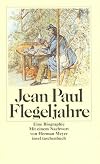
This is not a review. This is therapy.
Concerning the easy and uninterrupted flow of reading, this book is the next thing to a medieval drama in Sanskrit for a sophomore. Unless one is extremely well provided with the currency of names and ideas of the late Enlightenment, one feels like a very soft worm inside a huge rock of fossilized notions.
JP stretches syntax to a point of complete entanglement. While he warms up, reading his sentences is like playing snake, enjoying those little snacks show more of sense, growing, feeling your brain move, unfurl, until the next zeugmatic splash and crumble. Every sentence is a speleological expedition, with the guide getting agitated and hurriedly rounding a corner with his torch somewhere ahead, leaving you in the darkness, and although in the flare he seems to be floating, I think I heard him stumble a couple of times. Where Jean Paul stumbles, I lay in a heap of rubble.
He makes Gargantuan leaps with you on his shoulder, now head over the clouds with most of the landscape obscured from view, now merrily plunking his arse into a muddy puddle, now composing strange poetry he calls polymeter, now hurling at the reader sordid double, triple, quadruple entendres and mixing his metaphors into thick indigestible verbal dough.
I lived with him for at least half a year like one lives with an unexpected noisy relative, who keeps his shampoo in your fridge for some obscure and highly mutable reason, and wants you to cheer up and party when you are exhausted and want to lie down and drift away with a solid good book. I pushed him through 550 pages with his bloating smorgasbord of inconceivable possessions and out into the abyss of the long cold afterword and I miss him so much I could cry. show less
Concerning the easy and uninterrupted flow of reading, this book is the next thing to a medieval drama in Sanskrit for a sophomore. Unless one is extremely well provided with the currency of names and ideas of the late Enlightenment, one feels like a very soft worm inside a huge rock of fossilized notions.
JP stretches syntax to a point of complete entanglement. While he warms up, reading his sentences is like playing snake, enjoying those little snacks show more of sense, growing, feeling your brain move, unfurl, until the next zeugmatic splash and crumble. Every sentence is a speleological expedition, with the guide getting agitated and hurriedly rounding a corner with his torch somewhere ahead, leaving you in the darkness, and although in the flare he seems to be floating, I think I heard him stumble a couple of times. Where Jean Paul stumbles, I lay in a heap of rubble.
He makes Gargantuan leaps with you on his shoulder, now head over the clouds with most of the landscape obscured from view, now merrily plunking his arse into a muddy puddle, now composing strange poetry he calls polymeter, now hurling at the reader sordid double, triple, quadruple entendres and mixing his metaphors into thick indigestible verbal dough.
I lived with him for at least half a year like one lives with an unexpected noisy relative, who keeps his shampoo in your fridge for some obscure and highly mutable reason, and wants you to cheer up and party when you are exhausted and want to lie down and drift away with a solid good book. I pushed him through 550 pages with his bloating smorgasbord of inconceivable possessions and out into the abyss of the long cold afterword and I miss him so much I could cry. show less

A story of love and friendship, of foible, revenge and vanity told with quiet humor and numerous digressions in Jean Paul’s inimitable language encompassing empathy and satire. The text of this edition follows Jean Paul: Werke in 2 vol., Aufbau Verlag, Berlin 1973 and leaves out interludes which Jean Paul inserted some time following the first edition of 1809. The drawings by Paul Scheurich (taken from a 1912 edition) caricature the story with a smile. To my knowledge this work has never show more been translated into English; I am not astonished: an impossible task to re-create a translation that comes anywhere near the original. You either love or hate Jean Paul’s writings. To Goethe and Schiller they remained an alien world, I treasure them. (VI-16) show less

http://www.mytwostotinki.com/?p=2085
The narrator of this story, a man with a rich imagination, and prone to both bouts of migraine and frequent visions is walking up and down his study for hours. It is New Year's Eve of 1799, the last day of the 18th century. The writer waits for the return of his wife who is out for a visit to a sick friend, promising that she will be back "still in this century."
The last day of a year, and even more so the last day of a century is reason for contemplation, show more but our narrator has again a terrible migraine attack - and suddenly it happens:
after closing his eyes for a while and upon reopening them again he realizes that there is a group of five people, among them a little child in his room and he has no idea who they are or how they entered. The group's appearance is rather odd, not so much frightening and a dialogue between the narrator and the group is developing that covers most of the story. This dialogue deals mainly with the prospectives for the future. The tone, partly serious, partly humorous keeps a kind of balance that makes us readers wonder what the author is up to. One of the narrator's guests gets more and more excited and develops a truly apocalyptic scenario for the future that is the climax of this story:
"Es gibt einmal einen letzten Menschen – er wird auf einem Berg unter dem Äquator stehen und herabschauen auf die Wasser, welche die weite Erde überziehen – festes Eis glänzet an den Polen herauf der Mond und die Sonne hängen ausgebreitet und tief und nur blutig über der kleinen Erde, wie zwei trübe feindliche Augen oder Kometen – das aufgetürmte Gewölke strömet eilig durch den Himmel und stürzet sich ins Meer und fährt wieder empor, und nur der Blitz schwebt mit glühenden Flügeln zwischen Himmel und Meer und scheidet sie – Schau auf zum Himmel, letzter Mensch! Auf deiner Erde ist schon alles vergangen – deine großen Ströme ruhen aufgelöset im Meere."
"There will one day be a last man - he will stand on a mountain under the Equator, and look down upon the waters which welter over the wide earth - firmly from the poles gleams upward the unchangeable ice - the moon and the sun hang broad and bloody over the little earth, like two eyes full of hate. For the earth's spiral orbit has brought it nearer and nearer to the sun, and the moon's spiral has enlarged the face with which it looks ever steadfastly toward our planet, and their strong attraction caused the oceans to roll together round the Equator - and then the whole atmosphere with its vapors rushes up from the poles after the water, and still as the attraction increases, a frightful flood of electric fluid pours and swells over all. The clouds, piled up in mountain-towers stream quickly across the sky, and plunge into the sea, and then rush upward again, while the lightning on burning wings flashes from Heaven to the Ocean and cleaves them asunder. Look up to the Heaven, thou last man! All on thy earth has disappeared - all its rivers have been swallowed up in its sea." (translation by J.F.C., The Western Messenger, November 1838)
Believing that midnight is approaching, the uninvited guests are leaving - but it turns out that when the authors wife comes home from her visit it is one hour before midnight. Remarking her husband's mood, the wife sings and plays on the piano one of his favourite tunes and the usual order of things is re-established. The vision was most probably something only imagined by her husband.
This short story by Jean Paul Friedrich Richter - known in Germany as Jean Paul only - Die wunderbare Gesellschaft in der Neujahrsnacht (The strange company at New Year's Eve) is rather typical for this remarkable and not well-known author who wrote in the traditions of Swift and Laurence Sterne and who had a tremendous influence on authors like Hoffmann, de Quincey (who wrote an essay about him) or Arno Schmidt and among the contemporary German authors I could mention Walter Kappacher and Ludwig Harig (who was by coincidence my teacher when I was a first grader) as examples of novelists that are writing in Jean Paul's tradition.
The story from which I quoted is witty, well-written and despite the bleak quote very entertaining. And it is according to some SF experts most probably the first literary Dying Earth scenario ever published - and thus a kind of predecessor of a certain category of the Science Fiction genre.
Jean Paul lived most of his life in pre-Wagner Bayreuth, but he paid also longer visits to Weimar (Goethe and Schiller were rather distanced, partly because of literary reasons, partly because of the fact that Jean Paul, then a bachelor had several relationships with women which were considered a scandal; Wieland and Herder on the contrary liked him very much), and to Berlin - here he made friends with the Schlegel brothers, Schleiermacher, Fichte, and other important intellectuals.
Jean Paul is a great master of the German language; and he is also a master of the digression - his novels are usually very long because he is a true follower of Laurence Sterne here.
Who wants to discover this literary giant who was standing between Classicism and Romanticism can start with this rather short work that inspired also many famous illustrators (I have a beautiful edition with sketches by Alfred Kubin.). Unfortunately it seems that there is no collection of stories on the market that contains this story in English translation. Why, dear publishers?
A book I can heartily recommend for those with an interest in Jean Paul is Günter de Bruyn's biography Das Leben des Jean Paul Friedrich Richter (The Life of Jean Paul Frederick Richter), a beautiful dedication by the novelist de Bruyn to his literary ancestor Jean Paul. I fell a bit under the spell of Jean Paul after I had read this well-researched and brilliantly written book.
A translation of this book and a recent good edition of Jean Paul's shorter works in English is missing - but who knows, maybe a publisher is already working on it. That would be a great pleasure! show less
The narrator of this story, a man with a rich imagination, and prone to both bouts of migraine and frequent visions is walking up and down his study for hours. It is New Year's Eve of 1799, the last day of the 18th century. The writer waits for the return of his wife who is out for a visit to a sick friend, promising that she will be back "still in this century."
The last day of a year, and even more so the last day of a century is reason for contemplation, show more but our narrator has again a terrible migraine attack - and suddenly it happens:
after closing his eyes for a while and upon reopening them again he realizes that there is a group of five people, among them a little child in his room and he has no idea who they are or how they entered. The group's appearance is rather odd, not so much frightening and a dialogue between the narrator and the group is developing that covers most of the story. This dialogue deals mainly with the prospectives for the future. The tone, partly serious, partly humorous keeps a kind of balance that makes us readers wonder what the author is up to. One of the narrator's guests gets more and more excited and develops a truly apocalyptic scenario for the future that is the climax of this story:
"Es gibt einmal einen letzten Menschen – er wird auf einem Berg unter dem Äquator stehen und herabschauen auf die Wasser, welche die weite Erde überziehen – festes Eis glänzet an den Polen herauf der Mond und die Sonne hängen ausgebreitet und tief und nur blutig über der kleinen Erde, wie zwei trübe feindliche Augen oder Kometen – das aufgetürmte Gewölke strömet eilig durch den Himmel und stürzet sich ins Meer und fährt wieder empor, und nur der Blitz schwebt mit glühenden Flügeln zwischen Himmel und Meer und scheidet sie – Schau auf zum Himmel, letzter Mensch! Auf deiner Erde ist schon alles vergangen – deine großen Ströme ruhen aufgelöset im Meere."
"There will one day be a last man - he will stand on a mountain under the Equator, and look down upon the waters which welter over the wide earth - firmly from the poles gleams upward the unchangeable ice - the moon and the sun hang broad and bloody over the little earth, like two eyes full of hate. For the earth's spiral orbit has brought it nearer and nearer to the sun, and the moon's spiral has enlarged the face with which it looks ever steadfastly toward our planet, and their strong attraction caused the oceans to roll together round the Equator - and then the whole atmosphere with its vapors rushes up from the poles after the water, and still as the attraction increases, a frightful flood of electric fluid pours and swells over all. The clouds, piled up in mountain-towers stream quickly across the sky, and plunge into the sea, and then rush upward again, while the lightning on burning wings flashes from Heaven to the Ocean and cleaves them asunder. Look up to the Heaven, thou last man! All on thy earth has disappeared - all its rivers have been swallowed up in its sea." (translation by J.F.C., The Western Messenger, November 1838)
Believing that midnight is approaching, the uninvited guests are leaving - but it turns out that when the authors wife comes home from her visit it is one hour before midnight. Remarking her husband's mood, the wife sings and plays on the piano one of his favourite tunes and the usual order of things is re-established. The vision was most probably something only imagined by her husband.
This short story by Jean Paul Friedrich Richter - known in Germany as Jean Paul only - Die wunderbare Gesellschaft in der Neujahrsnacht (The strange company at New Year's Eve) is rather typical for this remarkable and not well-known author who wrote in the traditions of Swift and Laurence Sterne and who had a tremendous influence on authors like Hoffmann, de Quincey (who wrote an essay about him) or Arno Schmidt and among the contemporary German authors I could mention Walter Kappacher and Ludwig Harig (who was by coincidence my teacher when I was a first grader) as examples of novelists that are writing in Jean Paul's tradition.
The story from which I quoted is witty, well-written and despite the bleak quote very entertaining. And it is according to some SF experts most probably the first literary Dying Earth scenario ever published - and thus a kind of predecessor of a certain category of the Science Fiction genre.
Jean Paul lived most of his life in pre-Wagner Bayreuth, but he paid also longer visits to Weimar (Goethe and Schiller were rather distanced, partly because of literary reasons, partly because of the fact that Jean Paul, then a bachelor had several relationships with women which were considered a scandal; Wieland and Herder on the contrary liked him very much), and to Berlin - here he made friends with the Schlegel brothers, Schleiermacher, Fichte, and other important intellectuals.
Jean Paul is a great master of the German language; and he is also a master of the digression - his novels are usually very long because he is a true follower of Laurence Sterne here.
Who wants to discover this literary giant who was standing between Classicism and Romanticism can start with this rather short work that inspired also many famous illustrators (I have a beautiful edition with sketches by Alfred Kubin.). Unfortunately it seems that there is no collection of stories on the market that contains this story in English translation. Why, dear publishers?
A book I can heartily recommend for those with an interest in Jean Paul is Günter de Bruyn's biography Das Leben des Jean Paul Friedrich Richter (The Life of Jean Paul Frederick Richter), a beautiful dedication by the novelist de Bruyn to his literary ancestor Jean Paul. I fell a bit under the spell of Jean Paul after I had read this well-researched and brilliantly written book.
A translation of this book and a recent good edition of Jean Paul's shorter works in English is missing - but who knows, maybe a publisher is already working on it. That would be a great pleasure! show less
http://www.mytwostotinki.com/?p=2085
The narrator of this story, a man with a rich imagination, and prone to both bouts of migraine and frequent visions is walking up and down his study for hours. It is New Year's Eve of 1799, the last day of the 18th century. The writer waits for the return of his wife who is out for a visit to a sick friend, promising that she will be back "still in this century."
The last day of a year, and even more so the last day of a century is reason for contemplation, show more but our narrator has again a terrible migraine attack - and suddenly it happens:
after closing his eyes for a while and upon reopening them again he realizes that there is a group of five people, among them a little child in his room and he has no idea who they are or how they entered. The group's appearance is rather odd, not so much frightening and a dialogue between the narrator and the group is developing that covers most of the story. This dialogue deals mainly with the prospectives for the future. The tone, partly serious, partly humorous keeps a kind of balance that makes us readers wonder what the author is up to. One of the narrator's guests gets more and more excited and develops a truly apocalyptic scenario for the future that is the climax of this story:
"Es gibt einmal einen letzten Menschen – er wird auf einem Berg unter dem Äquator stehen und herabschauen auf die Wasser, welche die weite Erde überziehen – festes Eis glänzet an den Polen herauf der Mond und die Sonne hängen ausgebreitet und tief und nur blutig über der kleinen Erde, wie zwei trübe feindliche Augen oder Kometen – das aufgetürmte Gewölke strömet eilig durch den Himmel und stürzet sich ins Meer und fährt wieder empor, und nur der Blitz schwebt mit glühenden Flügeln zwischen Himmel und Meer und scheidet sie – Schau auf zum Himmel, letzter Mensch! Auf deiner Erde ist schon alles vergangen – deine großen Ströme ruhen aufgelöset im Meere."
"There will one day be a last man - he will stand on a mountain under the Equator, and look down upon the waters which welter over the wide earth - firmly from the poles gleams upward the unchangeable ice - the moon and the sun hang broad and bloody over the little earth, like two eyes full of hate. For the earth's spiral orbit has brought it nearer and nearer to the sun, and the moon's spiral has enlarged the face with which it looks ever steadfastly toward our planet, and their strong attraction caused the oceans to roll together round the Equator - and then the whole atmosphere with its vapors rushes up from the poles after the water, and still as the attraction increases, a frightful flood of electric fluid pours and swells over all. The clouds, piled up in mountain-towers stream quickly across the sky, and plunge into the sea, and then rush upward again, while the lightning on burning wings flashes from Heaven to the Ocean and cleaves them asunder. Look up to the Heaven, thou last man! All on thy earth has disappeared - all its rivers have been swallowed up in its sea." (translation by J.F.C., The Western Messenger, November 1838)
Believing that midnight is approaching, the uninvited guests are leaving - but it turns out that when the authors wife comes home from her visit it is one hour before midnight. Remarking her husband's mood, the wife sings and plays on the piano one of his favourite tunes and the usual order of things is re-established. The vision was most probably something only imagined by her husband.
This short story by Jean Paul Friedrich Richter - known in Germany as Jean Paul only - Die wunderbare Gesellschaft in der Neujahrsnacht (The strange company at New Year's Eve) is rather typical for this remarkable and not well-known author who wrote in the traditions of Swift and Laurence Sterne and who had a tremendous influence on authors like Hoffmann, de Quincey (who wrote an essay about him) or Arno Schmidt and among the contemporary German authors I could mention Walter Kappacher and Ludwig Harig (who was by coincidence my teacher when I was a first grader) as examples of novelists that are writing in Jean Paul's tradition.
The story from which I quoted is witty, well-written and despite the bleak quote very entertaining. And it is according to some SF experts most probably the first literary Dying Earth scenario ever published - and thus a kind of predecessor of a certain category of the Science Fiction genre.
Jean Paul lived most of his life in pre-Wagner Bayreuth, but he paid also longer visits to Weimar (Goethe and Schiller were rather distanced, partly because of literary reasons, partly because of the fact that Jean Paul, then a bachelor had several relationships with women which were considered a scandal; Wieland and Herder on the contrary liked him very much), and to Berlin - here he made friends with the Schlegel brothers, Schleiermacher, Fichte, and other important intellectuals.
Jean Paul is a great master of the German language; and he is also a master of the digression - his novels are usually very long because he is a true follower of Laurence Sterne here.
Who wants to discover this literary giant who was standing between Classicism and Romanticism can start with this rather short work that inspired also many famous illustrators (I have a beautiful edition with sketches by Alfred Kubin.). Unfortunately it seems that there is no collection of stories on the market that contains this story in English translation. Why, dear publishers?
A book I can heartily recommend for those with an interest in Jean Paul is Günter de Bruyn's biography Das Leben des Jean Paul Friedrich Richter (The Life of Jean Paul Frederick Richter), a beautiful dedication by the novelist de Bruyn to his literary ancestor Jean Paul. I fell a bit under the spell of Jean Paul after I had read this well-researched and brilliantly written book.
A translation of this book and a recent good edition of Jean Paul's shorter works in English is missing - but who knows, maybe a publisher is already working on it. That would be a great pleasure! show less
The narrator of this story, a man with a rich imagination, and prone to both bouts of migraine and frequent visions is walking up and down his study for hours. It is New Year's Eve of 1799, the last day of the 18th century. The writer waits for the return of his wife who is out for a visit to a sick friend, promising that she will be back "still in this century."
The last day of a year, and even more so the last day of a century is reason for contemplation, show more but our narrator has again a terrible migraine attack - and suddenly it happens:
after closing his eyes for a while and upon reopening them again he realizes that there is a group of five people, among them a little child in his room and he has no idea who they are or how they entered. The group's appearance is rather odd, not so much frightening and a dialogue between the narrator and the group is developing that covers most of the story. This dialogue deals mainly with the prospectives for the future. The tone, partly serious, partly humorous keeps a kind of balance that makes us readers wonder what the author is up to. One of the narrator's guests gets more and more excited and develops a truly apocalyptic scenario for the future that is the climax of this story:
"Es gibt einmal einen letzten Menschen – er wird auf einem Berg unter dem Äquator stehen und herabschauen auf die Wasser, welche die weite Erde überziehen – festes Eis glänzet an den Polen herauf der Mond und die Sonne hängen ausgebreitet und tief und nur blutig über der kleinen Erde, wie zwei trübe feindliche Augen oder Kometen – das aufgetürmte Gewölke strömet eilig durch den Himmel und stürzet sich ins Meer und fährt wieder empor, und nur der Blitz schwebt mit glühenden Flügeln zwischen Himmel und Meer und scheidet sie – Schau auf zum Himmel, letzter Mensch! Auf deiner Erde ist schon alles vergangen – deine großen Ströme ruhen aufgelöset im Meere."
"There will one day be a last man - he will stand on a mountain under the Equator, and look down upon the waters which welter over the wide earth - firmly from the poles gleams upward the unchangeable ice - the moon and the sun hang broad and bloody over the little earth, like two eyes full of hate. For the earth's spiral orbit has brought it nearer and nearer to the sun, and the moon's spiral has enlarged the face with which it looks ever steadfastly toward our planet, and their strong attraction caused the oceans to roll together round the Equator - and then the whole atmosphere with its vapors rushes up from the poles after the water, and still as the attraction increases, a frightful flood of electric fluid pours and swells over all. The clouds, piled up in mountain-towers stream quickly across the sky, and plunge into the sea, and then rush upward again, while the lightning on burning wings flashes from Heaven to the Ocean and cleaves them asunder. Look up to the Heaven, thou last man! All on thy earth has disappeared - all its rivers have been swallowed up in its sea." (translation by J.F.C., The Western Messenger, November 1838)
Believing that midnight is approaching, the uninvited guests are leaving - but it turns out that when the authors wife comes home from her visit it is one hour before midnight. Remarking her husband's mood, the wife sings and plays on the piano one of his favourite tunes and the usual order of things is re-established. The vision was most probably something only imagined by her husband.
This short story by Jean Paul Friedrich Richter - known in Germany as Jean Paul only - Die wunderbare Gesellschaft in der Neujahrsnacht (The strange company at New Year's Eve) is rather typical for this remarkable and not well-known author who wrote in the traditions of Swift and Laurence Sterne and who had a tremendous influence on authors like Hoffmann, de Quincey (who wrote an essay about him) or Arno Schmidt and among the contemporary German authors I could mention Walter Kappacher and Ludwig Harig (who was by coincidence my teacher when I was a first grader) as examples of novelists that are writing in Jean Paul's tradition.
The story from which I quoted is witty, well-written and despite the bleak quote very entertaining. And it is according to some SF experts most probably the first literary Dying Earth scenario ever published - and thus a kind of predecessor of a certain category of the Science Fiction genre.
Jean Paul lived most of his life in pre-Wagner Bayreuth, but he paid also longer visits to Weimar (Goethe and Schiller were rather distanced, partly because of literary reasons, partly because of the fact that Jean Paul, then a bachelor had several relationships with women which were considered a scandal; Wieland and Herder on the contrary liked him very much), and to Berlin - here he made friends with the Schlegel brothers, Schleiermacher, Fichte, and other important intellectuals.
Jean Paul is a great master of the German language; and he is also a master of the digression - his novels are usually very long because he is a true follower of Laurence Sterne here.
Who wants to discover this literary giant who was standing between Classicism and Romanticism can start with this rather short work that inspired also many famous illustrators (I have a beautiful edition with sketches by Alfred Kubin.). Unfortunately it seems that there is no collection of stories on the market that contains this story in English translation. Why, dear publishers?
A book I can heartily recommend for those with an interest in Jean Paul is Günter de Bruyn's biography Das Leben des Jean Paul Friedrich Richter (The Life of Jean Paul Frederick Richter), a beautiful dedication by the novelist de Bruyn to his literary ancestor Jean Paul. I fell a bit under the spell of Jean Paul after I had read this well-researched and brilliantly written book.
A translation of this book and a recent good edition of Jean Paul's shorter works in English is missing - but who knows, maybe a publisher is already working on it. That would be a great pleasure! show less
Lists
Awards


You May Also Like


Associated Authors
Statistics
- Works
- 229
- Also by
- 17
- Members
- 1,109
- Popularity
- #23,169
- Rating
- 3.9
- Reviews
- 12
- ISBNs
- 231
- Languages
- 6