
Seán O'Casey (1880–1964)
Author of Three Plays: Juno and the Paycock, The Shadow of a Gunman, The Plough and the Stars
About the Author
Image credit: Courtesy of the NYPL Digital Gallery (image use requires permission from the New York Public Library)
Series
Works by Seán O'Casey
Three Plays: Juno and the Paycock, The Shadow of a Gunman, The Plough and the Stars (1957) 905 copies, 7 reviews
Autobiographies I: I Knock at the Door, Pictures in the Hallway, and Drums Under the Windows (1980) 65 copies
Autobiographies II: Inishfallen, Fare Thee Well, Rose and Crown, Sunset and Evening Star Star (1980) 54 copies
Sean O'Casey: Plays 2: The Shadow of a Gunman, The Plough and the Stars, The Silver Tassie, Purple Dust, Hall of Healing (1998) 25 copies
Collected Plays, Volume I: Juno and the Paycock, The Shadow of a Gunman, The Plough and the Stars, A Pound on Demand, The End of the Beginning (1949) 10 copies
The End of the Beginning 3 copies
The Flying Wasp 2 copies
Théâtre, tome 3 : L'Ombre d'un franc-tireur - Les Tambours du père Ned - Le Dispensaire (1991) 2 copies
Autobiographies III: Rose and Crown and Sunset and Evening Star (Sean O'Casey autobiography) (2011) 1 copy
Largely Literary Designs: The World's a Stage and Most of Us Are Desperately Unrehearsed (1998) 1 copy
Das Sean O'Casey Lesebuch 1 copy
Drámák 1 copy
Bird Alone 1 copy
The Irish 1 copy
Sean O'Casey: Plays 1 1 copy
Juno and the paycock 1 copy
A Pound on Demand: A Play 1 copy
Bedtime Story 1 copy
The Sean O'Casey Reader 1 copy
The Story of Ireland 1 copy
Sağlık Yurdu 1 copy
Sean O'Casey : plays 1 copy
Behind the Green Curtains / Figuro in the Night / The Moon Shines on Kylenamoe: Three Plays (1961) 1 copy
Teatro 1 copy
El arado y las estrellas El fin del comienzo Cuento de la hora de acostarse Reembolso de una libra 1 copy
teatro 1 copy
Associated Works
The Playboy of the Western World and Two Other Irish Plays (1892) — Contributor — 138 copies, 1 review
Cavalcade of comedy; 21 brilliant comedies from Jonson and Wycherley to Thurber and Coward (1953) — Contributor — 100 copies
Gender in Modernism: New Geographies, Complex Intersections (2007) — Contributor — 12 copies, 1 review
Die englische Literatur 09 in Text und Darstellung. 20. Jahrhundert. (2001) — Contributor — 3 copies
Tagged
Common Knowledge
- Canonical name
- O'Casey, Seán
- Legal name
- Casey, John (birth)
- Other names
- Ó Cathasaigh, Seán
- Birthdate
- 1880-03-30
- Date of death
- 1964-09-18
- Gender
- male
- Occupations
- playwright
dramatist
memoirist - Organizations
- Irish Citizen Army
- Relationships
- O'Casey, Eileen (wife)
- Nationality
- Ireland
- Birthplace
- Dublin, Ireland
- Place of death
- Torquay, Devon, England, UK
- Burial location
- Golders Green Crematorium, London, England, UK
- Associated Place (for map)
- England, UK
Members
Reviews
Three Dublin Plays: The Shadow of a Gunman, Juno and the Paycock, & The Plough and the Stars by Seán O'Casey
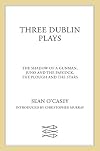
O'Casey's damning indictment of Irish Nationalism and the swathe of destruction caused by the Rising and Civil War remains as haunting and urgent now as it did ninety years ago. Familiar to Irish secondary schoolchildren - it should be mandatory reading for anyone who wants to romanticise the birth pangs of the Irish Republic.
Sean O’Casey’s plays could be called comic tragedies. They charm you with humor, rich playful language, and finely drawn characters; then the bottom drops out. The tragedy comes on either incrementally or rapidly, and it has impact.
These plays take place in Dublin from 1915 to the early 1920s and revolve around the troubles and political upheaval in Ireland. Juno and the Paycock is the best one here, but all three have a lot on the page and all are pure Irish.
These plays take place in Dublin from 1915 to the early 1920s and revolve around the troubles and political upheaval in Ireland. Juno and the Paycock is the best one here, but all three have a lot on the page and all are pure Irish.
Read in my hardcover of [b:Five Great Modern Irish Plays|3743896|Five Great Modern Irish Plays|George Jean Nathan|https://d.gr-assets.com/books/1454014822s/3743896.jpg|3787724] & listened to a full cast audio production on YouTube (introduced by the author).
This play is set in 1922 Dublin during the tail end of the Irish War of Independence and is about the Boyle family. While 'Captain' Jack Boyle, the father, is something of a buffoon, this is by no means a comedy. Juno Boyle, the mother, show more is struggling to keep the family going while her husband, unemployed, drinks with his 'butty' Joxer; the son Johnny, who lost an arm in the Easter Rising of 1916, is on the verge of a nervous breakdown; and the daughter Mary has thrown over her young man Jerry Devine. In case you were wondering, 'paycock' is the word "peacock" pronounced with an Irish accent.
I found this play to be tragic in a Shakespearean sense --while it looks like things might improve for the family early on, in the end everything is much much worse. I wonder if O'Casey was trying to say that independent Ireland ended up worse off than they had been before... . show less
This play is set in 1922 Dublin during the tail end of the Irish War of Independence and is about the Boyle family. While 'Captain' Jack Boyle, the father, is something of a buffoon, this is by no means a comedy. Juno Boyle, the mother, show more is struggling to keep the family going while her husband, unemployed, drinks with his 'butty' Joxer; the son Johnny, who lost an arm in the Easter Rising of 1916, is on the verge of a nervous breakdown; and the daughter Mary has thrown over her young man Jerry Devine. In case you were wondering, 'paycock' is the word "peacock" pronounced with an Irish accent.
I found this play to be tragic in a Shakespearean sense --
Sean O'Casey was an unapologetic critic of nearly all aspects of early 20th century Irish life and it shows in these three plays. These are tragedies, but O'Casey provides enough wit to prevent them from being overwhelmingly depressing. Juno and the Paycock details the events surrounding an inheritance given to a family readers are not meant to like, but essentially pity. The mother, Juno, is a strong sort who tries to guide her children, but who fails to reign in her story-telling, oafish show more husband. The plot is straight-forward and there is a great deal of religious commentary within this play which is high minded and enjoyable. The social message of O'Casey is clear and if readers miss it throughout the course of the play, they only need wait until the final act where he all but places it into bold faced type.
The Shadow of a Gunman is the most well-known of the three plays and is all but impossible to put down once it is started. Social, political, and religious messages penned by the author are given to readers through the cheeky tongue of the main character, who fails to understand the gravity of his situation and surroundings until it is too late. This was my favourite of the plays. O'Casey's decision to not show the primary actions of the play, rather to use the Grecian off-screen event followed by a retelling from a character method fits and makes the final act haunting and also lyrical in an altogether melancholic manner.
Finally, The Plough and the Stars, an earlier play, leaves no aspect of Irish revolution untouched by O'Casey's agenda. He wants readers to understand how blood spilled doesn't mean freedom, how the revolution is coming with the deaths of Ireland's people, and how lives are uniquely affected, yet suffer equally. Readers might be overwhelmed at first by the size of the cast and the vernacular, as he uses more slang and revolutionary terms in this play than the others, but the rhetoric of the plot and the dialogue is presented in blunt fashion. The plot follows a pretty straight narrative and as the story progresses, the cast thins as both a literary device and as a means of showing readers who is important, why you should pay attention, and what you should feel. A strong point of these plays is the author leaves almost no room for personal interpretation. He presents an argument and then proves why his position is correct. This is a contributing factor towards the desperation and desolation shared by the characters and those reading along. After finishing these three plays, it should be easy for readers to understand the atmosphere of revolutionary Ireland in the early 20th century and why certain groups would have tried so hard to silence O'Casey. show less
The Shadow of a Gunman is the most well-known of the three plays and is all but impossible to put down once it is started. Social, political, and religious messages penned by the author are given to readers through the cheeky tongue of the main character, who fails to understand the gravity of his situation and surroundings until it is too late. This was my favourite of the plays. O'Casey's decision to not show the primary actions of the play, rather to use the Grecian off-screen event followed by a retelling from a character method fits and makes the final act haunting and also lyrical in an altogether melancholic manner.
Finally, The Plough and the Stars, an earlier play, leaves no aspect of Irish revolution untouched by O'Casey's agenda. He wants readers to understand how blood spilled doesn't mean freedom, how the revolution is coming with the deaths of Ireland's people, and how lives are uniquely affected, yet suffer equally. Readers might be overwhelmed at first by the size of the cast and the vernacular, as he uses more slang and revolutionary terms in this play than the others, but the rhetoric of the plot and the dialogue is presented in blunt fashion. The plot follows a pretty straight narrative and as the story progresses, the cast thins as both a literary device and as a means of showing readers who is important, why you should pay attention, and what you should feel. A strong point of these plays is the author leaves almost no room for personal interpretation. He presents an argument and then proves why his position is correct. This is a contributing factor towards the desperation and desolation shared by the characters and those reading along. After finishing these three plays, it should be easy for readers to understand the atmosphere of revolutionary Ireland in the early 20th century and why certain groups would have tried so hard to silence O'Casey. show less
Lists
Irish writers (2)
Awards


You May Also Like


Associated Authors
Statistics
- Works
- 119
- Also by
- 18
- Members
- 2,341
- Popularity
- #10,956
- Rating
- 3.6
- Reviews
- 21
- ISBNs
- 125
- Languages
- 6
- Favorited
- 4