
Leah Price
Author of Unpacking My Library: Writers and Their Books
About the Author
Series
Works by Leah Price
What We Talk About When We Talk About Books: The History and Future of Reading (2019) 288 copies, 14 reviews
The Faire Pendant: The Tale of Atterberry (The Faire Pendant Series) (Volume 1) (2014) 5 copies, 1 review
The Faire Pendant: The Ballad of Captain Thatch (The Faire Pendant Series) (Volume 2) (2014) 2 copies, 1 review
Associated Works
Bookish Histories: Books, Literature, and Commercial Modernity, 1700-1900 (2009) — Contributor — 18 copies
The Faces of Anonymity: Anonymous and Pseudonymous Publication from the Sixteenth to the Twentieth Century (2003) — Contributor — 10 copies
Tagged
Common Knowledge
- Birthdate
- 1970-10-06
- Gender
- female
- Education
- Yale University (MPhil, PhD)
Harvard University (AB - Education)
Ecole Normale Supérieure, Paris - Occupations
- professor (English and American Literature and Language)
literary critic - Organizations
- Harvard University
University of Cambridge (Girton College) - Relationships
- Price, Richard (father)
Price, Sally (mother) - Nationality
- USA
- Places of residence
- USA
Paris, France - Associated Place (for map)
- Paris, France
Members
Reviews

Endlessly fascinating photos of several novelists' bookshelves, with brief interviews on the subject of the physical book, shelving practices, reading habits, etc. I love books about books, and this one is a treat. Even though I'm only marginally familiar with most of the authors featured here, it's still a rush to peer at their bookshelves (which range from the raw pine creatively messy conglomeration of Junot Diaz's collection to the sterile white uniformity of Rebecca Goldstein & Steven show more Pinker's cubic system) and find that I share titles with these successful writers and thinkers. I was surprised at the number of them who profess to have no attachment to their books as objects or repositories of memory ("I read that one at Aunt Clare's the summer my mother had her surgery" "That's the copy of Ulysses that the puppy chewed the back cover off" "This was Dad's favorite western novel; he read this copy as a teen-ager.") In addition to scoping out particular titles on the shelves, it was fun to be invited into the living rooms of strangers just to look around. Why, in Claire Messud's lovely, tasteful library/music room, is there what appears to be an Oriental rug rolled up and stashed behind a chair? What's the story behind the antique pitchfork in Lev Grossman's study? Philip Pullman, do you really always have those enormous stacks of books on the floor in front of your otherwise orderly bookshelves? (If so, I LOVE you, man!) A great number of the books on Edmund White's shelves seem to be unread copies of books by ----Edmund White. Each of the authors featured here was asked to share a "Top Ten" list. Comparing those was fun--Chekov, Tolstoy and Nabokov made multiple appearances; so did Virginia Woolf, Elizabeth Bishop and George Eliot. I was excited to see Barbara Pym and Alice Munro given mention. If you're a library voyeur, you can spend a lot more time with this book than it takes just to read the text.
Read and reviewed in 2011 show less
Read and reviewed in 2011 show less
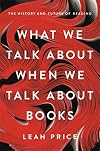
The subtitle on this one may be "the history and future of reading," but I think what it's actually about is something subtly different. It's the history (and present, and perhaps to some extent the future) of how we think about books and reading. There's a lot here, for instance, about the modern trend towards condemning reading from screens as inferior, as "not real reading" and as bad for our brains... but those condemnations look a lot different with some deeper historical perspective. show more "Real books," after all, were once the newfangled technology themselves, and reading novels was once condemned as bad for the brain and body in surprisingly similar terms. And did most people, most of the time, really ever read in the way we accuse screens of preventing us from doing now?
It's all really interesting, thoughtful stuff, and a very different take on bookish history than I'd seen before. show less
It's all really interesting, thoughtful stuff, and a very different take on bookish history than I'd seen before. show less
This is a book about books, the physical objects, not the texts they contain. It was interesting to dip in and out of. There is of course a discussion about "regular" books (text on paper, hardback or paperback) vs. ebooks, vs. audio books. And there is a lot of historical information, for example going back to the Gutenberg bibles and earlier. Lots and lots of interesting factoids to hold my interest.
For example in 2019 the average American spent 1500 odd hours yearly on their smart phones. show more Using an assumed average reading speed of 280 wpm, that same American could have read the entire In Search of Lost Time 20 times that year (assuming you'd want to read that book 20 times). I don't look at a lot on my iPhone, but this thought made me vow to look at my newsfeed less frequently, where I'm mostly perusing articles about keeping up with the Kardashians.
Then there is the question of readers who are constantly craning their necks on public transport to see what the other passengers are reading. This is a phenomenon that came about only with the rise of public transport. The author tells this anecdote:
"First horse-drawn omnibuses made it possible to read fellow commuters' books as easily as one's own. Eyeing the first installment of Dickens' Little Dorritt over the shoulder of a passenger on a Manchester bus in 1855, Elizabeth Gaskell complained that her fellow traveler 'was such a slow reader...you'll sympathize...{with} my impatience at his never getting to the bottom of the page."
The author is a book historian. That sounds like a nice job to have. Wish I'd known about it 50 years ago.
Recommended
3 stars show less
For example in 2019 the average American spent 1500 odd hours yearly on their smart phones. show more Using an assumed average reading speed of 280 wpm, that same American could have read the entire In Search of Lost Time 20 times that year (assuming you'd want to read that book 20 times). I don't look at a lot on my iPhone, but this thought made me vow to look at my newsfeed less frequently, where I'm mostly perusing articles about keeping up with the Kardashians.
Then there is the question of readers who are constantly craning their necks on public transport to see what the other passengers are reading. This is a phenomenon that came about only with the rise of public transport. The author tells this anecdote:
"First horse-drawn omnibuses made it possible to read fellow commuters' books as easily as one's own. Eyeing the first installment of Dickens' Little Dorritt over the shoulder of a passenger on a Manchester bus in 1855, Elizabeth Gaskell complained that her fellow traveler 'was such a slow reader...you'll sympathize...{with} my impatience at his never getting to the bottom of the page."
The author is a book historian. That sounds like a nice job to have. Wish I'd known about it 50 years ago.
Recommended
3 stars show less
Bibliostan World
Review of the Basic Books hardcover (2019) edition
I loved this quirky series of essays on the history of books and reading which covered everything from the different media from stone tablets to e-readers and the different usages or non-usages of books throughout history. Admittedly, books about books are not everyone's cup of tea but this is the sort of stuff that I really enjoy.
A few quirky trivia bits remain burned in my memory:
- the 1st mural of Edward Laning's "The show more Story of the Recorded Word" series in the New York Public Library apparently has "Thou Shalt Not Wipe" instead of "Thou Shalt Not Kill" as the 6th Commandment (a difference of 1 letter in Hebrew). It is hard to verify via photos on the web though.
See sample image at https://farm4.staticflickr.com/3115/2616650905_6a82d679bd_z.jpg for instance.
- in the time that the average American spends on their smartphone every year (approx. 1,500 hours) they could have read Marcel Proust's "In Search of Lost Time" 20 times. show less
Review of the Basic Books hardcover (2019) edition
I loved this quirky series of essays on the history of books and reading which covered everything from the different media from stone tablets to e-readers and the different usages or non-usages of books throughout history. Admittedly, books about books are not everyone's cup of tea but this is the sort of stuff that I really enjoy.
A few quirky trivia bits remain burned in my memory:
- the 1st mural of Edward Laning's "The show more Story of the Recorded Word" series in the New York Public Library apparently has "Thou Shalt Not Wipe" instead of "Thou Shalt Not Kill" as the 6th Commandment (a difference of 1 letter in Hebrew). It is hard to verify via photos on the web though.
See sample image at https://farm4.staticflickr.com/3115/2616650905_6a82d679bd_z.jpg for instance.
- in the time that the average American spends on their smartphone every year (approx. 1,500 hours) they could have read Marcel Proust's "In Search of Lost Time" 20 times. show less
Lists
Awards


You May Also Like


Associated Authors
Statistics
- Works
- 9
- Also by
- 5
- Members
- 854
- Popularity
- #29,957
- Rating
- 3.7
- Reviews
- 31
- ISBNs
- 31
- Favorited
- 2