
Paul Rink
Author of Admiral Richard Byrd: Alone in the Antarctic
About the Author
Paul Rink had much in common with Admiral Richard Byrd: he was a naval officer and had a deep interest in science. Rink spent the World War II years doing intelligence work in Central America before going to sea as an engineering officer in the South Pacific. After returning from sea, Mr. Rink show more devoted himself to writing, and in addition to several books for young adult readers, he published articles for publications like American Heritage and Esquire. He also wrote scripts for television, including the popular western drama Bonanza. show less
Works by Paul Rink
Tagged
Common Knowledge
Members
Reviews
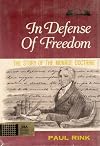
I decided to read Paul Rink's In Defense of Freedom not from any deep-seated interest in foreign policy, despite having spent 24 years in the U.S. military, but out of a desire to fill a gap in my understanding. Like many, my introduction to the Monroe Doctrine came through the lens of high school history, where it was briefly mentioned alongside its "Roosevelt Corollary." But what I never fully grasped was the doctrine's evolution—from a simple assertion of independence to a multifaceted show more policy tool. With China’s rising influence in Central and South America today, I felt this was the perfect time to revisit the topic in more depth.
Rink’s book is a concise exploration of the doctrine’s origins, tracing its development from a humble speech in 1823 to a cornerstone of U.S. foreign policy. One thing I appreciated was how Rink doesn’t just provide a history lesson but manages to weave these events into a compelling narrative. While there are some chronological leaps that might confuse readers at first, they eventually make sense in the broader context. His storytelling, while geared toward younger readers, kept me engaged.
Rink divides the history of the Monroe Doctrine into key periods, which I found insightful. He explores the doctrine’s initial use following the cession of Texas, how it took on new life under Teddy Roosevelt with "Yankee Imperialism," and how FDR's "Good Neighbor" policy reframed it. Each phase of the doctrine’s application reveals a different facet of U.S. interaction with its neighbors, sometimes noble, sometimes overreaching. I found this evolution fascinating, especially considering how the doctrine’s original intent—defending freedom in the Americas—took some unexpected turns along the way.
While Rink’s treatment of U.S. dominance might seem to gloss over some anti-American sentiment, I found his approach suitable for the book’s intended audience. This is not an academic text, but a high-school level overview, and I think Rink struck the right balance between providing context and encouraging further exploration.
One of the most intriguing aspects of the Monroe Doctrine is how it could be applied today. While Rink’s book stops in 1968, the parallels between the doctrine’s original intent and modern geopolitics are clear. With China’s growing presence in the Americas, it’s worth considering how the U.S. might interpret or invoke the doctrine in the future. Although Rink doesn’t cover this, it’s hard not to think about the doctrine’s potential relevance in an increasingly multipolar world.
Key Takeaways:
Overall, In Defense of Freedom is an accessible and engaging introduction to the Monroe Doctrine, perfect for readers like me who want to fill in the gaps in their knowledge without wading through dense academic prose. While it won’t provide a detailed critique of U.S. foreign policy, it offers a well-rounded view of one of the most significant diplomatic doctrines in American history. For anyone interested in understanding the roots of U.S. influence in the Americas, Rink’s book is a solid starting point. show less
Rink’s book is a concise exploration of the doctrine’s origins, tracing its development from a humble speech in 1823 to a cornerstone of U.S. foreign policy. One thing I appreciated was how Rink doesn’t just provide a history lesson but manages to weave these events into a compelling narrative. While there are some chronological leaps that might confuse readers at first, they eventually make sense in the broader context. His storytelling, while geared toward younger readers, kept me engaged.
Rink divides the history of the Monroe Doctrine into key periods, which I found insightful. He explores the doctrine’s initial use following the cession of Texas, how it took on new life under Teddy Roosevelt with "Yankee Imperialism," and how FDR's "Good Neighbor" policy reframed it. Each phase of the doctrine’s application reveals a different facet of U.S. interaction with its neighbors, sometimes noble, sometimes overreaching. I found this evolution fascinating, especially considering how the doctrine’s original intent—defending freedom in the Americas—took some unexpected turns along the way.
While Rink’s treatment of U.S. dominance might seem to gloss over some anti-American sentiment, I found his approach suitable for the book’s intended audience. This is not an academic text, but a high-school level overview, and I think Rink struck the right balance between providing context and encouraging further exploration.
One of the most intriguing aspects of the Monroe Doctrine is how it could be applied today. While Rink’s book stops in 1968, the parallels between the doctrine’s original intent and modern geopolitics are clear. With China’s growing presence in the Americas, it’s worth considering how the U.S. might interpret or invoke the doctrine in the future. Although Rink doesn’t cover this, it’s hard not to think about the doctrine’s potential relevance in an increasingly multipolar world.
Key Takeaways:
- The Original Intent of the Monroe Doctrine: Initially designed to prevent European colonization in the Americas while maintaining U.S. neutrality in European affairs.
- Evolution of the Doctrine: Transformed over time from a defensive policy to a justification for U.S. intervention in Latin American affairs, particularly through the Roosevelt Corollary.
- Cold War Application: Used as a rationale for U.S. interventions aimed at stopping the spread of communism in Latin America, tying the doctrine to broader Cold War policies.
- 21st Century Relevance: Remains a reference point for U.S. foreign policy, especially with China and Russia expanding their influence in Latin America.
- Complex Legacy: Criticized for justifying U.S. imperialism, leaving a mixed legacy as both a protector of freedom and a symbol of American dominance.
Overall, In Defense of Freedom is an accessible and engaging introduction to the Monroe Doctrine, perfect for readers like me who want to fill in the gaps in their knowledge without wading through dense academic prose. While it won’t provide a detailed critique of U.S. foreign policy, it offers a well-rounded view of one of the most significant diplomatic doctrines in American history. For anyone interested in understanding the roots of U.S. influence in the Americas, Rink’s book is a solid starting point. show less

You May Also Like


Associated Authors
Statistics
- Works
- 14
- Members
- 206
- Popularity
- #107,331
- Rating
- 4.0
- Reviews
- 2
- ISBNs
- 9