
Ernest Bramah (1868–1942)
Author of Kai Lung's Golden Hours
About the Author
Series
Works by Ernest Bramah
Collected Works of Ernest Bramah 3 copies
Ernest Bramah's Collected Works: Max Carrados, The Wallet of Kai Lung, The Mirror of Kong Ho, Kai Lung's Golden Hours, plus more! (7 Works ) (2013) 2 copies
The Collected Max Carrados Investigations: the Cases of the Renowned Blind Edwardian Detective (2013) 2 copies
26 Detecitve Stories: Anthology 2 copies
Maks Karados 1 copy
The Vanished Crown 1 copy
Associated Works
The Dead Witness: A Connoisseur's Collection of Victorian Detective Stories (2011) — Contributor — 162 copies, 5 reviews
The Rivals of Sherlock Holmes: A Collection of Victorian Detective Tales (2008) — Contributor — 141 copies, 1 review
101 Years' Entertainment: The Great Detective Stories 1841-1941 (1941) — Contributor — 111 copies, 1 review
The Rivals of Sherlock Holmes: The Greatest Detective Stories: 1837-1914 (2019) — Contributor — 40 copies
Sleuths: Twenty-Three Great Detectives of Fiction and Their Best Stories (1931) — Contributor — 7 copies
Detective-verhalen — Contributor — 3 copies
31 stories by 31 authors — Contributor — 2 copies
The detective in fiction: a posse of eight — Contributor — 2 copies
Georgian Stories 1924 — Contributor — 2 copies
Modern Detective Stories: Second Series — Contributor — 2 copies
Dystopia Boxed Set: 18 Dystopian Classics in One Edition — Contributor — 1 copy
Tagged
Common Knowledge
- Legal name
- Smith, Ernest Brammah
- Birthdate
- 1868-04-05
- Date of death
- 1942-06-27
- Gender
- male
- Education
- Manchester Grammar School
- Occupations
- writer
author - Nationality
- UK
- Birthplace
- Hulme, Chorlton, Lancashire, UK
- Place of death
- Weston-Super-Mare, Somerset, England, UK
- Associated Place (for map)
- UK
Members
Reviews

The first decade of the 20th century was a boom period for scare-fiction of various kinds — probably the most famous, William Lequeux's The invasion of 1910, appeared the year before this book, as did H.G. Wells's In the days of the comet (and The war of the worlds eight years before that). Chesterton's The Napoleon of Notting Hill came out in 1904 and The man who was Thursday in 1908, and even Joseph Conrad had a go with The secret agent in 1907. By 1909, the whole thing was such a show more cliché that P.G. Wodehouse came out with a parody version, The Swoop, in which "England was not merely beneath the heel of the invader. It was beneath the heels of nine invaders. There was barely standing-room." — but fortunately, Clarence the Boy-Scout is on hand to save the situation.
Where others saw the danger in Germans or Martians or anarchists or chemical catastrophe, Bramah's scare-novel of 1907 is meant to awaken his compatriots to an even more serious lurking peril: the English working-class and its poisonous socialistic ambitions. The story opens in the near future (1916), in a slightly alternative world where flying is an elegant human-powered activity for the wealthy (like cycling in its early days) and where messages can be transmitted by a kind of wireless fax system (which oddly seems to have exactly the same size of address space as our familiar IP v5 - set by eight sixteen-position selectors).
Instead of getting a mere 29 seats as Keir Hardie really did in 1906 (Daniel Jencka oddly calls this election a "Labour landslide" in his Introduction), Labour have been solidly in power for some ten years, and have been grinding the faces of the rich with horrendous taxes on share dividends, First Class railway tickets, domestic servants, and similar necessities of everyday life, all the while cutting spending on the armed forces and letting colonies drop away into independence. In the latest election, however, Labour have been pushed out by even more hard-line socialists, who are threatening to do things like introduce worker representatives on company boards, set a minimum wage, and impose taxes on personal wealth. Bramah is a lot vaguer about what these governments are doing with the money they take in — there are brief passing mentions of horrific ideas like the eight-hour day and sick-pay, but the general impression we are supposed to get is that socialism is all about taking money away from the taxpayer.
Naturally enough, the right-thinking middle and upper classes are getting restive, and an enigmatic resistance organisation — "The League" — is set up under the leadership of English-Gentleman Sir John Hampden and Intrepid-Man-of-Action "George Salt", assisted by the feisty lady office-worker Miss Irene Lisle. After much obfuscation, it turns out that their tactic for bringing the government down is to organise a consumer boycott of coal, which of course puts the socialists at odds with their key supporters in the mining districts, and provokes a vaguely Chestertonian showdown in early 1919.
Daniel Jencka, who edited the book for its 1995 reprint by Specular Press, sees this as a key piece of early "capitalist fiction", but that seems to an unwarrantably American reading of things. Bramah isn't a precursor of Ayn Rand, lauding individualism and the wisdom of the free market (what's individualistic or free about a boycott?). This isn't a book about economics, however much it might sound like that: it's good old British class prejudice. Bramah's argument against socialism (and democracy) is quite simply the horribly offensive notion you still occasionally come across, that working-class people are not intelligent and responsible enough to be given control over their own lives. If you give "them" the eight-hour day, "they" will spend the other sixteen hours of it drinking and making babies. "They" talk in dialect, haven't been to Oxford or Cambridge, and don't have "a stake in the country". Etc.
It's a book that reads weirdly to readers a century later, because almost everything Bramah rails against, from processed breakfast cereal to minimum wages and universal suffrage, is something we accept without question nowadays as a necessary component of a moderately fair and free society. As he's not the most inspired and competent of satirists, it is sometimes only the context that makes it clear that we are meant to be disapproving of the things he's telling us about. Of course, it was also bad luck for Bramah that we now remember the years 1916-1919 for something rather different — although it's interesting to speculate on whether the First World War could have been prevented by the sort of disarmament Bramah condemns.
It's also a rather clumsy book: the adventure story element feels rather rudimentary and bolted-on, and we spend too much time in endless conferences of the Socialist cabinet ministers whilst the action happens offstage and largely in secret. Miss Lisle is meant to be the heroine, but she gets very little to do except send faxes and look decorative.
What did rescue it a little for me was the entertaining business of watching the editor flounder through the business of annotating the book. Back in 1995, we didn't have Google and Wikipedia, so it was a lot harder to research stuff outside your own field (I don't know what Jencka's background is, but he's obviously not an expert on turn of the century London). Sitting in a library in Georgia, you would have to make a few inspired guesses and leaf through a lot of old issues of Lloyd's List to find out what Bramah is referring to when he talks about admirals who got their only experience on the deck of the Koh-I-Noor: it was a paddle-steamer that used to take holidaymakers from London to Southend. This is one of the many references that left Jencka baffled (and he sportingly admits it!), but of course these days it's the sort of thing you can dig out in a quarter of an hour without any real expertise. And it's a joke that W.S. Gilbert did rather better some years earlier ("that junior partnership, I ween, / Was the only ship that I ever had seen"). Oddly, Jencka doesn't comment on Bramah's choice of the name "Sir John Hampden" for his leading character: does he find this too obvious for his American readers to need telling?
The period detail was quite interesting, but the book itself is neither entertaining nor edifying, so it's probably one to avoid. show less
Where others saw the danger in Germans or Martians or anarchists or chemical catastrophe, Bramah's scare-novel of 1907 is meant to awaken his compatriots to an even more serious lurking peril: the English working-class and its poisonous socialistic ambitions. The story opens in the near future (1916), in a slightly alternative world where flying is an elegant human-powered activity for the wealthy (like cycling in its early days) and where messages can be transmitted by a kind of wireless fax system (which oddly seems to have exactly the same size of address space as our familiar IP v5 - set by eight sixteen-position selectors).
Instead of getting a mere 29 seats as Keir Hardie really did in 1906 (Daniel Jencka oddly calls this election a "Labour landslide" in his Introduction), Labour have been solidly in power for some ten years, and have been grinding the faces of the rich with horrendous taxes on share dividends, First Class railway tickets, domestic servants, and similar necessities of everyday life, all the while cutting spending on the armed forces and letting colonies drop away into independence. In the latest election, however, Labour have been pushed out by even more hard-line socialists, who are threatening to do things like introduce worker representatives on company boards, set a minimum wage, and impose taxes on personal wealth. Bramah is a lot vaguer about what these governments are doing with the money they take in — there are brief passing mentions of horrific ideas like the eight-hour day and sick-pay, but the general impression we are supposed to get is that socialism is all about taking money away from the taxpayer.
Naturally enough, the right-thinking middle and upper classes are getting restive, and an enigmatic resistance organisation — "The League" — is set up under the leadership of English-Gentleman Sir John Hampden and Intrepid-Man-of-Action "George Salt", assisted by the feisty lady office-worker Miss Irene Lisle. After much obfuscation, it turns out that their tactic for bringing the government down is to organise a consumer boycott of coal, which of course puts the socialists at odds with their key supporters in the mining districts, and provokes a vaguely Chestertonian showdown in early 1919.
Daniel Jencka, who edited the book for its 1995 reprint by Specular Press, sees this as a key piece of early "capitalist fiction", but that seems to an unwarrantably American reading of things. Bramah isn't a precursor of Ayn Rand, lauding individualism and the wisdom of the free market (what's individualistic or free about a boycott?). This isn't a book about economics, however much it might sound like that: it's good old British class prejudice. Bramah's argument against socialism (and democracy) is quite simply the horribly offensive notion you still occasionally come across, that working-class people are not intelligent and responsible enough to be given control over their own lives. If you give "them" the eight-hour day, "they" will spend the other sixteen hours of it drinking and making babies. "They" talk in dialect, haven't been to Oxford or Cambridge, and don't have "a stake in the country". Etc.
It's a book that reads weirdly to readers a century later, because almost everything Bramah rails against, from processed breakfast cereal to minimum wages and universal suffrage, is something we accept without question nowadays as a necessary component of a moderately fair and free society. As he's not the most inspired and competent of satirists, it is sometimes only the context that makes it clear that we are meant to be disapproving of the things he's telling us about. Of course, it was also bad luck for Bramah that we now remember the years 1916-1919 for something rather different — although it's interesting to speculate on whether the First World War could have been prevented by the sort of disarmament Bramah condemns.
It's also a rather clumsy book: the adventure story element feels rather rudimentary and bolted-on, and we spend too much time in endless conferences of the Socialist cabinet ministers whilst the action happens offstage and largely in secret. Miss Lisle is meant to be the heroine, but she gets very little to do except send faxes and look decorative.
What did rescue it a little for me was the entertaining business of watching the editor flounder through the business of annotating the book. Back in 1995, we didn't have Google and Wikipedia, so it was a lot harder to research stuff outside your own field (I don't know what Jencka's background is, but he's obviously not an expert on turn of the century London). Sitting in a library in Georgia, you would have to make a few inspired guesses and leaf through a lot of old issues of Lloyd's List to find out what Bramah is referring to when he talks about admirals who got their only experience on the deck of the Koh-I-Noor: it was a paddle-steamer that used to take holidaymakers from London to Southend. This is one of the many references that left Jencka baffled (and he sportingly admits it!), but of course these days it's the sort of thing you can dig out in a quarter of an hour without any real expertise. And it's a joke that W.S. Gilbert did rather better some years earlier ("that junior partnership, I ween, / Was the only ship that I ever had seen"). Oddly, Jencka doesn't comment on Bramah's choice of the name "Sir John Hampden" for his leading character: does he find this too obvious for his American readers to need telling?
The period detail was quite interesting, but the book itself is neither entertaining nor edifying, so it's probably one to avoid. show less

My copy arrived in the mail yesterday. I read the preface and the first story ('The Subtlety of Kang Chieng') last night. I can't believe it took over 100 years for this story to get published! Normally, when seeing these 'lost works' - the stories from the bottom of the barrel, so to speak- come out, I am prepared for mild disappointment, as I realize that there was perhaps a reason why they remained buried for so long. But in this case, I was not disappointed in the least. This story would show more have fit very well in The Wallet of Kai Lung. After a brief humorous introduction, in which Kai Lung is called upon by two individuals to resolve a dispute between them, his decision reminds him of the story which he proceeds to relate. If the rest of the previously unpublished stories are as good as the first, then this collection is an essential addition to the Kai Lung library.
I love the cover art chosen too. Very beautiful and appropriate for the work. show less
I love the cover art chosen too. Very beautiful and appropriate for the work. show less
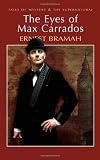
Ernest Bramah’s The Eyes of Max Carrados, a brick-sized entry in the Wordsworth “Tales of Mystery and the Supernatural” series, collects all 26 Max Carrados mysteries, originally published in several volumes during the first quarter of the 20th century. Max Carrados is one of the truly unique detectives in the entire genre: he is blind, but has compensated for that impairment by some remarkable enhancements to his other senses - a very subtle, but very effective, array of superpowers show more that give him an edge in solving his baffling cases. The basic setup of the stories is that Louis Carlyle, an inquiry agent, functions as Carrados’s associate, bringing each of the cases to him. Carrados zeroes in on the most obscure details to find relevant clues. And the urbane and witty interplay between Carrados and Carlyle is quite engaging, with suspects, clues, and motives duly bantered about. Most of the stories are fun and intriguing, though some do tend to drag a bit. Highly recommended, particularly for aficionados of vintage Edwardian mysteries. show less
“All the same, Max, I don’t think that you have treated me quite fairly,” protested Carlyle, getting over his first surprise and passing to a sense of injury. “Here we are and I know nothing, absolutely nothing, of the whole affair.”
From “The Knight’s Cross Signal Problem”
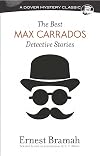
That’s pretty much how readers will feel when reading the 10 short stories gathered in this re-release of a 1972 anthology of Ernest Bramah’s blind detective, Max Carrados. Braham spends nearly as much show more time is spent in each tale marveling at how the blind Carrados can “read” newspaper headlines by feeling the newsprint, know (due to his other senses) what people have in their pockets, and other impossible feats as he spends on the actual investigation. Author Bramah never plays fair with readers, providing them no more clues than he passes on to Carrados’ private detective pal Mr. Carlyle.
Bramah published his first Max Carrados book in 1914 and continued the stories into the 1930s. Inexplicably, these stories were pretty popular in their day, sometimes outselling Sherlock Holmes stories. However, modern audiences are likely to find Carrados disappointing since his revelations at the end of each short story seem to come out of nowhere. I give Bramah credit for being incredibly ahead of his time on both race and imperialism, but otherwise his descent into obscurity is entirely understandable.
In the interest of full disclosure, I received this book from NetGalley and Dover Publications in exchange for an honest review. show less
Lists
Favourite Books (2)
Mamet's Ear (1)
Awards


You May Also Like


Associated Authors
Statistics
- Works
- 58
- Also by
- 58
- Members
- 1,635
- Popularity
- #15,709
- Rating
- 3.8
- Reviews
- 39
- ISBNs
- 311
- Languages
- 3
- Favorited
- 14