
Steven E. Koonin
Author of Unsettled: What Climate Science Tells Us, What It Doesn't, and Why It Matters
Works by Steven E. Koonin
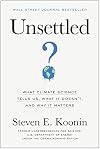
Unsettled: What Climate Science Tells Us, What It Doesn't, and Why It Matters (2021) 281 copies, 8 reviews
Tagged
Common Knowledge
- Canonical name
- Koonin, Steven E.
- Legal name
- Koonin, Steven Elliot
- Other names
- Кунин, Стивен Э.
Кунин, С. - Birthdate
- 1951-12-12
- Gender
- male
- Nationality
- USA
- Birthplace
- Brooklyn, New York, USA
- Associated Place (for map)
- New York, USA
Members
Reviews
In our age of enraged and vacuous polemical partisanship, this sober and rational foray into an important topic couldn't be more welcome or (sadly) out of place.
An important and salient work that, especially in Part I, tells an important story from the vantage point of someone very much in the thick of climate and energy policy. That this is the work of a knowledgeable scientist whose work in academia, industry, and government (last in the Obama admin's Energy Department) puts him at the show more very heart of the international effort to figure out what is happening to the earth's climate (for whatever cause) and collaborate on potential ways to address it, makes the story within all the more compelling and critical to understand. Should be required high school/university reading for young people, the most worried, but least informed, about climate and the supposed looming catastrophes related to it.
The climate is changing, man is contributing to it, but what you think you know after that is largely not backed by real-life science. If that astounds you, read this book and then look into the data, the reports, and the primary research for yourself. You won't be sorry, no matter where you're coming from. show less
An important and salient work that, especially in Part I, tells an important story from the vantage point of someone very much in the thick of climate and energy policy. That this is the work of a knowledgeable scientist whose work in academia, industry, and government (last in the Obama admin's Energy Department) puts him at the show more very heart of the international effort to figure out what is happening to the earth's climate (for whatever cause) and collaborate on potential ways to address it, makes the story within all the more compelling and critical to understand. Should be required high school/university reading for young people, the most worried, but least informed, about climate and the supposed looming catastrophes related to it.
The climate is changing, man is contributing to it, but what you think you know after that is largely not backed by real-life science. If that astounds you, read this book and then look into the data, the reports, and the primary research for yourself. You won't be sorry, no matter where you're coming from. show less
If You Want To Talk About Climate, You Need To Read This Book First. Seriously, it is *that* important and *that* illuminating. Here, Koonin lays bare what the science actually says - and what "the science" that so many claim is "settled" want to make you think. Chapter 4 alone, where Koonin - who helped *create* some of the first computer based climate models and literally wrote a textbook on the subject - discusses climate models and how reliable - or not - they are is worth the price of show more the book.
Ultimately this is a book that no partisan will be happy with. Koonin eviscerates positions on both the left and the right of American politics with equal aplomb, sticking to the facts of the matter at hand as the science itself dictates them and refraining from veering into political recommendations. Thus, where the science genuinely is clear that humans are having some impact or another, Koonin points this out in precise detail - precise enough for the purposes of this text anyway, while citing the studies that show the more scientific level precision. Where the science is more muddled, Koonin points this out too - and explains where we know what we don't know and even some of where we don't know what we don't know.
This book, per its very cover, sets out to uncover what we know, what we don't know, and why the distinction matters - and it does exactly this truly remarkably well. Very much recommended. show less
Ultimately this is a book that no partisan will be happy with. Koonin eviscerates positions on both the left and the right of American politics with equal aplomb, sticking to the facts of the matter at hand as the science itself dictates them and refraining from veering into political recommendations. Thus, where the science genuinely is clear that humans are having some impact or another, Koonin points this out in precise detail - precise enough for the purposes of this text anyway, while citing the studies that show the more scientific level precision. Where the science is more muddled, Koonin points this out too - and explains where we know what we don't know and even some of where we don't know what we don't know.
This book, per its very cover, sets out to uncover what we know, what we don't know, and why the distinction matters - and it does exactly this truly remarkably well. Very much recommended. show less
At long last, here is a climate change analysis that credibly challenges the generally-accepted hysteria with facts, replicable criticisms, and a basis of solid scientific discipline. Steven Koonin was Undersecretary for Science in the Energy Department during the Obama Administration, and a 15 year climate scientist who has worked for Big Oil and numerous scientific organizations. His book Unsettled, collects his thoughts from that period, as well as the many challenges he has made to show more “The Science” of climate fear-mongering.
His objections fall into two broad buckets: while there is real evidence of man’s contribution to pollution, there is no evidence the climate is changing directly because of it. And at the same time, the claims presented by scientists is not merely faulty, they often fly in the face of the very evidence they provide. All in all, it’s a bizarre, if not bogus way to run science. It bothers him no end when science is used “to persuade rather than to inform.”
With those focuses in mind, Koonin attacks various climate change aspects, from hurricanes to sea levels, to carbon dioxide. In every case, he finds science has been misrepresented, and the role of Man exaggerated if not unproven.
His issue with human responsibility is the old (and valid) charge that correlation does not imply causation. Technically, it is all but impossible to attribute what little measurable change there has been in the climate today (compared to the last century) to activities by Man. So, for example, while carbon dioxide levels in the air have breached the 400 ppm level set tens of millions of years ago, there is no evidence this has shaken the climate to its roots today. And the scientific papers he cites predict little or no drama ever, either.
Similarly, the record does not show there are more hurricanes or fiercer hurricanes or more long-lived hurricanes than ever. Same goes for tornadoes. And the same UN-IPCC reports that everyone uses to prove damage from climate change also state that if the global temperature rises 3°C instead of being held to 1.5°, the economic impact will be minimal. Not catastrophic, not an existential global mega-threat. Minimal. Their word, not Koonin’s. And yet, the news media word on warming is catastrophic.
A quarter of the way through, he finds a way to neatly summarize his frustration: “Understanding how the climate system responds to human influences is, unfortunately, a lot like trying to understand the connection between human nutrition and weight loss, a subject famously unsettled to this day.”
Koonin has the data and the science down pat. This however means most readers will have to trust him as he employs measures that mere mortals have never heard of, such as the PDI – the power dissipation index (for use in hurricane studies).
Then, on blame for it all: “As for the media, pointing to hurricanes as an example of the ravages of human-caused climate change is at best unconvincing and at worst plainly dishonest.” He has similar words for politicians and scientific publishers and associations, who ignore their own findings to create (false) attention-grabbing headlines. He says the peer review system does not attempt to replicate results, so papers simply get published as claimed. He would prefer a red team-blue team attack and defend process, but no one in power is signing up for it.
I have plenty of issues with his approach. On sea level rise, for example, Koonin points to the historical record that shows the seas have been rising for 150 years now. Not much, but recordable. Therefore, there is no great threat from sea level rise. But in everything else I have read, sea level rise starts small, and only really kicks in beyond the year 2100. In other words (to cite another old saw), past performance is no indicator of future results.
Also from what I have read and reviewed, probably 40 or 50 volumes now, there is reason to predict that tornadoes, while not bigger or more frequent, will cover an ever larger area as the climate changes, to greatly extend the areas where conditions are ripe. This is real change. Not in severity, but in scope. His backward-looking charts do not account for that.
And despite his measly figures, tens of thousands of properties are being bought up by governments weary of insuring them, rebuilding roads to them, and servicing them. Insurance companies are routinely refusing policy renewals in ever-widening flood-prone areas. On the US east coast, they are raising their homes 10-12 feet on stilts to survive the ocean surges. The US Navy is looking at hundreds of billions to rehab its concrete docks that now routinely get swamped. So there is a disconnect between Koonin’s figures and our lying eyes.
While Koonin’s charts show only incremental changes and no dramatic new trends, we in the northeast United States have watched the steady erosion of winter for years. Peak fall leaves used to occur the week of Columbus Day, around the 10th of October. Now they peak around Hallowe’en. In the spring, the trees suddenly leaf out in in mid to late April instead of the first week of May. This means winter has shrunk by four or five weeks. Doesn’t matter what his charts say (though he doesn’t address the changing of the seasons at all), we can see it ourselves, along with the southern insects that are making their way north as the climate changes to accommodate them.
I think Koonin wouldn’t argue the point. He’d just say yes, but what harm is it all doing? My answer is we don’t know yet, but we should stop screwing with it regardless.
Which brings up geoengineering. Koonin has looked into numerous schemes to treat the land, sea and air with various chemicals and shrapnel to make the planet more reflective, and therefore cooler. Polluting them all this way is at very least dangerous, as our lying eyes tell us from the work of the Army Corps of Engineers. The Corps has long been our own crew of geoengineers, tilting at windmills and causing more problems than they solve, in order to tame Nature. We do not want more of that on a global scale.
His issues with geoengineering are different, though. He sees problems getting buy-in from every country before we pollute the air globally for their benefit. On the other hand, some people are so rich they could do it themselves, without permission if the mood struck them. Unfortunately, they would have to keep at it continuously, forever. Because if they stop, he admits, it would be like closing an umbrella in the rain or closing a parasol in the sun. The reversal would be immediate and dramatic.
For the first time in 4.5 billion years, the waste produced by a species on Earth is toxic to the planet. From plastics to carbon dioxide, insecticides and nuclear weapons and reactors, Man’s waste does not fit or benefit the ecosystem and is clearly (to most people) doing considerable harm. For Koonin to ignore this in favor of charts looking back 150 years is as intellectually dishonest as the clcikbait headlines from rotten studies in scientific journals.
He also seems to take the position that climate change causes no deaths. This appears to be like the argument that guns don’t kill people, bullets kill people. But in more severe monsoons and more intense heatwaves, people die. For instance, in France in 2003, a three week “once in a lifetime” heat wave killed 15,000. It led to a whole new industry – air conditioning – that France never needed before. But it does now, and in a suddenly very big way, as heat waves have continued to appear and increase in both frequency and intensity. Construction workers increasingly work nights and not days because of the dangers and lack of productivity in 40°C heat. At a certain point, planes can’t fly either. This is not weather; this is climate change. And people die because of it.
So while I very much appreciate the analysis of the faults in scientific circles, the prejudices in the news media and among politicians, Unsettled is unsatisfying. Yes, the book is tight, well-constructed and thorough. Yes, Koonin is telling the truth, as far as his charts let him. But there’s more to it than Koonin’s stats and charts. He does not succeed in making me feel there’s no need to worry, that Man’s contribution has had minimal effect, and nothing much is going to change regardless of what we do. The science might be unsettled, but the willful damage is real.
David Wineberg show less
His objections fall into two broad buckets: while there is real evidence of man’s contribution to pollution, there is no evidence the climate is changing directly because of it. And at the same time, the claims presented by scientists is not merely faulty, they often fly in the face of the very evidence they provide. All in all, it’s a bizarre, if not bogus way to run science. It bothers him no end when science is used “to persuade rather than to inform.”
With those focuses in mind, Koonin attacks various climate change aspects, from hurricanes to sea levels, to carbon dioxide. In every case, he finds science has been misrepresented, and the role of Man exaggerated if not unproven.
His issue with human responsibility is the old (and valid) charge that correlation does not imply causation. Technically, it is all but impossible to attribute what little measurable change there has been in the climate today (compared to the last century) to activities by Man. So, for example, while carbon dioxide levels in the air have breached the 400 ppm level set tens of millions of years ago, there is no evidence this has shaken the climate to its roots today. And the scientific papers he cites predict little or no drama ever, either.
Similarly, the record does not show there are more hurricanes or fiercer hurricanes or more long-lived hurricanes than ever. Same goes for tornadoes. And the same UN-IPCC reports that everyone uses to prove damage from climate change also state that if the global temperature rises 3°C instead of being held to 1.5°, the economic impact will be minimal. Not catastrophic, not an existential global mega-threat. Minimal. Their word, not Koonin’s. And yet, the news media word on warming is catastrophic.
A quarter of the way through, he finds a way to neatly summarize his frustration: “Understanding how the climate system responds to human influences is, unfortunately, a lot like trying to understand the connection between human nutrition and weight loss, a subject famously unsettled to this day.”
Koonin has the data and the science down pat. This however means most readers will have to trust him as he employs measures that mere mortals have never heard of, such as the PDI – the power dissipation index (for use in hurricane studies).
Then, on blame for it all: “As for the media, pointing to hurricanes as an example of the ravages of human-caused climate change is at best unconvincing and at worst plainly dishonest.” He has similar words for politicians and scientific publishers and associations, who ignore their own findings to create (false) attention-grabbing headlines. He says the peer review system does not attempt to replicate results, so papers simply get published as claimed. He would prefer a red team-blue team attack and defend process, but no one in power is signing up for it.
I have plenty of issues with his approach. On sea level rise, for example, Koonin points to the historical record that shows the seas have been rising for 150 years now. Not much, but recordable. Therefore, there is no great threat from sea level rise. But in everything else I have read, sea level rise starts small, and only really kicks in beyond the year 2100. In other words (to cite another old saw), past performance is no indicator of future results.
Also from what I have read and reviewed, probably 40 or 50 volumes now, there is reason to predict that tornadoes, while not bigger or more frequent, will cover an ever larger area as the climate changes, to greatly extend the areas where conditions are ripe. This is real change. Not in severity, but in scope. His backward-looking charts do not account for that.
And despite his measly figures, tens of thousands of properties are being bought up by governments weary of insuring them, rebuilding roads to them, and servicing them. Insurance companies are routinely refusing policy renewals in ever-widening flood-prone areas. On the US east coast, they are raising their homes 10-12 feet on stilts to survive the ocean surges. The US Navy is looking at hundreds of billions to rehab its concrete docks that now routinely get swamped. So there is a disconnect between Koonin’s figures and our lying eyes.
While Koonin’s charts show only incremental changes and no dramatic new trends, we in the northeast United States have watched the steady erosion of winter for years. Peak fall leaves used to occur the week of Columbus Day, around the 10th of October. Now they peak around Hallowe’en. In the spring, the trees suddenly leaf out in in mid to late April instead of the first week of May. This means winter has shrunk by four or five weeks. Doesn’t matter what his charts say (though he doesn’t address the changing of the seasons at all), we can see it ourselves, along with the southern insects that are making their way north as the climate changes to accommodate them.
I think Koonin wouldn’t argue the point. He’d just say yes, but what harm is it all doing? My answer is we don’t know yet, but we should stop screwing with it regardless.
Which brings up geoengineering. Koonin has looked into numerous schemes to treat the land, sea and air with various chemicals and shrapnel to make the planet more reflective, and therefore cooler. Polluting them all this way is at very least dangerous, as our lying eyes tell us from the work of the Army Corps of Engineers. The Corps has long been our own crew of geoengineers, tilting at windmills and causing more problems than they solve, in order to tame Nature. We do not want more of that on a global scale.
His issues with geoengineering are different, though. He sees problems getting buy-in from every country before we pollute the air globally for their benefit. On the other hand, some people are so rich they could do it themselves, without permission if the mood struck them. Unfortunately, they would have to keep at it continuously, forever. Because if they stop, he admits, it would be like closing an umbrella in the rain or closing a parasol in the sun. The reversal would be immediate and dramatic.
For the first time in 4.5 billion years, the waste produced by a species on Earth is toxic to the planet. From plastics to carbon dioxide, insecticides and nuclear weapons and reactors, Man’s waste does not fit or benefit the ecosystem and is clearly (to most people) doing considerable harm. For Koonin to ignore this in favor of charts looking back 150 years is as intellectually dishonest as the clcikbait headlines from rotten studies in scientific journals.
He also seems to take the position that climate change causes no deaths. This appears to be like the argument that guns don’t kill people, bullets kill people. But in more severe monsoons and more intense heatwaves, people die. For instance, in France in 2003, a three week “once in a lifetime” heat wave killed 15,000. It led to a whole new industry – air conditioning – that France never needed before. But it does now, and in a suddenly very big way, as heat waves have continued to appear and increase in both frequency and intensity. Construction workers increasingly work nights and not days because of the dangers and lack of productivity in 40°C heat. At a certain point, planes can’t fly either. This is not weather; this is climate change. And people die because of it.
So while I very much appreciate the analysis of the faults in scientific circles, the prejudices in the news media and among politicians, Unsettled is unsatisfying. Yes, the book is tight, well-constructed and thorough. Yes, Koonin is telling the truth, as far as his charts let him. But there’s more to it than Koonin’s stats and charts. He does not succeed in making me feel there’s no need to worry, that Man’s contribution has had minimal effect, and nothing much is going to change regardless of what we do. The science might be unsettled, but the willful damage is real.
David Wineberg show less
Throughout the book, Koonin is Technically Correct, which we all know is The Best Kind of correct.
Example:
Person: Help, I was just stabbed and am dying, please take me to the hospital
Koonin: Statistically, most people do not die from stab wounds
Person: the blood is literally leaking from a hole in my side!
Koonin: Technically, the blood is hemorrhaging, not leaking
Person: It really hurts, can you at least apply some pressure to slow the bleeding
Koonin: My coagulation model shows that there is show more a wide range of potential outcomes, depending on how deep the wound is, the width and sharpness of the object used in the stabbing, the location of the stabbing, and a variety of other factors, many of which are difficult to predict
Person: Everything is getting dark
Koonin: Well actually, we first need to check your blood sugar level to rule out natural causes
Person: dies
Koonin: I can now state with a fair degree of confidence that the stab wound was likely a contributing factor towards the person's death, but we need to perform an autopsy to confirm, and should not jump to conclusions.
He rightly points out that science is hard, and climate science is no exception. Especially when it comes to making predictions, in particular when they concern the future. This of course comes as no surprise to anyone caught in a sudden rain shower that wasn't in the morning's weather forecast. However, his wait & see approach is potentially disastrous. By the time the science is "settled" to his satisfaction, it will be too late to forestall the catastrophic effects, and a lot more costly in every way than if we undertake some modest precautionary measures in advance.
He also rightly goes after the horrid misrepresentation of how mainstream journalism reports on scientific research, with sensationalist headlines that often grossly distort what the study actually says. But this is by no means restricted to climate science, and even when the predictions are exaggerated it doesn't negate the underlying trends, and blaming the scientists as he does is malicious.
The biggest issue with the book is that he portrays the current situation as one of overreaction. Yet each year brings both more urgent warnings from climate scientists, more data and studies indicating increasing anthropocentric warming, and the continued stubbornness to do much about it. We've blown past even the modest Paris targets, and major emitters like the United States are doubling down on their intent to continue to spew greenhouse gasses into the atmosphere. Yet Koonin decided to ignore all the dangers and focus instead on the non-existence risks of overstating the confidence in the models that predict dire consequences for inaction.
It's as if he's concerned that we make the world better for nothing. show less
Example:
Person: Help, I was just stabbed and am dying, please take me to the hospital
Koonin: Statistically, most people do not die from stab wounds
Person: the blood is literally leaking from a hole in my side!
Koonin: Technically, the blood is hemorrhaging, not leaking
Person: It really hurts, can you at least apply some pressure to slow the bleeding
Koonin: My coagulation model shows that there is show more a wide range of potential outcomes, depending on how deep the wound is, the width and sharpness of the object used in the stabbing, the location of the stabbing, and a variety of other factors, many of which are difficult to predict
Person: Everything is getting dark
Koonin: Well actually, we first need to check your blood sugar level to rule out natural causes
Person: dies
Koonin: I can now state with a fair degree of confidence that the stab wound was likely a contributing factor towards the person's death, but we need to perform an autopsy to confirm, and should not jump to conclusions.
He rightly points out that science is hard, and climate science is no exception. Especially when it comes to making predictions, in particular when they concern the future. This of course comes as no surprise to anyone caught in a sudden rain shower that wasn't in the morning's weather forecast. However, his wait & see approach is potentially disastrous. By the time the science is "settled" to his satisfaction, it will be too late to forestall the catastrophic effects, and a lot more costly in every way than if we undertake some modest precautionary measures in advance.
He also rightly goes after the horrid misrepresentation of how mainstream journalism reports on scientific research, with sensationalist headlines that often grossly distort what the study actually says. But this is by no means restricted to climate science, and even when the predictions are exaggerated it doesn't negate the underlying trends, and blaming the scientists as he does is malicious.
The biggest issue with the book is that he portrays the current situation as one of overreaction. Yet each year brings both more urgent warnings from climate scientists, more data and studies indicating increasing anthropocentric warming, and the continued stubbornness to do much about it. We've blown past even the modest Paris targets, and major emitters like the United States are doubling down on their intent to continue to spew greenhouse gasses into the atmosphere. Yet Koonin decided to ignore all the dangers and focus instead on the non-existence risks of overstating the confidence in the models that predict dire consequences for inaction.
It's as if he's concerned that we make the world better for nothing. show less
You May Also Like


Statistics
- Works
- 4
- Members
- 335
- Popularity
- #71,018
- Rating
- 4.4
- Reviews
- 8
- ISBNs
- 22
- Languages
- 6