
Kevin Sampsell
Author of A Common Pornography: A Memoir (P.S.)
About the Author
Works by Kevin Sampsell
Spork 4.3 3 copies
Baby In the Night 2 copies
Camp Psychic, The 1 copy
Eyeheart Everything 1 copy
Spork #4.3 1 copy
Associated Works
In Heaven, Everything Is Fine: Fiction Inspired by David Lynch (2013) — Contributor — 56 copies, 1 review
Get Out of My Crotch! Twenty-One Writers Respond to America's War on Women's Rights and Reproductive Health (2013) — Contributor — 12 copies
Fairy Tale Review: The Grey Issue — Contributor — 2 copies
Tagged
Common Knowledge
- Gender
- male
- Places of residence
- Kennewick, Washington, USA
- Associated Place (for map)
- Washington, USA
Members
Reviews

Bet I’m gonna get some interesting new followers and fun spam comments with the word “pornography” in the title of my post, but you know what? It will be totally worth it for the opportunity to talk about this incredibly unique, impossible-to-put-down book. (That’s my new workaround for “unputdownable,” which I know many of you hate. What do you think?)
Anyway, let’s talk about A Common Pornography because it really is fascinating. After Kevin Sampsell’s father died suddenly show more of a brain aneurysm in 2008, he returned to the small town in Washington state where he grew up, and as he revisited memories from his childhood, viewing them through the new lens of adulthood and realizing that his life was not nearly as normal as he once thought, his mother revealed new information about his family’s history—including his father’s molestation of his half-sister—that enabled him to put the pieces together in a way he never had before. What resulted from this reflection is the “memory experiment” that forms A Common Pornography.
Presented in short vignettes—most pieces in the book are just a few pages—that seem to be a free association of memories about childhood, adolescence, family dysfunction, sexual experiences, and much more, A Common Pornography tells the story of Sampsell’s life through a series of written snapshots. By giving readers insight into the most salient, formative moments of his life—and many mundane ones as well—Sampsell pieces together an autobiography that doesn’t mess around with small talk but instead goes right to the heart of who and how he is and why that is so
The make-up of Sampsell’s family is unusual, consisting of several half-siblings–one of whom is black— from his mother’s two previous marriages, and his relationship with his half-siblings and his father is complicated to say the least. The snapshot vignettes exploring these relationships are remarkably weighty, particularly for such short pieces, and they indicate that what Sampsell has done here goes beyond having a way with words. These pieces pack a strong emotional punch, and Sampsell takes us with him as he forms new understandings of his family following his mother’s revelations.
In balance to these darker pieces, Sampsell tells us about his adolescent porn collection (you were waiting for that, weren’t you?), which he first hid behind a tile of his bedroom ceiling, but which, fearing that it would cave in and expose him (this is a BIG porn collection, people), he eventually culled down to a kind of greatest hits collection that he kept in an old blue suitcase in the back of his closet. Reflections on the discovery of pornography and masturbation are a dime a dozen in male coming-of-age stories and memoirs, but Sampsell makes it seem fresh, new, and endearing, and that is the defining feature of this memoir.
I like to the think that the title of this book refers not to just to Sampsell’s suitcase porn collection but to humans’ endless fascination with each other. We are innately, insatiably curious about the lives of others, and memoirs, in their way, have become a kind of literary pornography, an opportunity to exercise voyeurism in a socially acceptable way and to peer into experiences that are simultaneously banal and noteworthy. Tolstoy was right; every unhappy family is unhappy in its own way, and it is Sampsell’s ability to see that in his own family and excise the best bits that makes A Common Pornography feel so original.
Originally published at The Book Lady's Blog. show less
Anyway, let’s talk about A Common Pornography because it really is fascinating. After Kevin Sampsell’s father died suddenly show more of a brain aneurysm in 2008, he returned to the small town in Washington state where he grew up, and as he revisited memories from his childhood, viewing them through the new lens of adulthood and realizing that his life was not nearly as normal as he once thought, his mother revealed new information about his family’s history—including his father’s molestation of his half-sister—that enabled him to put the pieces together in a way he never had before. What resulted from this reflection is the “memory experiment” that forms A Common Pornography.
Presented in short vignettes—most pieces in the book are just a few pages—that seem to be a free association of memories about childhood, adolescence, family dysfunction, sexual experiences, and much more, A Common Pornography tells the story of Sampsell’s life through a series of written snapshots. By giving readers insight into the most salient, formative moments of his life—and many mundane ones as well—Sampsell pieces together an autobiography that doesn’t mess around with small talk but instead goes right to the heart of who and how he is and why that is so
The make-up of Sampsell’s family is unusual, consisting of several half-siblings–one of whom is black— from his mother’s two previous marriages, and his relationship with his half-siblings and his father is complicated to say the least. The snapshot vignettes exploring these relationships are remarkably weighty, particularly for such short pieces, and they indicate that what Sampsell has done here goes beyond having a way with words. These pieces pack a strong emotional punch, and Sampsell takes us with him as he forms new understandings of his family following his mother’s revelations.
In balance to these darker pieces, Sampsell tells us about his adolescent porn collection (you were waiting for that, weren’t you?), which he first hid behind a tile of his bedroom ceiling, but which, fearing that it would cave in and expose him (this is a BIG porn collection, people), he eventually culled down to a kind of greatest hits collection that he kept in an old blue suitcase in the back of his closet. Reflections on the discovery of pornography and masturbation are a dime a dozen in male coming-of-age stories and memoirs, but Sampsell makes it seem fresh, new, and endearing, and that is the defining feature of this memoir.
I like to the think that the title of this book refers not to just to Sampsell’s suitcase porn collection but to humans’ endless fascination with each other. We are innately, insatiably curious about the lives of others, and memoirs, in their way, have become a kind of literary pornography, an opportunity to exercise voyeurism in a socially acceptable way and to peer into experiences that are simultaneously banal and noteworthy. Tolstoy was right; every unhappy family is unhappy in its own way, and it is Sampsell’s ability to see that in his own family and excise the best bits that makes A Common Pornography feel so original.
Originally published at The Book Lady's Blog. show less
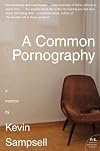
I stand in awe of anyone who can write and publish a memoir, for two reasons: first, that some people have had lives interesting enough that anyone wants to read about them; and second, that some people are brave enough to write about particular incidents and personality quirks -- see, esp., one's sex life -- without altering the details to make themselves look more noble, more thoughtful, or more mature than they really are.
Kevin Sampsell succeeded in impressing me on both counts. I will show more confess that I was predisposed toward liking this memoir, as Kevin is almost exactly my age (he's about a year younger), and I figured that we'd share certain of the same childhood experiences. Well, it turns out that we did -- in superficial ways, anyway, such as liking the same music, recording songs from the radio, etc.
But it's not only shared experience that made this book worthwhile. Sampsell's style is somewhat non-traditional for this genre -- discrete memories, placed roughly chronologically, to tell the story of Sampsell's childhood and young adulthood, along with that of his brothers and sisters (most notably, the inutterably sad story of his half-sister Elinda, and her sexual abuse at the hands of Sampsell's father). The non-traditional form, though, is more true-to-life than the form you find in most memoirs -- after all, we really do tend to remember our childhoods in episodes, sometimes vivid ones that come back to us after laying dormant for years. Here, as with our own stories, the episodes come together to give an indelible account of a life -- one in which the protagonist doesn't necessarily try to convince you that he's someone you'd like to spend time with.
Sampsell has written memoir that's often sad, sometimes loud-out-loud funny (the virtual-reality dentist episode is what James Frey probably wished he'd written), but always brave and ultimately hopeful. show less
Kevin Sampsell succeeded in impressing me on both counts. I will show more confess that I was predisposed toward liking this memoir, as Kevin is almost exactly my age (he's about a year younger), and I figured that we'd share certain of the same childhood experiences. Well, it turns out that we did -- in superficial ways, anyway, such as liking the same music, recording songs from the radio, etc.
But it's not only shared experience that made this book worthwhile. Sampsell's style is somewhat non-traditional for this genre -- discrete memories, placed roughly chronologically, to tell the story of Sampsell's childhood and young adulthood, along with that of his brothers and sisters (most notably, the inutterably sad story of his half-sister Elinda, and her sexual abuse at the hands of Sampsell's father). The non-traditional form, though, is more true-to-life than the form you find in most memoirs -- after all, we really do tend to remember our childhoods in episodes, sometimes vivid ones that come back to us after laying dormant for years. Here, as with our own stories, the episodes come together to give an indelible account of a life -- one in which the protagonist doesn't necessarily try to convince you that he's someone you'd like to spend time with.
Sampsell has written memoir that's often sad, sometimes loud-out-loud funny (the virtual-reality dentist episode is what James Frey probably wished he'd written), but always brave and ultimately hopeful. show less
I greatly enjoyed this book. A collection of very short pieces of the author's life arranged into a greater kind of memoir. The memories of Kevin Sampsell are moving, terrifying, humorous, and indescribably fucked-up. I felt at times as if I was eating from a bowl filled with bitter little pieces of candy. The author is able to reach into your heart and grab you, then leave you feeling stunned or sad or moved in some way, all within a couple pages, and sometimes even a couple paragraphs. show more After that, you have to take a break to emotionally recover before moving on to the next story. This feat is accomplished by use of a very simple, straightforward, and earnest writing style that feels as if you're being told a story personally. And yet, even accounting for such an economic use of words, nothing seems to be left unsaid. show less

Portland Noir is a collection of original short stories that is all over the map -- if the map is of the Rose City. The stories are set in different neighborhoods that collectively make up the seedy underbelly of Portland.
The anthology, edited by Kevin Sampsell, is part of the Akashic Books Noir series -- 'a groundbreaking series of original noir anthologies. Each book is comprised of all-new stories, each one set in a distinct neighborhood or location within the city of the book.'
The show more Portland stories take readers to many a gritty, greasy corner of Portland, where junkies break into the wrong houses, lesbians fantasize about strangling the men in their beds, and love gets strange. The stories come in many shades of dark, from creepy (“Baby, I’m Here”) to clever (“Shanghaied”); violent (“The Wrong House”) to sadly sweet (“Alzheimer’s Noir”).
If there is anything generally missing, it is . . .
Full review posted on Rose City Reader. show less
The anthology, edited by Kevin Sampsell, is part of the Akashic Books Noir series -- 'a groundbreaking series of original noir anthologies. Each book is comprised of all-new stories, each one set in a distinct neighborhood or location within the city of the book.'
The show more Portland stories take readers to many a gritty, greasy corner of Portland, where junkies break into the wrong houses, lesbians fantasize about strangling the men in their beds, and love gets strange. The stories come in many shades of dark, from creepy (“Baby, I’m Here”) to clever (“Shanghaied”); violent (“The Wrong House”) to sadly sweet (“Alzheimer’s Noir”).
If there is anything generally missing, it is . . .
Full review posted on Rose City Reader. show less
Awards

You May Also Like


Associated Authors
Statistics
- Works
- 15
- Also by
- 6
- Members
- 368
- Popularity
- #65,432
- Rating
- 3.4
- Reviews
- 18
- ISBNs
- 15
- Favorited
- 1