
Enid Shomer
Author of The Twelve Rooms of the Nile
Works by Enid Shomer
Floodgate Poetry Series Vol. 3: Three Chapbooks in a Single Volume (Volume 3) (2016) 2 copies, 1 review
Associated Works
When She Named Fire: An Anthology of Contemporary Poetry by American Women (2008) — Contributor — 15 copies
Kalliope : A Journal of Women's Art, Tenth Anniversary Issue — Contributor — 1 copy
Tagged
Common Knowledge
- Gender
- female
Members
Reviews

He crawled across the space between them and rested his head against her shoulder. Philae held them in its silted-up silence. Barely touching her for fear she’d collapse under the weight of an embrace or move away again, he encircled her with his arms. “I am waiting for the muse to visit me,” he managed to whisper, “just as you are waiting for God to speak to you again.” Were they not both self-made pariahs? He felt himself in complete sympathy with her, as if they had mingled show more their blood in the purity and innocence of childhood.
Part love story, part historical adventure, Enid Shomer’s The Twelve Rooms of the Nile is a fun jaunt back into the Egypt of the mid 1800’s, only just beginning to be appreciated and explored by adventurous Europeans. The tale follows Florence Nightingale, during her pre-Crimean War years, and French writer Gustave Flaubert, as they separately travel the Nile by boat. Both actually did take such trips during their lifetimes—and indeed, even at the same time—though they never actually met, as far as history records. But Ms. Shomer has imagined an alternate, enthralling world—where they do.
The Florence she imagines for us is one who hungers to do some great humanitarian work and leave her mark on the world, but is hampered by the conventions of her Victorian culture, a culture whose foremost watchdog is Florence’s own mother. Prim and proper, but longing to be free, Florence strains against the stays of her society, and briefly escapes the constrictures of her family with two doting friends who agree to chaperone the Egyptian excursion. Gustave, tormented by his companions’ dismissal of his first novel (and not yet the writer who will one day write Madame Bovary), is in Egypt to gather impressions, both in the literal sense, as he makes ‘squeezes’ of hieroglyphs, and in the artistic sense, as he records with his highly attuned, hedonistic perceptions, the pleasures and realities life in Egypt offers.
Shomer, a poet with several published collections, writes with unerring skill, capturing with vivid prose both the characters inner lives, and the exotic world they travel through. And unlike some poets who attempt fiction, she at no time wanders astray into self-indulgent passages that have no bearing on the story being told; while the language is evocative and at times transportive, it at all times serves the tale, making this novel a delight.
This writer’s strengths: Language, obviously, being a poet, but she also possesses a good imagination, and doesn’t back off from an almost brutal honesty when depicting her characters inner lives. There are some graphic sexual scenes in this novel—it is about Flaubert, after all, and he did die of (probably) complications of syphilis; or ‘the pox’ (which was something of a scourge among Europeans of the time). But they are written with such apparent honesty, that even the luridness of the brothel visits feels necessary.
Who will enjoy this book: The novel was clearly deeply researched, so history buffs of the time, or anyone curious about either of the main characters lives (and if you’re not, you will be, after reading this book), those who enjoy tales of Egypt, especially during the 1800s. Readers who enjoy deeply investigated flawed and believable characters. Readers who enjoy literary writing and a well-turned phrase combined with an adventurous tale.
The Twelve Rooms of the Nile is 445 pages. I did not note any editing errors. It was published in 2012 by Simon & Schustler.
I highly recommend it. show less
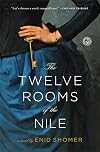
Florence Nightengale and Gustave Flaubert were the exact opposites: she a prim and proper upper class English woman and he a French man obsessed with prostitutes. As was common for the time in the 1800's, both found themselves cruising down the Nile River to explore Egypt's antiquities. She was chaperoned by an older couple and a personal maid, Trout. He was accompanying a photographer friend. They happened on accident to meet and a strange relationship developed.
Florence has never met show more anyone like Gustave and he has never met anyone as naive as Florence who at the same time is chafing under the strict cultural rules of the time. Having turned down a suitor, Florence does not want to be married, fearing that she would lose all independence if she did. She is brilliant and has a great desire to be useful in the world, unlike the rest of her family. Flaubert wants to write, but is frustrated with subject matter having written one very unsuccessful novel. Added to this mixture is Trout, her maid. Trout does not want to be in Egypt, does not understand Florence, and frustrates Florence who thinks of Trout as only "dull." The trip down the Nile and then overland through the Sahara Desert on camels allows each person to see the other in a totally different light.
The kidnapping of Trout by a group of Bedouins is a bit of a stretch, but adds to the story a sense of mystery when it causes Florence to read Trout's diary. Although the two as maid and lady are physically close, they know very little of each other.
I loved this book which actually made me laugh out loud at times. The description of the anxiety of Florence and the antics of Gustave are so totally believable. There are passages that are almost embarrassingly raw and border on weirdness, but it is not gratuitous; they are essential in the understanding of a man such as Flaubert. Great read. show less
Florence has never met show more anyone like Gustave and he has never met anyone as naive as Florence who at the same time is chafing under the strict cultural rules of the time. Having turned down a suitor, Florence does not want to be married, fearing that she would lose all independence if she did. She is brilliant and has a great desire to be useful in the world, unlike the rest of her family. Flaubert wants to write, but is frustrated with subject matter having written one very unsuccessful novel. Added to this mixture is Trout, her maid. Trout does not want to be in Egypt, does not understand Florence, and frustrates Florence who thinks of Trout as only "dull." The trip down the Nile and then overland through the Sahara Desert on camels allows each person to see the other in a totally different light.
The kidnapping of Trout by a group of Bedouins is a bit of a stretch, but adds to the story a sense of mystery when it causes Florence to read Trout's diary. Although the two as maid and lady are physically close, they know very little of each other.
I loved this book which actually made me laugh out loud at times. The description of the anxiety of Florence and the antics of Gustave are so totally believable. There are passages that are almost embarrassingly raw and border on weirdness, but it is not gratuitous; they are essential in the understanding of a man such as Flaubert. Great read. show less
3.5 stars. Filled with lovely prose & luscious descriptions, "The Twelve Rooms of the Nile" is an intricately-researched historical fiction novel. I thoroughly enjoyed Shomer's detailed depictions of both Florence Nightingale & Gustave Flaubert, as well as her gorgeous descriptions of Egypt itself. Seemingly, quite a few people have enjoyed the sections about Nightingale more than the ones about Flaubert; I have the opposite opinion -- I enjoyed the parts about Flaubert & sometimes felt show more slightly vexed at Nightingale's intermittent whiny attitude. Shomer's writing is lovely & complex (at times more of an extended character sketch than much of a plot).... Recommended especially for lovers of historical fiction &/or Victorian-style travelogues in exotic locales. show less
I didn't like it for most of the book - nothing happened until page 150! and again for many more pages...but when I got to the end, I liked it very much. It seems to me that Shomer is writing about the mystery of having a true calling -- which both Florence Nightingale and Gutave Flaubert did. No matter where it comes from, or the person called, comes from, it will assert itself. This reminds me of the book, Code of the Soul, which explains all this. The book is descriptive, and surprising, show more and does succeed in bringing to light the advantages and the drawbacks of wealth which makes exotic travel possible, but can cut one off from great satisfactions of serving and honest work as well. The discrepancies of the Victorian mind and culture are very much in evidence in this book. And it will be a hard one to forget. So although for the greater part of it, I can't say I enjoyed reading it, I'm glad I did, and have to give it four stars. show less
Awards


You May Also Like


Associated Authors
Statistics
- Works
- 15
- Also by
- 8
- Members
- 322
- Popularity
- #73,504
- Rating
- 3.5
- Reviews
- 20
- ISBNs
- 24