
About the Author
Walter Scheidel is Dickason Professor in the Humanities and Professor of Classics and History at Stanford University. His previous publications include Rome and China and, as coeditor with Pete Fibiger Bang and C. A. Bayly, The Oxford World History of Empire.
Image credit: Scheidel at the World Economic Forum Annual Meeting of the New Champions in 2012 [credit: World Economic Forum]
Works by Walter Scheidel
The Great Leveler: Violence and the History of Inequality from the Stone Age to the Twenty-First Century (2017) 526 copies, 3 reviews
Rome and China: Comparative Perspectives on Ancient World Empires (2009) — Editor — 73 copies, 1 review
The Science of Roman History: Biology, Climate, and the Future of the Past (2018) — Editor — 48 copies, 1 review
The Oxford Handbook of the State in the Ancient Near East and Mediterranean (2013) — Editor — 21 copies
Death on the Nile: Disease and the Demography of Roman Egypt (Mnemosyne, Bibliotheca Classica Batava Supplementum) (VOLUME 228) (2001) 8 copies
Associated Works
The Cambridge World History of Slavery: Volume 1, The Ancient Mediterranean World (2011) — Contributor — 29 copies
Money, Labour and Land: Approaches to the economics of ancient Greece (Routledge Classical Monographs) (2001) — Contributor — 20 copies
Eurasian Empires in Antiquity and the Early Middle Ages: Contact and Exchange between the Graeco-Roman World, Inner Asia and China (2017) — Contributor — 12 copies
Helots and Their Masters in Laconia and Messenia: Histories, Ideologies, Structures (2004) — Contributor — 11 copies
People, Land, and Politics : Demographic Developments and the Transformation of Roman Italy, 300 BC–AD 14 (2008) — Contributor — 6 copies
Arethusa (vol 58 no 1) — Contributor — 1 copy
Tagged
Common Knowledge
- Canonical name
- Scheidel, Walter
- Birthdate
- 1966-07-09
- Gender
- male
- Education
- University of Graz (habilitation|1998)
University of Vienna (M.Phil|1989|Ph.D|1993) - Occupations
- classicist
historian
editor
Dickason Professorship in the Humanities - Organizations
- Stanford University
University of Chicago
Darwin College, Cambridge
University of Cambridge
University of Vienna - Awards and honors
- Oswald Spengler Prize (2020)
Corresponding Member, Austrian Academy of Sciences (2015) - Nationality
- Austria
- Birthplace
- Vienna, Austria
- Associated Place (for map)
- Vienna, Austria
Members
Reviews
Escape from Rome: The Failure of Empire and the Road to Prosperity (The Princeton Economic History of the Western World Book 94) by Walter Scheidel
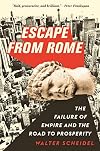
The author's wide ranging exploration of the question of why what most deem the "great divergence," and what he deems the "second great divergence" happened - why is it that the industrial revolution took place in northwestern Europe rather than elsewhere?
The author sets forth his thesis that it was primarily the polycentric nature of Western Europe that can explain it best historically.
The author begins with the Roman Empire. He points out how odd the Roman Empire was in the grand scheme show more of things - not just in the number of people over which it ruled, and for how long it ruled, but also the area over which it ruled. He does well at showing how well Rome was able to rule and the kind of quality of life enjoyed under the Empire, which in many respects would not be seen again until the modern era.
He explains how Rome was able to build itself up as a power and why that power was able to spread as it did: the militaristic culture, the high percentage of soldiers available, the size of armies, and the constant economic pressure to conquer more and more people until the development of the Empire itself. He then explored counterfactuals: under what situations would Rome not become what it was? The strongest counterfactuals stem from Roman origins and then the prospect of invasion from Alexander the Great. The rest stretched credulity; thus the strength of Rome in its moment is explained well.
Then the author tackles the question why no other empire was able to coalesce in Western Europe. He goes through a series of counterfactuals regarding every major power from Justinian to Napoleon and wondering what it would have taken for them to develop an empire like Rome. He is very persuasive at showing how no such power could have really built an empire once the fracture took place and Justinian's designs were frustrated by plague and collapse.
He then explains what he calls the first great divergence: the path Western Europe took toward polycentrism after the collapse of the Roman Empire whereas empires remained prevalent in eastern Europe and Asia. He shows powerfully the effect of geography and persuasively argues for a steppe effect: any agricultural-based power near the Eurasian/African steppe would likely develop into an empire since they have horses and a strong enemy at the ready. Southeast Asia and Western Europe are the only regions fully cut off from the steppe, and those are the places you find polycentrism. The author also looks at cultural reasons - religion, philosophy, etc. He shows how Catholicism maintains a common identity in Western Europe while in many respects fostering the fractured political entities of the day; nevertheless, he shows well that the cultures that developed in China vs. Western Europe were very much creatures of their particular context and are as much explained by the other factors as being an explaining factor in and of itself.
The author then explores the medieval and early modern era, primarily comparing and contrasting Western Europe and China. He shows why the way the Westerners fought each other led to developments in technology, and how the multiple states and their competition allowed for freer thought, discovering other lands, the sheltering of others' dissenters, the effect of the Reformation, etc., and ultimately the development of the mercantilist economies of the Netherlands and Britain that fostered the second great divergence. He persuasively explains why empires like the Ottomans and the Chinese proved less interested in investments technological development or journeys of discovery, focusing instead on their own survival and aggrandizement. He also shows how that was true of the late Roman Empire.
In the Epilogue he asks what Rome did for us, and his answer seems to be primarily that it went away and never returned. He's willing to consider Christianity and Latin as unifying premises fostering a kind of common identity despite polycentrism, but isn't convinced that the second great divergence would not follow the first had Rome ended while fully pagan.
This is a great historical analysis: the author is able to explain why certain developments and changes took place in northwestern Europe without relying at all on any kind of supremacist trope. This is a great work of post-white supremacy historical analysis: it is not a triumphalist tale, but a reminder that one group of people developed in a way they did because of their particular context, and if they had lived somewhere else, and another group lived where they lived, their circumstances would likely have followed their placement. There's still some room for historical accident - Alexander's death in particular stands out - but you walk away from this book with a much better handle as to why world history has played out like it has.
Long and involved but worthwhile. show less
The author sets forth his thesis that it was primarily the polycentric nature of Western Europe that can explain it best historically.
The author begins with the Roman Empire. He points out how odd the Roman Empire was in the grand scheme show more of things - not just in the number of people over which it ruled, and for how long it ruled, but also the area over which it ruled. He does well at showing how well Rome was able to rule and the kind of quality of life enjoyed under the Empire, which in many respects would not be seen again until the modern era.
He explains how Rome was able to build itself up as a power and why that power was able to spread as it did: the militaristic culture, the high percentage of soldiers available, the size of armies, and the constant economic pressure to conquer more and more people until the development of the Empire itself. He then explored counterfactuals: under what situations would Rome not become what it was? The strongest counterfactuals stem from Roman origins and then the prospect of invasion from Alexander the Great. The rest stretched credulity; thus the strength of Rome in its moment is explained well.
Then the author tackles the question why no other empire was able to coalesce in Western Europe. He goes through a series of counterfactuals regarding every major power from Justinian to Napoleon and wondering what it would have taken for them to develop an empire like Rome. He is very persuasive at showing how no such power could have really built an empire once the fracture took place and Justinian's designs were frustrated by plague and collapse.
He then explains what he calls the first great divergence: the path Western Europe took toward polycentrism after the collapse of the Roman Empire whereas empires remained prevalent in eastern Europe and Asia. He shows powerfully the effect of geography and persuasively argues for a steppe effect: any agricultural-based power near the Eurasian/African steppe would likely develop into an empire since they have horses and a strong enemy at the ready. Southeast Asia and Western Europe are the only regions fully cut off from the steppe, and those are the places you find polycentrism. The author also looks at cultural reasons - religion, philosophy, etc. He shows how Catholicism maintains a common identity in Western Europe while in many respects fostering the fractured political entities of the day; nevertheless, he shows well that the cultures that developed in China vs. Western Europe were very much creatures of their particular context and are as much explained by the other factors as being an explaining factor in and of itself.
The author then explores the medieval and early modern era, primarily comparing and contrasting Western Europe and China. He shows why the way the Westerners fought each other led to developments in technology, and how the multiple states and their competition allowed for freer thought, discovering other lands, the sheltering of others' dissenters, the effect of the Reformation, etc., and ultimately the development of the mercantilist economies of the Netherlands and Britain that fostered the second great divergence. He persuasively explains why empires like the Ottomans and the Chinese proved less interested in investments technological development or journeys of discovery, focusing instead on their own survival and aggrandizement. He also shows how that was true of the late Roman Empire.
In the Epilogue he asks what Rome did for us, and his answer seems to be primarily that it went away and never returned. He's willing to consider Christianity and Latin as unifying premises fostering a kind of common identity despite polycentrism, but isn't convinced that the second great divergence would not follow the first had Rome ended while fully pagan.
This is a great historical analysis: the author is able to explain why certain developments and changes took place in northwestern Europe without relying at all on any kind of supremacist trope. This is a great work of post-white supremacy historical analysis: it is not a triumphalist tale, but a reminder that one group of people developed in a way they did because of their particular context, and if they had lived somewhere else, and another group lived where they lived, their circumstances would likely have followed their placement. There's still some room for historical accident - Alexander's death in particular stands out - but you walk away from this book with a much better handle as to why world history has played out like it has.
Long and involved but worthwhile. show less
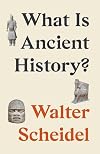
This book limps on no fewer than three legs: 1. It outlines how the study of ancient history has evolved in Western Europe and America, especially since the 18th century, and particularly in Germany; 2. It offers a fierce critique of the limitations of that historiography, which was too Eurocentric and Hellenophilistic, too philologically focused, and structurally rigid; 3. And it offers alternatives to break through those limitations, towards a truly Global History of Antiquity. The author show more is no ordinary author; he knows what he's writing about, everything he writes is highly relevant, and he clearly does so with passion for his field. However, I wonder how many people—even worldwide—he will reach with this highly specialized book. Perhaps he should have limited it to a pamphlet: with his name, he could have reached at least as many people, and perhaps a much larger audience. Because, let me be clear, his message deserves widespread resonance: the foundations of our current society were laid in antiquity, and that in itself deserves that we take this period absolutely seriously and employ all the tools to study it—correctly—and disseminate its insights far and wide.
More about Scheidel's "foundational" message in my History account on Goodreads: https://www.goodreads.com/review/show/8311733089 show less
More about Scheidel's "foundational" message in my History account on Goodreads: https://www.goodreads.com/review/show/8311733089 show less
The Great Leveler: Violence and the History of Inequality from the Stone Age to the Twenty-First Century (The Princeton Economic History of the Western World) by Walter Scheidel
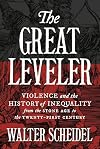
Important and Depressing.
The Necessity of Violence
In known History, according to our author Walter Scheidel, peaceful redistribution has never succeeded in lessening inequality of wealth.
Now, the forms of violence that lessen inequality may be the result of direct human choice, such as war and revolution; or they may be (at least partially) unwilled, such as famine and pandemics. ...With state collapse seemingly a combination of both the willed and unwilled.
Let us grant all this for the show more sake of argument. Even so, none of these will _always_ produce an easing of inequality. But, according to our author, it is always through some form of violence that economic inequality is substantially lessened.
...ALWAYS.
Thoughts
This would seemingly leave us with only two choices:
either we accept ever-increasing economic inequality,
or we accept the necessity of massive violence to stop this.
Obviously, no one is maintaining that the growth of inequality can't be slowed by legislation, such as progressive taxation. But all these various progressive schemes do is slow the rate of growth of inequality. Taxes and welfare redistribution only slow the inevitable rise of inequality. Inequality must increase, however slowly, even in welfare states.
Again, there are only two choices. Violence or ever-growing Inequality.
...Now, which do you choose? show less
The Necessity of Violence
In known History, according to our author Walter Scheidel, peaceful redistribution has never succeeded in lessening inequality of wealth.
Now, the forms of violence that lessen inequality may be the result of direct human choice, such as war and revolution; or they may be (at least partially) unwilled, such as famine and pandemics. ...With state collapse seemingly a combination of both the willed and unwilled.
Let us grant all this for the show more sake of argument. Even so, none of these will _always_ produce an easing of inequality. But, according to our author, it is always through some form of violence that economic inequality is substantially lessened.
...ALWAYS.
Thoughts
This would seemingly leave us with only two choices:
either we accept ever-increasing economic inequality,
or we accept the necessity of massive violence to stop this.
Obviously, no one is maintaining that the growth of inequality can't be slowed by legislation, such as progressive taxation. But all these various progressive schemes do is slow the rate of growth of inequality. Taxes and welfare redistribution only slow the inevitable rise of inequality. Inequality must increase, however slowly, even in welfare states.
Again, there are only two choices. Violence or ever-growing Inequality.
...Now, which do you choose? show less
The Great Leveler: Violence and the History of Inequality from the Stone Age to the Twenty-First Century by Walter Scheidel
Seemingly the "definitive" history of inequality. A deeply researched and documented tome basing its conclusions on something called the Gini Coeffcient. And the conclusion seems to be that equality will only be achieved when there is nothing left to hoard or consume. Pedantic, depressing, and ultimately unsatisfying despite its obvious scholarly intent.
Lists
Awards


You May Also Like


Associated Authors
Statistics
- Works
- 22
- Also by
- 21
- Members
- 1,184
- Popularity
- #21,706
- Rating
- 3.8
- Reviews
- 7
- ISBNs
- 82
- Languages
- 7
- Favorited
- 2