
Peter D. Schiff
Author of How an Economy Grows and Why It Crashes
About the Author
Works by Peter D. Schiff
Tagged
Common Knowledge
- Birthdate
- 1964
- Gender
- male
- Education
- University of California, Berkeley
- Occupations
- investment advisor
- Relationships
- Paul, Ron (economic advisor)
- Nationality
- USA
- Places of residence
- New Haven, Connecticut, USA
New York, New York, USA - Associated Place (for map)
- USA
Members
Reviews
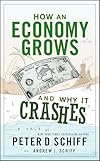
Peter Schiff is at it again. Yet this time instead of explaining how to invest in an uncertain economy he does something much more basic; he explains what an economy is and how it functions. And not in the snoozefest manner of economic professors (who, as a group, seem to have the same attribute as my college econ profs of being able to make the subject more confusing rather than less). Instead he uses the manner of a favorite first grade teacher of telling a story with line drawing and show more everything. Bear with me here. From anyone else this method might be insulting to one's intelligence but Schiff manages to pull it off without making his audience feel stupid. This book is not only imminently readable but also full of information; an alternate title could be "Everything You Thought You Knew About the Economy But Were Afraid to Ask". As Schiff tells the story he also puts it in context by sprinkling "Realty Check" boxes throughout and ends each chapter with a "Takeaway" summary to bring the points home. There is also a great deal of poking fun at pundits and politicians with thinly veiled name changes (naw, Peter, tell us how you really feel about TV personality Barry Codroe).
This a book that every voting American should read (as a democracy requires an informed electorate) and also should be required reading for every elected official (why do I have a sneaking suspicion that Congress should have read this before passing the hastily passed financial reform bill). I have a child taking economics next year in high school - this will be summer reading for her so she has a solid grasp of the subject.
Highly, highly recommended but only if you want to understand the US economy (or any economy for that matter) AND have a sense of humor. show less
This a book that every voting American should read (as a democracy requires an informed electorate) and also should be required reading for every elected official (why do I have a sneaking suspicion that Congress should have read this before passing the hastily passed financial reform bill). I have a child taking economics next year in high school - this will be summer reading for her so she has a solid grasp of the subject.
Highly, highly recommended but only if you want to understand the US economy (or any economy for that matter) AND have a sense of humor. show less
The Real Crash: America's Coming Bankruptcy---How to Save Yourself and Your Country by Peter D. Schiff
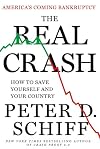
The author is worth paying attention to since he was right about the internet and housing bubbles and predicted the collapse of both of them.
Now,(published 2012) he sees a bond bubble with the same root in FED enabled artificially low interest rates, and he spends some time on the sleazy alliance between fiscally irresponsible politicians and a currency debasing central bank.
He takes the entirely believable line that large deficits can't be funded for ever by dollar printing, and that show more politicians will never allow the massive tax rises and/or massive spending cuts necessary to reach budget stability, so the only route left is inflation with a consequent crash in the value of the dollar and government bonds.
I see some problems here with the evidence, and issues that could have been in the book but weren't.
The evidence (as of April 2013) is that FED liquidity isn't producing inflation. On the contrary, the banks are channeling liquidity into speculative market bubbles rather than real investments that counteract societal deleveraging. Why should they do anything else? All sectors need to reduced debt and don't want to take on any more. The result is general deflation apart from the "bubble asset du jour" class with the evidence including falling commodity prices - particularly precious metals (which are on his list of recommended investments).
He wants to return government to the basic functions given in the Constitution and he is surely right that government has got involved in many areas where it should never have gone. nevertheless, modern societies need a sophisticated "nerve centre" that is fairly large and expensive and the successful ones all have large and active governments. Because it is corrupt and inefficient doesn't mean that it isn't necessary.
The author speaks as if the United States is a homogeneous country like Germany, Holland, China or Japan, when in fact the government clearly states that it is multicultural. The evidence unfortunately shows that it is fast pulling apart (see The Big Sort: Why the Clustering of Like-Minded America is Tearing Us Apart. Societies like this don't seem to react well to severe economic stress. If they can't pull together they fly apart like the once great multicultural Austro-Hungarian Empire.
Schiff recommends that people without capital store food and basic goods as a protection against 1) inflation and 2) societal disruption. The inflation may eventually come if a desperate government hands out wads of dollars to government workers, but the situation would probably be so chaotic that his recommendation would not work. A real possibility of dictatorship combined with some kind of civil war may well produce regimes like the Bolsheviks or Nazis who both outlawed food hoarding with a death penalty. In the winter of 1932/33 the Bolsheviks actually declared that all the food in the Ukraine was government property, and removed it, resulting in at least 3 million deaths from starvation (see Holodomor Kaganovitch in Google). A better recommendation if things go this way would be to leave the US temporarily or emigrate to a more functional country.
There's also the problem of how you get from here to there. If America is to return to a simple Constitutional style alliance of States with a minimal central government (which may work) and it can resolve its corruption and cultural issues, how under a Democracy will people (particularly minorities and the poor) be persuaded to vote to give up social medicine, schools, welfare benefits etc. etc? I may be wrong, but it seems very unlikely. show less
Now,(published 2012) he sees a bond bubble with the same root in FED enabled artificially low interest rates, and he spends some time on the sleazy alliance between fiscally irresponsible politicians and a currency debasing central bank.
He takes the entirely believable line that large deficits can't be funded for ever by dollar printing, and that show more politicians will never allow the massive tax rises and/or massive spending cuts necessary to reach budget stability, so the only route left is inflation with a consequent crash in the value of the dollar and government bonds.
I see some problems here with the evidence, and issues that could have been in the book but weren't.
The evidence (as of April 2013) is that FED liquidity isn't producing inflation. On the contrary, the banks are channeling liquidity into speculative market bubbles rather than real investments that counteract societal deleveraging. Why should they do anything else? All sectors need to reduced debt and don't want to take on any more. The result is general deflation apart from the "bubble asset du jour" class with the evidence including falling commodity prices - particularly precious metals (which are on his list of recommended investments).
He wants to return government to the basic functions given in the Constitution and he is surely right that government has got involved in many areas where it should never have gone. nevertheless, modern societies need a sophisticated "nerve centre" that is fairly large and expensive and the successful ones all have large and active governments. Because it is corrupt and inefficient doesn't mean that it isn't necessary.
The author speaks as if the United States is a homogeneous country like Germany, Holland, China or Japan, when in fact the government clearly states that it is multicultural. The evidence unfortunately shows that it is fast pulling apart (see The Big Sort: Why the Clustering of Like-Minded America is Tearing Us Apart. Societies like this don't seem to react well to severe economic stress. If they can't pull together they fly apart like the once great multicultural Austro-Hungarian Empire.
Schiff recommends that people without capital store food and basic goods as a protection against 1) inflation and 2) societal disruption. The inflation may eventually come if a desperate government hands out wads of dollars to government workers, but the situation would probably be so chaotic that his recommendation would not work. A real possibility of dictatorship combined with some kind of civil war may well produce regimes like the Bolsheviks or Nazis who both outlawed food hoarding with a death penalty. In the winter of 1932/33 the Bolsheviks actually declared that all the food in the Ukraine was government property, and removed it, resulting in at least 3 million deaths from starvation (see Holodomor Kaganovitch in Google). A better recommendation if things go this way would be to leave the US temporarily or emigrate to a more functional country.
There's also the problem of how you get from here to there. If America is to return to a simple Constitutional style alliance of States with a minimal central government (which may work) and it can resolve its corruption and cultural issues, how under a Democracy will people (particularly minorities and the poor) be persuaded to vote to give up social medicine, schools, welfare benefits etc. etc? I may be wrong, but it seems very unlikely. show less
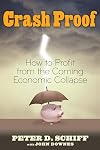
Interesting to go back to this book on my bookshelf and to throw it out the window. In one respect the author previsages the financial crisis around real estate, in another he misses the mark completely in his framing of what is to come and the mechanics of systemic shocks we have seen over the years.
At its core there are some good points but they could be condensed to a few pages. The bulk of the book is fluff and predictions that are unhelpful and inaccurate.
One should regularly read these show more sort of books to avoid overly framing reality in the current space, with the current problems.
His core advice: invest in good companies outside the US and in gold. And then more in detail suggestions like mining companies which actually suffered greatly. show less
At its core there are some good points but they could be condensed to a few pages. The bulk of the book is fluff and predictions that are unhelpful and inaccurate.
One should regularly read these show more sort of books to avoid overly framing reality in the current space, with the current problems.
His core advice: invest in good companies outside the US and in gold. And then more in detail suggestions like mining companies which actually suffered greatly. show less
The book discourses the subject of Economics in a highly comical way. The 'story', so to say, correlates with real life examples of the growth and fall of the US economy. I was disinterested / disinclined in Economics during my school days probably because my teachers made the arcane and boring subject it even more torturous. The authors on the other hand transformed it into a highly entertaining and enlightening topic.
The mantra "Productivity, not spending, is the key for economic growth" show more stands out for me in the entire book. "If you want its stuff, you need its currency." - how ingeniously well-stated.
The author encourages global free-trade and suggests that although some businesses might close due to inefficient practices in producing some goods, the countries involved will nevertheless grow in the long run.
The latter part of the book concentrates on the interaction between US and China and shows how China is playing a bigger role than what meets the eye.
I'd like the authors to extend this book to show how '$' affects the economies of the rest of the countries. show less
The mantra "Productivity, not spending, is the key for economic growth" show more stands out for me in the entire book. "If you want its stuff, you need its currency." - how ingeniously well-stated.
The author encourages global free-trade and suggests that although some businesses might close due to inefficient practices in producing some goods, the countries involved will nevertheless grow in the long run.
The latter part of the book concentrates on the interaction between US and China and shows how China is playing a bigger role than what meets the eye.
I'd like the authors to extend this book to show how '$' affects the economies of the rest of the countries. show less
Lists
Awards


You May Also Like


Associated Authors
Statistics
- Works
- 12
- Members
- 1,027
- Popularity
- #25,074
- Rating
- 3.6
- Reviews
- 14
- ISBNs
- 53
- Languages
- 7
- Favorited
- 1