
Thomas E. Woods
Author of The Politically Incorrect Guide to American History
About the Author
Thomas E. Woods Jr. was born on August 1, 1972. He holds a BA degree in history from Harvard and his masters and PhD from Columbia University. He served as a history department faculty member at Suffolk County Community College in N.Y. until 2006 then moved on to resident scholar and senior faculty show more member of Ludwig Von Misses Institute in Alabama. He is a N.Y. Times bestselling author of 10 books such as Meltdown: A Free Market Look at Why the Stock Market Collapsed, The Economy Tanked and Government Bailout Will Make Things Worse and Nullification: How to resist Federal Tyranny in the 21st Century. He has also written for several scholarly periodicals such as Historical Review and Investors Daily. He won the $50, 000 first prize in the Templeton Enterprise Awards for 2006 for his book The Church and The Market. He has been the associate editor for the Latin Mass magazine for 11 years. He has also appeared on MSNBC's Scarborough County and Bloomberg Television. (Bowker Author Biography) show less
Image credit: Mises.org
Works by Thomas E. Woods
Meltdown: A Free-Market Look at Why the Stock Market Collapsed, the Economy Tanked, and Government Bailouts Will Make Things Worse (2009) 348 copies, 10 reviews
Who Killed the Constitution?: The Fate of American Liberty from World War I to George W. Bush (2008) 139 copies, 2 reviews
The Church and the Market: A Catholic Defense of the Free Economy (Studies in Ethics and Economics) (2005) 104 copies, 1 review
The Church Confronts Modernity: Catholic Intellectuals and the Progressive Era (Religion and American Culture) (2004) 48 copies
Real Dissent: A Libertarian Sets Fire to the Index Card of Allowable Opinion (2014) 41 copies, 1 review
Diary of a Psychosis: How Public Health Disgraced Itself During COVID Mania (2023) — Author — 20 copies, 1 review
Associated Works
The American Republic: Its Constitution, Tendencies, and Destiny (2003) — Editor, some editions — 148 copies
Tagged
Common Knowledge
- Canonical name
- Woods, Thomas E.
- Legal name
- Woods, Thomas E., Jr.
- Birthdate
- 1972-08-01
- Gender
- male
- Education
- Columbia University (Ph.D.|Economics)
Harvard University (B.A.|History)
Columbia University (M.A.)
Columbia University (M.Phil.) - Occupations
- economist
author
historian
podcaster - Organizations
- Ludwig von Mises Institute
- Awards and honors
- Templeton Enterprise Award (2006)
- Short biography
- Podcaster (Tom Woods Show, Contra-Krugman), Author, Libertarian
- Nationality
- USA
- Places of residence
- Topeka, Kansas, USA
Florida, USA - Associated Place (for map)
- USA
Members
Reviews
Who Killed the Constitution?: The Fate of American Liberty from World War I to George W. Bush by Thomas E. Woods
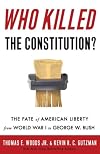
I sometimes think that in an era when "history" means who won last season's American Idol, one of the hardest things to get people to understand is that the assault on the American Constitution didn't begin with George W. Bush. The systematic attempt to expand and centralize State power at the expense of individual liberty goes much farther back in our past ... probably to the very adoption of the Constitution in place of the Articles of Confederation, but at least, as Thomas Woods and Kevin show more Gutzman argue, to the first world war. Indeed, as I saw someone express it recently, George W. Bush is a pro-bono attorney for the ACLU compared to that true monster, Woodrow Wilson.
So that's the first thing about "Who Killed the Constitution?": the authors' well-grounded historical viewpoint. The second is their research and documentation. It would be one thing to disregard them as ideologists if all they were doing was huffing and puffing like a Fox News pundit. But for them to marshal facts and citations and many, many quotations, as they do, makes this not pontificating but important investigative history. Discounting the seriousness of their argument would require ... well, exactly what has been happening for that last century or so ... the bald-faced denial of the evidence of our senses and reason. But if the rational reader can't see through that after a few hours in these pages, then I'm not sure what more we can do.
Of course, I'm not entirely sure what we can do anyway. I was all set to write that I wished I shared the authors' belief that Something Can Be Done, that the Republic is salvageable, and what's been lost can be regained. I had even prepared to title my review something like "A great book, heartbreakingly irrelevant."
I should have paid more attention to the title.
You see, the authors are not asking *whether* the Constitution is dead. They know it is. It was murdered by presidents, legislators, and jurists who sought Constitutional cover to create a veil of legitimacy around what they had already planned to do. Once they've come up with the arguments in which to clothe their intentions (the Constitution's "capacity for adaptation is indefinitely flexible," Justice George Sutherland wrote in 1919 [p. 162]), they lift the Constitution into the air like a shamanistic totem and the rest of us fall into line, hand over heart, like they knew we would.
Imperial ipsedixitism triumphs again.
So then what's left for the remnant? To their credit, the authors are more skilled than I at avoiding resignation. They write in their final paragraph that it's up to the American people to decide what to do with the information here presented. As I asked in my review of Woods' 33 Questions About American History You're Not Supposed to Ask, what if they're right? Whether this great book does in fact turn out to be heart-breakingly irrelevant is one, I suppose, that will only be answered in hindsight. show less
So that's the first thing about "Who Killed the Constitution?": the authors' well-grounded historical viewpoint. The second is their research and documentation. It would be one thing to disregard them as ideologists if all they were doing was huffing and puffing like a Fox News pundit. But for them to marshal facts and citations and many, many quotations, as they do, makes this not pontificating but important investigative history. Discounting the seriousness of their argument would require ... well, exactly what has been happening for that last century or so ... the bald-faced denial of the evidence of our senses and reason. But if the rational reader can't see through that after a few hours in these pages, then I'm not sure what more we can do.
Of course, I'm not entirely sure what we can do anyway. I was all set to write that I wished I shared the authors' belief that Something Can Be Done, that the Republic is salvageable, and what's been lost can be regained. I had even prepared to title my review something like "A great book, heartbreakingly irrelevant."
I should have paid more attention to the title.
You see, the authors are not asking *whether* the Constitution is dead. They know it is. It was murdered by presidents, legislators, and jurists who sought Constitutional cover to create a veil of legitimacy around what they had already planned to do. Once they've come up with the arguments in which to clothe their intentions (the Constitution's "capacity for adaptation is indefinitely flexible," Justice George Sutherland wrote in 1919 [p. 162]), they lift the Constitution into the air like a shamanistic totem and the rest of us fall into line, hand over heart, like they knew we would.
Imperial ipsedixitism triumphs again.
So then what's left for the remnant? To their credit, the authors are more skilled than I at avoiding resignation. They write in their final paragraph that it's up to the American people to decide what to do with the information here presented. As I asked in my review of Woods' 33 Questions About American History You're Not Supposed to Ask, what if they're right? Whether this great book does in fact turn out to be heart-breakingly irrelevant is one, I suppose, that will only be answered in hindsight. show less
Meltdown: A Free-Market Look at Why the Stock Market Collapsed, the Economy Tanked, and Government Bailouts Will Make Things Worse by Thomas E. Woods
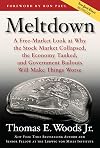
In discussions of today's economic meltdown and what to do about it, the Federal Reserve is a stealth helicopter: it never shows up on the radar. With the exception of a few esoteric specialists and those Ron Paul Revolutionaries who burst into chants of "Abolish the Fed!" during campus rallies last year, it's like something has been put in our water to cause our eyes to glaze over and our minds to wander off at the very mention of centralized banking.
Which is, of course, a Problem, since as show more historian Thomas Woods notes in this important book, the Federal Reserve bears a large part of the blame for the mess we're in. In the first part of "Meltdown," Woods shows how both in theory (the Austrian School, to be precise) and in practice, Fed policy fueled an artificial boom and instead of allowing the necessary, if unpleasant, short-term bust that will lead to recovery, is pursuing policies guaranteed to drive us deeper into the abyss. Little of this finds its way into the popular or business press, suggesting that the people who know the truth aren't talking, and the people who are talking either don't know or are deliberately trying to keep the helicopter hidden. As Woods writes, "critics of the market who ignore the arguments raised in this chapter are, to say the least, not being honest" (p. 86).
But to paraphrase Will Rogers (no relation), it's not so much the things we don't know that are a problem, it's the things we DO know that aren't really true. That's why every bit as important as Woods' explanation of the role of the Federal Reserve in the unnecessary cycle of boom and bust is his taking down of decades' worth of myths about the government's role in the economy. As the author points out, historians have more or less abandoned the idea that New Deal intervention "got us out of the Depression," but the myth remains stronger than ever among journalists and the public. The result of this is not only a profound misunderstanding of American history, but more to the point, a widespread delusion that "history proves" massive government spending promoting consumer demand is the way out of a recession. Here again we see the apocalyptic power of bad ideas.
All this suggests the economic crisis, and particularly the stimulus-driven response to it on the part of the Bush and Obama administrations, are a domestic equivalent of the Iraq War (I want to note that this is my metaphor, not Woods'): an over-reaction to a situation by and large of our own creation, and sold to the American people through a series of lies, the plan largely benefits those who argue for it most strongly while the rest of us end up poorer. The "opposition" is arguing over details while conceding the fundamental principle -- an intervention that gives the government a foothold of occupation it will probably never relinquish.
That's why "Meltdown" is so important -- and why the Austrian School, which alone not only foresaw the coming crash but understood why it was going to happen, deserves so much wider attention. If I could improve anything about "Meltdown," I would have made even more prominent the citations of thinkers and books interested readers should pursue. Woods does do this in an appendix, and I strongly recommend you read the footnotes closely. But something like the "additional reading" or "books they don't want you to read" call-outs of the author's The Politically Incorrect Guide to American History would, I think, have been even more useful.
If "respectable opinion" does pay attention to this book and the ideas it promotes, it will do so with the same combination of pity and contempt that earlier book received. As Woods writes, "You do not win friends in the political and media establishments by proposing a monetary system that cannot be exploited by governments to enrich their friends, enable their addiction to spending and looting, and fund their bailouts" (p. 134). But out here among the non-establishment, you DO make friends by telling the truth. And Tom Woods has a lot of friends. show less
Which is, of course, a Problem, since as show more historian Thomas Woods notes in this important book, the Federal Reserve bears a large part of the blame for the mess we're in. In the first part of "Meltdown," Woods shows how both in theory (the Austrian School, to be precise) and in practice, Fed policy fueled an artificial boom and instead of allowing the necessary, if unpleasant, short-term bust that will lead to recovery, is pursuing policies guaranteed to drive us deeper into the abyss. Little of this finds its way into the popular or business press, suggesting that the people who know the truth aren't talking, and the people who are talking either don't know or are deliberately trying to keep the helicopter hidden. As Woods writes, "critics of the market who ignore the arguments raised in this chapter are, to say the least, not being honest" (p. 86).
But to paraphrase Will Rogers (no relation), it's not so much the things we don't know that are a problem, it's the things we DO know that aren't really true. That's why every bit as important as Woods' explanation of the role of the Federal Reserve in the unnecessary cycle of boom and bust is his taking down of decades' worth of myths about the government's role in the economy. As the author points out, historians have more or less abandoned the idea that New Deal intervention "got us out of the Depression," but the myth remains stronger than ever among journalists and the public. The result of this is not only a profound misunderstanding of American history, but more to the point, a widespread delusion that "history proves" massive government spending promoting consumer demand is the way out of a recession. Here again we see the apocalyptic power of bad ideas.
All this suggests the economic crisis, and particularly the stimulus-driven response to it on the part of the Bush and Obama administrations, are a domestic equivalent of the Iraq War (I want to note that this is my metaphor, not Woods'): an over-reaction to a situation by and large of our own creation, and sold to the American people through a series of lies, the plan largely benefits those who argue for it most strongly while the rest of us end up poorer. The "opposition" is arguing over details while conceding the fundamental principle -- an intervention that gives the government a foothold of occupation it will probably never relinquish.
That's why "Meltdown" is so important -- and why the Austrian School, which alone not only foresaw the coming crash but understood why it was going to happen, deserves so much wider attention. If I could improve anything about "Meltdown," I would have made even more prominent the citations of thinkers and books interested readers should pursue. Woods does do this in an appendix, and I strongly recommend you read the footnotes closely. But something like the "additional reading" or "books they don't want you to read" call-outs of the author's The Politically Incorrect Guide to American History would, I think, have been even more useful.
If "respectable opinion" does pay attention to this book and the ideas it promotes, it will do so with the same combination of pity and contempt that earlier book received. As Woods writes, "You do not win friends in the political and media establishments by proposing a monetary system that cannot be exploited by governments to enrich their friends, enable their addiction to spending and looting, and fund their bailouts" (p. 134). But out here among the non-establishment, you DO make friends by telling the truth. And Tom Woods has a lot of friends. show less
Meltdown: A Free-Market Look at Why the Stock Market Collapsed, the Economy Tanked, and Government Bailouts Will Make Things Worse by Thomas E. Woods
Don't expect this author to hurl the blame for the nation's fiscal woes in the direction of any one political faction. Woods makes a compelling argument that there is more than enough blame to go around. The premise of this work is that government intervention -- not deregulation -- causes economic chaos. While the book's review of economic theory and monetary policy becomes necessarily dry in spots, it's highly educational. Woods makes a Herculean effort to simplify some incredibly complex show more issues. He lays out the tenets of Austrian Economics, then explores some of the historic economic crises the nation has weathered. The housing bubble, Woods asserts, was the result of government entities and private sector players pushing people to buy homes who simply didn't have the financial instrastructure to sustain ownership. He also argues that cheap money (artifically depressed interest rates) lures people into speculative ventures who do not belong in this arena. The author even argues that some of the New Deal policies advanced in response to the Great Depression actually prolonged the economic pain. It takes some patience and discpline to make it through "Meltdown," but the journey is worth the effort. show less
Who Killed the Constitution?: The Fate of American Liberty from World War I to George W. Bush by Thomas E. Woods

Viewing history and law through an ideological lens colors your perspective. This coloring can affect your ability to make consistent arguments in support of your favored position. This appears to be a pitfall that Thomas E. Woods, Jr. and Kevin R. C. Gutzman have fallen into in Who Killed the Constitution?. While they espouse, for much of the book, a version of strong libertarianism in the spirit of Ron Paul (they advocate a return to the gold standard for the U.S. among other things), and show more an extreme form of originalist Constitutional interpretation, they stretch their arguments too far in many of the examples they give in an effort to reach their desired conclusion. Consequently, this dilutes the impact of the arguments that they make upon which they are on solid footing, and renders the book less powerful than it could have been. While in some parts much of their fundamental thesis, that all branches of government and all elements of the political spectrum have joined together to systematically trample on the Constitution, is sound, their clear biases result in numerous examples that don't really support their point, making their argument less than convincing.
The format the authors choose to illustrate their argument that U.S. liberty has been consistently eroded through the twentieth century is an analysis of several discrete examples intended to build their case. The twelve instances of governmental overreach that the authors identify and examine in the book, the "dirty dozen" as they call them, are: the sedition laws passed and enforced during World War I under Woodrow Wilson; Harry Truman's seizure of the steel mills in the 1950s; the Brown v. Board of Education decision; the subsequent decisions to require forced busing to remedy past discrimination; the arrogation by the Federal government of the ability to build roads; the seizure of the U.S. gold stocks from the populace by Franklin Delano Roosevelt in 1933; the removal of prayer from public schools to enforce the "Wall of Separation" between Church and State; the draft; the prohibitions against the use of medical marijuana; the increasing power of the executive to set and implement foreign policy; the development of the doctrine of executive war powers; and finally, the ever expansive view of executive power, culminating with the rapid rise in the use of signing statements and the assertion by George W. Bush's administration that Congress could not interfere in its ability to judge what is and is not permissible interrogation techniques or torture.
In each example, the authors try to make the case for these being unjustified expansions of governmental power in violation of the U.S. Constitution, which, of course, supports their central thesis that the Constitution is "dead". In some cases, their points are quite salient. Most notably, in the examples describing the expansion of executive power, drawing a line from the expansion of Presidential power to the level of exclusivity in foreign affairs, to the broad executive "war powers" doctrine that has come to override the Congressional war making power, to the unfettered executive power asserted by the administration of George W. Bush. The authors also make a strong case that the erosion of free speech under Woodrow Wilson was particularly egreigious. But what goes unmentioned is that the excesses of (for example) the Woodrow Wilson years have been by and large repudiated, and although there have been abuses that have occurred subsequently, the issue has moved more like a pendulum swinging back and forth rather than an ever increasing infringement upon liberty. This sort of one-way logic is most apparent when the authors recount Harry Truman's seizure of the steel mills, which was probably the most naked grab for power in the Twentieth century. Although they point out that the negative reaction was massive, they gloss over the fact that this sort of naked exertion of executive power has not been repeated since then, giving the impression that seizure of industries has become de rigeur in American life.
One could argue that where the authors most go astray in their analysis is with respect to Brown v. Board of Education, in which their adherence to an extreme version of originalism blinds them to the actual basis for the decision in the case. While they argue that the original intent of the Fourteenth Amendment was not to desgregate schools using the fact that most states at the time of ratification had segregated schools to support this assertion. But Warren's decision relies primarily on an evaluation of what 'equal" means, and finds that segregated schools simply don't meet the standard. By asserting that only the inferred meaning that those who originally adopted the Amendment counts, the authors foreclose the possibility that an opinion concerning what is "equal" can change. They also fall into the trap of assessing legislative history and commentary as a primary guide for the interpretation of a piece of law. As any serious practicing lawyer will tell you, one only resorts to the use of legislative history or commentary when one is desperate. This is because legislative history is so unreliable as a guide to the intent of the legislature: it is merely a guide to the intent of those legislators who have spoken on the legislative record, or, at best, a guide to the intent of a committee that has placed its thoughts into the record. But the only way to truly evaluate the will of a legislative body as a whole is to independently evaluate the output of the entire legislative body - the text of the legislation itself. It should probably come as no surprise that using commentary to deduce meaning is even more unreliable. And this is truly unfortunate, because their clearly poorly grounded criticisms of Brown serve to sap the life out of their much better founded criticisms of forced busing. In short, stetching their point beyond tenability in some areas makes them less convincing in the others where they are on more solid footing.
The true illustration of the authors using results based analysis comes with respect to the end of prayer in schools. After applying their extreme version of originalism to the First Amendment establishment clause, and glossing over the incorporation doctrine of the Reconstruction Amendments, the authors proceed to assert that the decision in Evenson v. Board of Education is suspect because Justice Hugo Black was a bad guy because he was a racist. But this sort of data is entirely beside the point when evaluating whether a particular ruling was wise or unwise. The fact that they spend much of the chapter belaboring this point only illustrates the paucity of their arguments on the merits. And while they are more than willing to cite legislative history and commentary when it supports their position, they completely ignore Thomas Jefferson's famous letter to the Danbury Baptist Association, which clearly shows that they are cherry picking their sources to fit their biases. They later show their hand further when discussing Franklin Roosevelt's gold seizure and leap from assessing the legalities of this action to a diatribe about why the government should have never abandoned the gold standard that would have fit perfectly in Ron Paul's mouth. They also advocate a ruinous banking policy that would contract the U.S. economy many-fold, which makes one wonder if they truly understand the economic matters they discuss in the book at all.
Because it lurches back and forth between fairly reasonable criticisms of government infringements and wild-eyed claims that don't hold up to scrutiny, Who Killed the Constitution? undermines its own central thesis. Because the supporting material is so clearly cherry picked on several issues, and is in large part of dubious quality to begin with (being legsialtive history and commentary) one begins to suspect that the authors have let their ideological biases color all of their assessments. And given that many of the infringements they cite have either been redressed or merely abandoned in subsequent years, their thesis of an ever shrinking ambit of Constitutional protection is unconvincing. In the end, despite strong rhetoric and ardent arguments, the book contains so many inherent contradictions that while the good parts are quite good, the bad parts damage the overall thesis enough that one feels that it is probably too soon to write off the U.S. Constitution. The document's funeral, it seems, is simply not as imminent as the author's would have you believe.
This review has also been posted to my blog Dreaming About Other Worlds. show less
The format the authors choose to illustrate their argument that U.S. liberty has been consistently eroded through the twentieth century is an analysis of several discrete examples intended to build their case. The twelve instances of governmental overreach that the authors identify and examine in the book, the "dirty dozen" as they call them, are: the sedition laws passed and enforced during World War I under Woodrow Wilson; Harry Truman's seizure of the steel mills in the 1950s; the Brown v. Board of Education decision; the subsequent decisions to require forced busing to remedy past discrimination; the arrogation by the Federal government of the ability to build roads; the seizure of the U.S. gold stocks from the populace by Franklin Delano Roosevelt in 1933; the removal of prayer from public schools to enforce the "Wall of Separation" between Church and State; the draft; the prohibitions against the use of medical marijuana; the increasing power of the executive to set and implement foreign policy; the development of the doctrine of executive war powers; and finally, the ever expansive view of executive power, culminating with the rapid rise in the use of signing statements and the assertion by George W. Bush's administration that Congress could not interfere in its ability to judge what is and is not permissible interrogation techniques or torture.
In each example, the authors try to make the case for these being unjustified expansions of governmental power in violation of the U.S. Constitution, which, of course, supports their central thesis that the Constitution is "dead". In some cases, their points are quite salient. Most notably, in the examples describing the expansion of executive power, drawing a line from the expansion of Presidential power to the level of exclusivity in foreign affairs, to the broad executive "war powers" doctrine that has come to override the Congressional war making power, to the unfettered executive power asserted by the administration of George W. Bush. The authors also make a strong case that the erosion of free speech under Woodrow Wilson was particularly egreigious. But what goes unmentioned is that the excesses of (for example) the Woodrow Wilson years have been by and large repudiated, and although there have been abuses that have occurred subsequently, the issue has moved more like a pendulum swinging back and forth rather than an ever increasing infringement upon liberty. This sort of one-way logic is most apparent when the authors recount Harry Truman's seizure of the steel mills, which was probably the most naked grab for power in the Twentieth century. Although they point out that the negative reaction was massive, they gloss over the fact that this sort of naked exertion of executive power has not been repeated since then, giving the impression that seizure of industries has become de rigeur in American life.
One could argue that where the authors most go astray in their analysis is with respect to Brown v. Board of Education, in which their adherence to an extreme version of originalism blinds them to the actual basis for the decision in the case. While they argue that the original intent of the Fourteenth Amendment was not to desgregate schools using the fact that most states at the time of ratification had segregated schools to support this assertion. But Warren's decision relies primarily on an evaluation of what 'equal" means, and finds that segregated schools simply don't meet the standard. By asserting that only the inferred meaning that those who originally adopted the Amendment counts, the authors foreclose the possibility that an opinion concerning what is "equal" can change. They also fall into the trap of assessing legislative history and commentary as a primary guide for the interpretation of a piece of law. As any serious practicing lawyer will tell you, one only resorts to the use of legislative history or commentary when one is desperate. This is because legislative history is so unreliable as a guide to the intent of the legislature: it is merely a guide to the intent of those legislators who have spoken on the legislative record, or, at best, a guide to the intent of a committee that has placed its thoughts into the record. But the only way to truly evaluate the will of a legislative body as a whole is to independently evaluate the output of the entire legislative body - the text of the legislation itself. It should probably come as no surprise that using commentary to deduce meaning is even more unreliable. And this is truly unfortunate, because their clearly poorly grounded criticisms of Brown serve to sap the life out of their much better founded criticisms of forced busing. In short, stetching their point beyond tenability in some areas makes them less convincing in the others where they are on more solid footing.
The true illustration of the authors using results based analysis comes with respect to the end of prayer in schools. After applying their extreme version of originalism to the First Amendment establishment clause, and glossing over the incorporation doctrine of the Reconstruction Amendments, the authors proceed to assert that the decision in Evenson v. Board of Education is suspect because Justice Hugo Black was a bad guy because he was a racist. But this sort of data is entirely beside the point when evaluating whether a particular ruling was wise or unwise. The fact that they spend much of the chapter belaboring this point only illustrates the paucity of their arguments on the merits. And while they are more than willing to cite legislative history and commentary when it supports their position, they completely ignore Thomas Jefferson's famous letter to the Danbury Baptist Association, which clearly shows that they are cherry picking their sources to fit their biases. They later show their hand further when discussing Franklin Roosevelt's gold seizure and leap from assessing the legalities of this action to a diatribe about why the government should have never abandoned the gold standard that would have fit perfectly in Ron Paul's mouth. They also advocate a ruinous banking policy that would contract the U.S. economy many-fold, which makes one wonder if they truly understand the economic matters they discuss in the book at all.
Because it lurches back and forth between fairly reasonable criticisms of government infringements and wild-eyed claims that don't hold up to scrutiny, Who Killed the Constitution? undermines its own central thesis. Because the supporting material is so clearly cherry picked on several issues, and is in large part of dubious quality to begin with (being legsialtive history and commentary) one begins to suspect that the authors have let their ideological biases color all of their assessments. And given that many of the infringements they cite have either been redressed or merely abandoned in subsequent years, their thesis of an ever shrinking ambit of Constitutional protection is unconvincing. In the end, despite strong rhetoric and ardent arguments, the book contains so many inherent contradictions that while the good parts are quite good, the bad parts damage the overall thesis enough that one feels that it is probably too soon to write off the U.S. Constitution. The document's funeral, it seems, is simply not as imminent as the author's would have you believe.
This review has also been posted to my blog Dreaming About Other Worlds. show less
Lists
Read These Too (1)
Awards

You May Also Like


Associated Authors
Statistics
- Works
- 28
- Also by
- 1
- Members
- 3,031
- Popularity
- #8,424
- Rating
- 3.9
- Reviews
- 44
- ISBNs
- 90
- Languages
- 9
- Favorited
- 6