

William Tenn (1920–2010)
Author of Of Men and Monsters
About the Author
William Tenn, the pseudonym of Philip Klass, was born in London, England on May 9, 1920. He grew up in Brooklyn, New York and served as a combat engineer in the United States Army during World War II. After leaving the Army, he worked as a technical editor with an Air Force radar and radio show more laboratory and was employed by Bell Labs. He taught English and comparative literature at Penn State University for 24 years. He wrote academic articles, essays, one novel entitled Of Men and Monsters, and more than 60 short stories including Child's Play, Venus and the Seven Sexes, Down Among the Dead Men, The Liberation of Earth, Time in Advance, and On Venus, Have We Got a Rabbi. He received the Author Emeritus honor by the Science Fiction and Fantasy Writers of America in 1999. He died of congestive heart failure on February 7, 2010 at the age of 89. (Bowker Author Biography) show less
Image credit: By Laurie Mann.Lauriemann at en.wikipedia [Public domain], from Wikimedia Commons
Series
Works by William Tenn
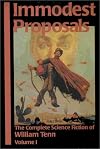
Immodest Proposals: The Complete Science Fiction of William Tenn, Volume 1 (2001) 171 copies, 2 reviews
Galaxy, Teil 5: Eine Auswahl der besten Stories aus dem amerikanischen Science Fiction Magazin Galaxy (1966) — Contributor — 5 copies
Eastward Ho! [short fiction] 5 copies
Null-P [short story] 4 copies
Generation Of Noah 4 copies
The Masculinist Revolt 3 copies
The Sickness [short story] 3 copies
Mundos posibles 3 copies
Extraños en la tierra 3 copies
The Discovery of Morniel Mathaway 3 copies
Wednesday's Child 3 copies
Science-fiction Thinking Machines 2 copies
Short Science Fiction Collection 058 2 copies
La Tierra invadida 2 copies
Down Among The Dead Men 2 copies
The House Dutiful 2 copies
The Puzzle Of Priipiirii 1 copy
Og Men and Monsters 1 copy
The Malted Milk Monster 1 copy
Consulate 1 copy
The Custodian 1 copy
Weird Tales Volume 39 Number 11, May 1947 — Contributor — 1 copy
The Tenants 1 copy
Winthrop Was Stubborn 1 copy
A Man of Family 1 copy
The Deserter [short story] 1 copy
Los Invasores 1 copy
Il problema della Servitu' 1 copy
A Lamp for Medusa 1 copy
My Mother Was A Witch 1 copy
Venus And The Seven Sexes 1 copy
Outsiders Children of Wonder 1 copy
Associated Works
The Big Book of Science Fiction: The Ultimate Collection (2016) — Contributor — 522 copies, 8 reviews
Wandering Stars: An Anthology of Jewish Fantasy and Science Fiction (1974) — Contributor — 339 copies, 6 reviews
Southern Blood: Vampire Stories from the American South (1997) — Contributor — 169 copies, 2 reviews
Isaac Asimov's Magical Worlds of Fantasy, Volume 2: Witches (1984) — Contributor — 153 copies, 1 review
The Very Best of Fantasy & Science Fiction: Sixtieth Anniversary Anthology (2009) — Contributor — 148 copies, 6 reviews
Isaac Asimov Presents : The Golden Years of Science Fiction, 5th Series (1985) — Contributor — 103 copies
Weird Vampire Tales: 30 Blood-Chilling Stories from the Weird Fiction Pulps (1992) — Contributor — 98 copies, 3 reviews
Isaac Asimov's Wonderful Worlds of Science Fiction, Volume 8: Monsters (1988) — Author — 76 copies, 2 reviews
Famous Fantastic Mysteries: 30 Great Tales of Fantasy and Horror from the Classic Pulp Magazines Famous Fantastic Mysteries & Fantastic Novels (1991) — Contributor — 67 copies, 1 review
A Century of Science Fiction 1950-1959 : The Greatest Stories of the Decade (1996) — Contributor — 63 copies, 2 reviews
Planet Stories 59, March 1953 — Contributor — 3 copies
Once and future tales; from the Magazine of fantasy and science fiction (1968) — Contributor — 3 copies
Den elektriske myre og andre science fiction-fortællinger (1984) — Author, some editions — 2 copies, 1 review
Short Science Fiction Collection 040 — Contributor — 1 copy
Tagged
Common Knowledge
- Legal name
- Klass, Philip
- Other names
- Tenn, William
- Birthdate
- 1920-05-09
- Date of death
- 2010-02-07
- Gender
- male
- Occupations
- combat engineer
professor
editor (technical)
novelist - Organizations
- United States Army (WWII)
Bell Laboratories - Awards and honors
- SFWA Author Emeritus (1999)
- Relationships
- Klass, Fruma (spouse)
Klass, Perri (niece)
Klass, Morton (brother) - Nationality
- UK (birth)
USA (naturalized) - Birthplace
- London, England, UK
- Places of residence
- London, England, UK (birth)
Brooklyn, New York, USA
Mount Lebanon, Pennsylvania, USA - Place of death
- Pittsburgh, Pennsylvania, USA
- Associated Place (for map)
- USA
Members
Discussions
Found: Changing the past changes the present in Name that Book (January 19)
Reviews
William Tenn is a science fiction writer who ought to be better known. He was an influential editor and a masterful short story writer with a sly, acerbic wit. Tenn is the pen name of Philip Klass. Klass wrote nonfiction under his own name and should not be confused with Philip J. Klass, who denied the existence of flying saucers. Though he lived until 2010, Tenn wrote most of his science fiction in the 1950s and ‘60s. He wrote only one novel, Of Men and Monsters (1968), that reads like an show more extended short story. It is a single-gimmick story in which humanity is conquered by giant aliens who quickly strip the planet of resources and move on to their next target. Human survivors must decide whether to go with them and occupy an ecological niche in alien culture similar to cockroaches in human culture. Many of the short stories in this omnibus collection have equally sardonic ideas.
Each story has an afterword by Tenn in which he explains what inspired it, how it was received, and what he thinks of it at the end of his career. He also provides the dates of composition and publication for each story—a practice that I wish more anthologists would adopt. “The Masculinist Revolt,” for example, was written in 1961, two years before Betty Friedan’s The Feminine Mystique, but not published until 1965. It describes a future in which men begin wearing codpieces as political symbols: “There are men people and women people—and what’s the difference anyway? They want something that does what the codpiece does, that tells them they are not people, they’re men!” Tenn says he lost an agent and friends of both sexes over the story—a woman called it a castration fantasy, and a man called it a manifesto. Tenn said the story was meant to be “gently but encompassingly satiric” in the manner of E. B. White. One editor at Playboy said he should expand the story into a novella for the magazine, but another editor sent the story back because he saw it as a satire aimed at the Playboy empire. Tenn concludes, “All right, maybe it’s not the stuff of immortality, but I still think it is pretty good and pretty funny.”
I would say the same for the entire collection. show less
Each story has an afterword by Tenn in which he explains what inspired it, how it was received, and what he thinks of it at the end of his career. He also provides the dates of composition and publication for each story—a practice that I wish more anthologists would adopt. “The Masculinist Revolt,” for example, was written in 1961, two years before Betty Friedan’s The Feminine Mystique, but not published until 1965. It describes a future in which men begin wearing codpieces as political symbols: “There are men people and women people—and what’s the difference anyway? They want something that does what the codpiece does, that tells them they are not people, they’re men!” Tenn says he lost an agent and friends of both sexes over the story—a woman called it a castration fantasy, and a man called it a manifesto. Tenn said the story was meant to be “gently but encompassingly satiric” in the manner of E. B. White. One editor at Playboy said he should expand the story into a novella for the magazine, but another editor sent the story back because he saw it as a satire aimed at the Playboy empire. Tenn concludes, “All right, maybe it’s not the stuff of immortality, but I still think it is pretty good and pretty funny.”
I would say the same for the entire collection. show less

My reactions to reading this novel in 1968. Spoilers follow.
I enjoyed this famous Tenn novel about men living in the walls of the “Monster” alien race that conquered Earth.
This is Tenn so the story is humorous and almost savage in parts. The title comes from Steinbeck’s novel Of Mice and Men, but the inspiration and structure of the novel seems to come from the Brobdingnab section of Gulliver’s Travels. The plot starts as a variation on that favored by many stories and films show more featuring primitive (or post-holocaust primitives): a young man finds himself on the wrong side of tribal politics and questioning a religious taboo. Here that's that Ancestor-Science is not as efficacious in battling the Monsters as advertised. After all, as the uncle who initiates hero Eric the Only into the heresy points out, it didn’t do humanity much good in resisting the Monsters. But Alien-Science turns out to be, in part, a scheme by Eric’s uncle to become Chief, a scheme that leads to a brutally suppressed uprising. Eric takes up with the more advanced “back burrowers” only to find their technology and knowledge of Monsters impressive but their military skills lacking. Eventually, he meets, marries, and mates with a woman of the Aaron People (after a funny scene where he tries to act dignified while assessing his mate’s physical wiles).
In a way, this is one of those conceptual breakthrough stories. Eric learns that the tribal society he was born in was based partly on fraud - rigged visions used in naming initiate warriors and “enemy” chiefs who will band together to quell heretic Alien Sciencers. He also learns that not front or back burrower, Ancestor Science or Alien Science is a total solution, that other points of view have merit, that man lives in the walls of Monster houses (the whole novel is set in one Monster house before man leaves for the stars), and that a whole universe exists outside the Monster house, a universe which renders Monsters as inconsequential as man.
My favorite moments are when Tenn defies the clichés of this sort of plot. There is no claim that lost human science can ever defeat the monsters or bring humanity lordship of the Earth. In a discussion about why some ancients saw the Monsters as divine judgment, Rachel, Eric’s mate, remarks man was always guilty about how he treated other animals. How, she asks, can we judge the Monsters brutal (some of the book depicts experiments on humans in an alien Pest Control Lab) for their actions when man historically (and even in the course of this book) does just as brutal things to each other? Another of my favorite scenes is when Eric, told of the Aaron People’s plan to hope on a Monster starship and infest Monster dwellings throughout the universe, bitterly retorts they can’t expect man to become vermin. The Aaron replies that he already is a vermin of a most superior (like the rat and cockroach) kind. This is a condition Eric and everybody else cheerfully accepts at story’s end. show less
I enjoyed this famous Tenn novel about men living in the walls of the “Monster” alien race that conquered Earth.
This is Tenn so the story is humorous and almost savage in parts. The title comes from Steinbeck’s novel Of Mice and Men, but the inspiration and structure of the novel seems to come from the Brobdingnab section of Gulliver’s Travels. The plot starts as a variation on that favored by many stories and films show more featuring primitive (or post-holocaust primitives): a young man finds himself on the wrong side of tribal politics and questioning a religious taboo. Here that's that Ancestor-Science is not as efficacious in battling the Monsters as advertised. After all, as the uncle who initiates hero Eric the Only into the heresy points out, it didn’t do humanity much good in resisting the Monsters. But Alien-Science turns out to be, in part, a scheme by Eric’s uncle to become Chief, a scheme that leads to a brutally suppressed uprising. Eric takes up with the more advanced “back burrowers” only to find their technology and knowledge of Monsters impressive but their military skills lacking. Eventually, he meets, marries, and mates with a woman of the Aaron People (after a funny scene where he tries to act dignified while assessing his mate’s physical wiles).
In a way, this is one of those conceptual breakthrough stories. Eric learns that the tribal society he was born in was based partly on fraud - rigged visions used in naming initiate warriors and “enemy” chiefs who will band together to quell heretic Alien Sciencers. He also learns that not front or back burrower, Ancestor Science or Alien Science is a total solution, that other points of view have merit, that man lives in the walls of Monster houses (the whole novel is set in one Monster house before man leaves for the stars), and that a whole universe exists outside the Monster house, a universe which renders Monsters as inconsequential as man.
My favorite moments are when Tenn defies the clichés of this sort of plot. There is no claim that lost human science can ever defeat the monsters or bring humanity lordship of the Earth. In a discussion about why some ancients saw the Monsters as divine judgment, Rachel, Eric’s mate, remarks man was always guilty about how he treated other animals. How, she asks, can we judge the Monsters brutal (some of the book depicts experiments on humans in an alien Pest Control Lab) for their actions when man historically (and even in the course of this book) does just as brutal things to each other? Another of my favorite scenes is when Eric, told of the Aaron People’s plan to hope on a Monster starship and infest Monster dwellings throughout the universe, bitterly retorts they can’t expect man to become vermin. The Aaron replies that he already is a vermin of a most superior (like the rat and cockroach) kind. This is a condition Eric and everybody else cheerfully accepts at story’s end. show less

I'm sitting here feeling I've almost (not quite, but very nearly) failed some sort of intelligence test with this book. Having completely missed the huge clue in its title, some distance in I was still thinking, 'Well, I like the oddness of this, but it doesn't seem to be going anywhere much' and it looked to be heading for a disappointing two stars.
The set-up is this: after an invasion from space by gigantic aliens (called 'Monsters' throughout) what's left of humanity has been show more reduced to living in a maze of burrows and tunnels - scuttling to and fro behind the wainscotting so to speak - and risking their lives on expeditions out into Monster territory to steal food from the invaders' gigantic larders. The story itself follows raw initiate Eric the Only as he's transformed by his experiences into a resourceful leader; and, although actually published in 1968, it had a pleasantly nostalgic 1950s-or-so feel to it.
It's a satire of course (the quote from Gulliver's Travels at the start was another Monster-sized clue I nearly missed). For 'men' read 'mice' and for 'monsters' read 'men' - the Monsters are us in disguise, while we are now the mice, annoying 'vermin' to be exterminated. 'See how you like it' is the theme, see how it feels to be a couple of inches tall and at the mercy of something a hundred times your size. And an alien invasion is a good metaphor for that: appearing as if out of nowhere (which, in evolutionary terms at least, H. sapiens certainly has), armed with incomprehensible weapons, suddenly here and taking over the whole world. The book does satirise other things too (religion for instance) but in essence it's about us humans seen from the terrifying perspective of a house mouse.
So, in the end, I thoroughly enjoyed this novel as it climbed steadily all the way up to a solid four-star rating. I'm giving myself only one star though; I did get the point of Men and Monsters, did solve the maze and reach the cheese, but only (eek, eek!) by a whisker. show less
The set-up is this: after an invasion from space by gigantic aliens (called 'Monsters' throughout) what's left of humanity has been show more reduced to living in a maze of burrows and tunnels - scuttling to and fro behind the wainscotting so to speak - and risking their lives on expeditions out into Monster territory to steal food from the invaders' gigantic larders. The story itself follows raw initiate Eric the Only as he's transformed by his experiences into a resourceful leader; and, although actually published in 1968, it had a pleasantly nostalgic 1950s-or-so feel to it.
It's a satire of course (the quote from Gulliver's Travels at the start was another Monster-sized clue I nearly missed). For 'men' read 'mice' and for 'monsters' read 'men' - the Monsters are us in disguise, while we are now the mice, annoying 'vermin' to be exterminated. 'See how you like it' is the theme, see how it feels to be a couple of inches tall and at the mercy of something a hundred times your size. And an alien invasion is a good metaphor for that: appearing as if out of nowhere (which, in evolutionary terms at least, H. sapiens certainly has), armed with incomprehensible weapons, suddenly here and taking over the whole world. The book does satirise other things too (religion for instance) but in essence it's about us humans seen from the terrifying perspective of a house mouse.
So, in the end, I thoroughly enjoyed this novel as it climbed steadily all the way up to a solid four-star rating. I'm giving myself only one star though; I did get the point of Men and Monsters, did solve the maze and reach the cheese, but only (eek, eek!) by a whisker. show less

Mankind consisted of 128 people. The sheer population pressure of so vast a horde had long ago filled a dozen burrows.
This novella is a satire in which aliens have conquered earth, leaving the remnants of mankind living in burrows in the walls of their massive buildings like mice or cockroaches, and raiding their kitchens for food and other useful items. As the story begins, the young protagonist, Eric, is about to go on his first raiding party, a rite of passage after which he will become a show more man. But things do not go as expected.
It later became the first of three parts of the novel Of Men and Monsters, which I have added to my wish list, as I would like to find out out what happens next. Will the supporters of Alien-Science prevail over the Ancestor-Science regime, and will either brand of science be any use in the struggle to expel the aliens from the Earth? show less
This novella is a satire in which aliens have conquered earth, leaving the remnants of mankind living in burrows in the walls of their massive buildings like mice or cockroaches, and raiding their kitchens for food and other useful items. As the story begins, the young protagonist, Eric, is about to go on his first raiding party, a rite of passage after which he will become a show more man. But things do not go as expected.
It later became the first of three parts of the novel Of Men and Monsters, which I have added to my wish list, as I would like to find out out what happens next. Will the supporters of Alien-Science prevail over the Ancestor-Science regime, and will either brand of science be any use in the struggle to expel the aliens from the Earth? show less
Lists
Awards


You May Also Like


Associated Authors
Statistics
- Works
- 80
- Also by
- 110
- Members
- 2,004
- Popularity
- #12,848
- Rating
- 3.7
- Reviews
- 37
- ISBNs
- 59
- Languages
- 8
- Favorited
- 7