
Eric Frank Russell (1905–1978)
Author of Wasp
About the Author
Series
Works by Eric Frank Russell
Ik ben hier zelf ook vreemd 9 copies
Unterwegs in die Welt von Morgen 116 : George R. Stewart - Leben ohne Ende / Eric Frank Russell - Störfaktor (1990) 7 copies, 1 review
Mechanical Mice — Author — 6 copies
Le sentinelle del cielo-Wade Harper, investigatore-Imponderabile più X-Missione su Jaimec (1987) 6 copies
I Am Nothing [short story] 4 copies
me and my shadow 3 copies
a matter of instinct 3 copies
Basic right / Eric Frank Russell, in: Astounding science fiction ; vol. lxi no. 2, April 1958 3 copies
Early Bird 3 copies
Sole Solution [short fiction] 3 copies
Seeker Of Tomorrow — Author — 2 copies
Appointment at Noon {short story} 2 copies
Boomerand 2 copies
Minor Ingredients 2 copies
Venturer Of The Martian Mimics 2 copies
The Waitabits 2 copies
Fast Falls The Eventide 2 copies
Rainbow's End 1 copy
Gabu 1 copy
Fiction Collection 1 copy
Faiseurs de crimes 1 copy
The Silent Sentinels 1 copy
Ниточка к сердцу 1 copy
Единственное решение 1 copy
Миг возмездия 1 copy
Science-Fiction-Stories 19 1 copy
Planet der Verbannten 1 copy
Le strade dell'invasione 1 copy
Test Piece [short fiction] 1 copy
The Witness 1 copy
A Little Oil 1 copy
Homo Saps 1 copy
Tieline 1 copy
Top Secret 1 copy
Nothing New 1 copy
Azione di disturbo 1 copy
Balsas tyruose — Contributor — 1 copy
Caccia Grossa 1 copy
Love Story 1 copy
Russell Eric Frank 1 copy
Duiveltjelief 1 copy
Guêpe, suivi de Plus X 1 copy
Associated Works
The Science Fiction Hall of Fame, Volume Two A: The Greatest Science Fiction Novellas of All Time (1973) — Contributor — 990 copies, 12 reviews
The Prentice Hall Anthology of Science Fiction and Fantasy (2000) — Contributor — 99 copies, 2 reviews
Rivals of Weird Tales: 30 Great Fantasy & Horror Stories from the Weird Fiction Pulps (1990) — Contributor — 97 copies, 1 review
Creatures from Beyond: Nine Stories of Science Fiction and Fantasy (1975) — Contributor — 88 copies, 1 review
Weird Tales : a selection in facsimile, of the best from the world's most famous fantasy magazine (1976) — Contributor — 82 copies
Isaac Asimov Presents : The Golden Years of Science Fiction, 3rd Series (1984) — Contributor — 60 copies
Menace of the Monster: Classic Tales of Creatures from Beyond (2019) — Contributor — 41 copies, 2 reviews
The Best Science Fiction Stories and Novels: Ninth Series (2024) — Contributor — 39 copies, 1 review
Future Crimes: Mysteries and Detection through Time and Space (2021) — Contributor — 35 copies, 1 review
Spaceworlds (British Library Science Fiction Classics): Stories of Life in the Void: 17 (2021) — Contributor — 30 copies, 1 review
Beyond Human Ken: 21 Startling Stories of Science Fiction and Fantasy (1952) — Contributor — 20 copies
Van Jules Verne tot Isaac Asimov de vijftig beste science fiction verhalen (1981) — Contributor — 16 copies, 1 review
The Magazine of Fantasy and Science Fiction January 1960, Vol. 18, No. 1 (1960) — Contributor — 9 copies
Tagged
Common Knowledge
- Canonical name
- Russell, Eric Frank
- Legal name
- Russell, Eric Frank
- Other names
- Craig, Douglas
Munro, Duncan H
Wilde, Niall - Birthdate
- 1905-01-06
- Date of death
- 1978-02-08
- Gender
- male
- Occupations
- engineer
science fiction writer - Organizations
- Royal Air Force (WWII)
- Awards and honors
- SF Hall Of Fame (Posthumous Inductee, 2000)
- Nationality
- UK
- Birthplace
- Sandhurst, Surrey, England, UK
- Places of residence
- Liverpool, Merseyside, England, UK
- Place of death
- Liverpool, Lancashire, England, UK
- Map Location
- England, UK
Members
Discussions
The Tale of an Alumnus of Yale in Good Show Sir! — bad science fiction and fantasy covers (March 2)
Inaccurate after May 1... in Good Show Sir! — bad science fiction and fantasy covers (May 2025)
Reviews
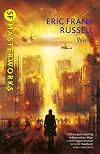
One of the best entries in the SF Masterworks series, this is a tense, gripping and humorous story of one man's covert operation to seed dissent on an enemy planet with disruption, fake propaganda and gossip
ie by being annoying. What a great job to have!!
The book hooked me from the get go. Within 50 pages we get the mission briefing, humorous anecdotes, a trip to another planet, some brief background, a bit of extra-planetary subterfuge and the start of the campaign against the enemy show more including propaganda leafleting, disruption on a train and the killing of a high profile military target. Phew!
From there the tension just kept rising and I have no shame in saying I was rooting for Mowry all the way, despite having no initial reason to pick a side in the war and some of his antics having morally troublesome consequences towards innocent citizens. I'm sure that highlights some deep rooted problem in my psyche and perhaps it's fair to say I fell a bit too easily into step, but when the Gestapo-like enforcement appear to thwart him, then it was hard not to root for his cause. And there are plenty of genuinely tense moments where I wasn't sure if he'd finally get caught or what his escape plan would be.
Despite some moments requiring a suspension of disbelief, it's mostly intelligently thought out, proceeding quickly and with little preamble; something I wish more writers today would take notes on, as this is a prime example of tight, focused plotting with snappy dialogue, that gets a lot done in well under 200 pages. The only pin I'd put in this was that the purism of the science fiction element is somewhat oblique to the plot. The premise could work for any war, but it's scaled up here in the background to a mini galactic scale just for extra effect. Perhaps though, that Cold War feel gives it a greater appeal outside of it's own genre.
Overall, fantastic; I laughed and was gripped until the end. show less
ie by being annoying. What a great job to have!!
The book hooked me from the get go. Within 50 pages we get the mission briefing, humorous anecdotes, a trip to another planet, some brief background, a bit of extra-planetary subterfuge and the start of the campaign against the enemy show more including propaganda leafleting, disruption on a train and the killing of a high profile military target. Phew!
From there the tension just kept rising and I have no shame in saying I was rooting for Mowry all the way, despite having no initial reason to pick a side in the war and some of his antics having morally troublesome consequences towards innocent citizens. I'm sure that highlights some deep rooted problem in my psyche and perhaps it's fair to say I fell a bit too easily into step, but when the Gestapo-like enforcement appear to thwart him, then it was hard not to root for his cause. And there are plenty of genuinely tense moments where I wasn't sure if he'd finally get caught or what his escape plan would be.
Despite some moments requiring a suspension of disbelief, it's mostly intelligently thought out, proceeding quickly and with little preamble; something I wish more writers today would take notes on, as this is a prime example of tight, focused plotting with snappy dialogue, that gets a lot done in well under 200 pages. The only pin I'd put in this was that the purism of the science fiction element is somewhat oblique to the plot. The premise could work for any war, but it's scaled up here in the background to a mini galactic scale just for extra effect. Perhaps though, that Cold War feel gives it a greater appeal outside of it's own genre.
Overall, fantastic; I laughed and was gripped until the end. show less

This slender 1950s sf volume (my copy is from 1965) contains an introductory short story regarding the "emergency pilot" Jay Score, and then a series of three novellas about the extrasolar voyages of the spaceship Marathon. All are told in the voice of Sarge, a sergeant-at-arms for space-going vessels. Even in the opening pages, there's some suspect attention given to racial difference, implying that the "Negro" humans who are given medical duties are as different from "white Terrestrials" show more as are the many-tentacled and alien-brained Martians who are another part of the crew.
Each novella introduces a new exoplanet, and the encounters with indigenous intelligences are all ultimately hostile. Captain McNulty's perennial caution about harming natives gets mild scorn from Sarge. The whole thing has a sort of "boys' adventure" feel to it, with lots of "thrilling" violence and "good-natured" grumbling banter.
These tales offer nothing like sexual impulse or even identity for their characters. The "mixed" crew doesn't include women. Everyone of whatever species on the Marathon uses masculine pronouns, and the details of Martian sexuality aren't given even the consideration of a passing enigma. Nor does any notion of gender or sexuality arise in considering the newly-encountered creatures of distant worlds.
The Martians are notable for being near-delirious chess enthusiasts, to the extent that they are never not thinking about the game--while their peculiar mental constitutions allow them to direct their attentions simultaneously for other tasks. I wonder if Russell was cued by Edgar Rice Burroughs to make chess an essential part of the Martian culture.
It almost goes without saying that there's no technological speculation of current interest in this book, and there are a few mild clunkers--most notably the primitive approach to photography. It was not a read I'd counsel anyone to seek out for pleasure or enlightenment, although it was hardly a heavy lift. show less
Each novella introduces a new exoplanet, and the encounters with indigenous intelligences are all ultimately hostile. Captain McNulty's perennial caution about harming natives gets mild scorn from Sarge. The whole thing has a sort of "boys' adventure" feel to it, with lots of "thrilling" violence and "good-natured" grumbling banter.
These tales offer nothing like sexual impulse or even identity for their characters. The "mixed" crew doesn't include women. Everyone of whatever species on the Marathon uses masculine pronouns, and the details of Martian sexuality aren't given even the consideration of a passing enigma. Nor does any notion of gender or sexuality arise in considering the newly-encountered creatures of distant worlds.
The Martians are notable for being near-delirious chess enthusiasts, to the extent that they are never not thinking about the game--while their peculiar mental constitutions allow them to direct their attentions simultaneously for other tasks. I wonder if Russell was cued by Edgar Rice Burroughs to make chess an essential part of the Martian culture.
It almost goes without saying that there's no technological speculation of current interest in this book, and there are a few mild clunkers--most notably the primitive approach to photography. It was not a read I'd counsel anyone to seek out for pleasure or enlightenment, although it was hardly a heavy lift. show less
Wasp by Eric Frank Russell is one of the most gleefully subversive books I've ever read. Its SF premise barely disguises an A-Z manual on how to destabilise governments.
Earth is losing a war against the Sirian Empire. In a bid to change the odds one man is disguised as a Sirian and sent to the enemy homeworld. His instructions: to cause as much chaos as he possibly can. He does. And after reading Wasp, you'll know how to follow his example. :D
Earth is losing a war against the Sirian Empire. In a bid to change the odds one man is disguised as a Sirian and sent to the enemy homeworld. His instructions: to cause as much chaos as he possibly can. He does. And after reading Wasp, you'll know how to follow his example. :D

En un futuro cercano (desde el punto de vista en que fue escrita la obra, que data de 1939), se están produciendo una serie de misteriosas muertas de científicos, aparentemente accidentales o naturales. Bill Graham, un agente estadounidense, es testigo involuntario de una de estas muertes. Sin embargo, cuando investiga un poco más en el asunto, empieza a sospechar que dichas muertes son más bien asesinatos. Pero, ¿quiénes son los artífices?
‘Barrera siniestra’ (Sinister Barrier, show more 1939), del escritor Eric Frank Russell, es una novela de ciencia ficción encuadrada en ese curioso subgénero que es el de las invasiones silenciosas, donde destacan ‘¿Quién anda ahí?, de John W. Campbell, Jr., ‘Amos de títeres’, de Robert A. Heinlein, y ‘La invasión de los ladrones de cuerpos’, de Jack Finney. La novela empieza como una historia policial, pero según se suceden los acontecimientos, se va adentrando más en el género fantástico. En resumen, un libro entretenido e interesante. show less
‘Barrera siniestra’ (Sinister Barrier, show more 1939), del escritor Eric Frank Russell, es una novela de ciencia ficción encuadrada en ese curioso subgénero que es el de las invasiones silenciosas, donde destacan ‘¿Quién anda ahí?, de John W. Campbell, Jr., ‘Amos de títeres’, de Robert A. Heinlein, y ‘La invasión de los ladrones de cuerpos’, de Jack Finney. La novela empieza como una historia policial, pero según se suceden los acontecimientos, se va adentrando más en el género fantástico. En resumen, un libro entretenido e interesante. show less
Lists
Awards


You May Also Like


Associated Authors
Statistics
- Works
- 117
- Also by
- 135
- Members
- 4,630
- Popularity
- #5,443
- Rating
- 3.8
- Reviews
- 119
- ISBNs
- 113
- Languages
- 9
- Favorited
- 15