

Jim Hightower
Author of Thieves in High Places: They've Stolen Our Country--And It's Time to Take It Back
About the Author
Jim Hightower is an American original who burst on the national scene twenty years ago from the unlikely launching pad of Texas agricultural commissioner, an obscure (but powerful) office to which he was elected for two terms.
Image credit: Credit: Larry D. Moore, Texas Book Festival, Austin, TX, Nov. 1, 2008
Series
Works by Jim Hightower
Thieves in High Places: They've Stolen Our Country--And It's Time to Take It Back (2003) 350 copies, 4 reviews
There's Nothing in the Middle of the Road but Yellow Stripes and Dead Armadillos: A Work of Political Subversion (1997) 188 copies
The Hightower Lowdown: Vol. 10: #12 2 copies
The Hightower Lowdown 1 copy
Associated Works
Cable News Confidential: My Misadventures in Corporate Media (2006) — Foreword, some editions — 39 copies
Challenging the Chip: Labor Rights and Environmental Justice in the Global Electronics Industry (2006) — Foreword, some editions — 23 copies, 1 review
Democracy in Print: The best of the Progressive Magazine, 1909-2009 (2009) — Contributor — 14 copies
Funny Times: A Monthly Newspaper of Humor, Politics & Fun, Volume 16, Issue 3 (2001) — Contributor — 1 copy
Funny Times: A Monthly Newspaper of Humor, Politics & Fun, Volume 16, Issue 2 (2001) — Contributor — 1 copy
Tagged
Common Knowledge
- Canonical name
- Hightower, Jim
- Legal name
- Hightower, James Allen
- Birthdate
- 1943-01-11
- Gender
- male
- Education
- University of North Texas
- Occupations
- journalist
politician
radio host
columnist - Organizations
- The Texas Observer
Creators Syndicate - Nationality
- USA
- Places of residence
- Denison, Texas, USA (birthplace)
- Associated Place (for map)
- Texas, USA
Members
Reviews

While a little bit dated (for example, sadly, ACORN is no more), Jim Hightower provides an excellent how-to manual for citizen activism. If you get the Audible edition, as I did, you'll have the added thrill to hear the inimitable Jim Hightower read his own work. Priceless!

Whodathunk that Texas could produce not one, but two wickedly funny unabashedly liberal (although not slavishly so) political writers? But here is Jim Hightower, almost as funny and incisive as Molly Ivins, not a political clone, with some divergent opinions from her. This book is his take on the inherent and major problems of our political system, the main culprit being the free-flowing and corrupting money that flows from corporations to politicians. He also touches on various prominent show more politicos, finding all wanting of integrity and independence, and finding precious little difference between the two main parties. Both are influenced and corrupted by corporate contributions. He does offer a grass-roots solution that the average citizen can undertake, which I find naively idealistic. But his analysis of the problems of our system is insightful and surprising. I had been a hard-core NAFTA supporter; after reading his account of how the system was written and is applied, I may have to rethink that. And whereas Molly Ivins is an unabashed Clinton admirer, Hightower shares my contempt for the man, although not for the character flaws that perturbed me, but for his innovatedly corrupt money-chasing. show less
A central principle of American progressive politics is that the average American should not be afraid to stand up for justice and fair treatment for everyone in society. It is not necessary to attempt to fix all of America’s problems all at once; start with your own town or workplace. This book visits a number of people and groups doing just that.
It’s no great revelation to say that the American family farm is in very bad shape. A number of groups of farmers have banded together into show more democratically-run cooperatives to get decent prices for their products, something they could never have done individually. Employees of a Madison, Wisconsin cab company were tired of being treated like garbage, so they joined a union. A couple of strikes later, the owner abruptly closed up shop. The employees scraped together enough money to buy the company, and despite long odds and sleepless nights, have made the company a success. The employees of a strip club in San Francisco faced a similar dilemma. They joined a union and got their working conditions improved, then the owner suddenly closed the club. The women, several of whom have college degrees, decided that the only thing to do was become a worker-owned cooperative. They split up the duties, and got a crash course in running a business.
Creation Care is a growing movement that mixes environmentalism and evangelical religion. A way that corporations keep people apart is to assert, for instance, that gain for environmentalists means a loss for labor. Evidently, the Sierra Club and the United Steelworkers of America never got the memo, because they recently developed a joint public policy agenda, with clean energy at the top of the list. Don’t think for a second that a person loses their ability to make a difference in America once they reach "old age."
This is another excellent book from Jim Hightower. There is a list of addresses in the back (both regular mail and email) for all the groups mentioned here. If a person can’t find a local group in which to get involved, they could do a lot worse than contact any of these groups. What can I do to make America a better place? Here is a wonderful place to start. show less
It’s no great revelation to say that the American family farm is in very bad shape. A number of groups of farmers have banded together into show more democratically-run cooperatives to get decent prices for their products, something they could never have done individually. Employees of a Madison, Wisconsin cab company were tired of being treated like garbage, so they joined a union. A couple of strikes later, the owner abruptly closed up shop. The employees scraped together enough money to buy the company, and despite long odds and sleepless nights, have made the company a success. The employees of a strip club in San Francisco faced a similar dilemma. They joined a union and got their working conditions improved, then the owner suddenly closed the club. The women, several of whom have college degrees, decided that the only thing to do was become a worker-owned cooperative. They split up the duties, and got a crash course in running a business.
Creation Care is a growing movement that mixes environmentalism and evangelical religion. A way that corporations keep people apart is to assert, for instance, that gain for environmentalists means a loss for labor. Evidently, the Sierra Club and the United Steelworkers of America never got the memo, because they recently developed a joint public policy agenda, with clean energy at the top of the list. Don’t think for a second that a person loses their ability to make a difference in America once they reach "old age."
This is another excellent book from Jim Hightower. There is a list of addresses in the back (both regular mail and email) for all the groups mentioned here. If a person can’t find a local group in which to get involved, they could do a lot worse than contact any of these groups. What can I do to make America a better place? Here is a wonderful place to start. show less
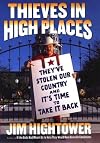
Jim Hightower is a true "prairie populist", a more idealistic and slightly more uneven version of Molly Ivins - and, as it turns out, they are longtime friends. This is an often revealing and surprising look at how polititicians and giant corporations (or at least their CEO's) have conspired to deprive us of our rights, choices and money, usually without our knowledge or consent. The first part of the book does a masterful job of describing the problems. Hightower, to his credit, does offer show more some grassroot solutions, but these often seem naive. Hightower is a little rougher and more uneven than Ivins, but they are plainly political soulmates. There is on page 139 a marvelous essay by a 12-year-old student for her school assignment, "What the American Flag Stands For", which led her teacher to call her unpatriotic. Actually, the essay is almost too good to be true, and I wonder if she really wrote it. show less
Lists
Awards

You May Also Like


Associated Authors
Statistics
- Works
- 11
- Also by
- 8
- Members
- 876
- Popularity
- #29,232
- Rating
- 3.6
- Reviews
- 12
- ISBNs
- 34
- Languages
- 1
- Favorited
- 2
